Can you explain Dexter's multi-agent architecture?
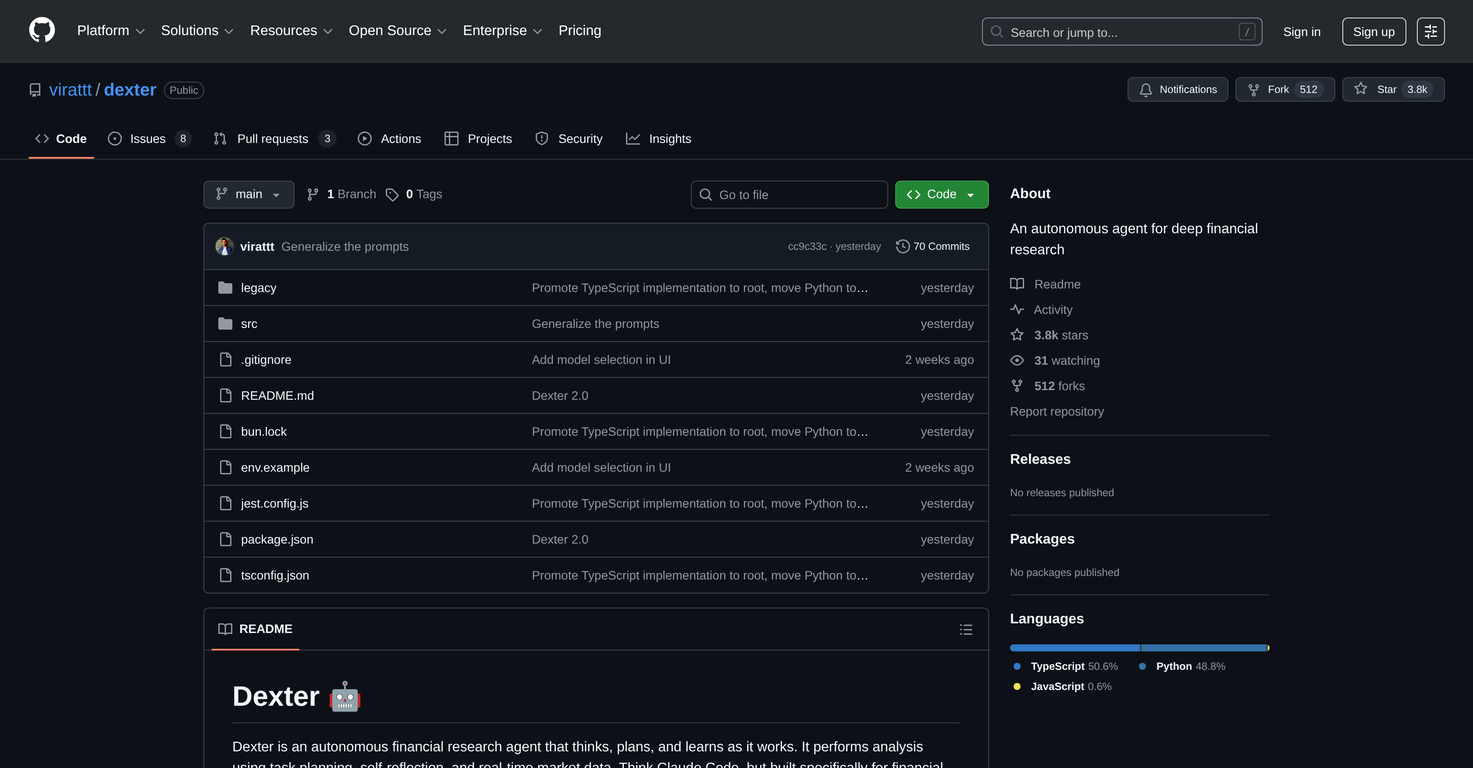
Dexter is built on a multi-agent architecture with four key agents: Planning, Action, Validation, and Answer. These agents are specialized components working in harmony to perform their assigned shares of work in the research process.
What roles do the four key agents in Dexter's architecture perform?
The four key agents in Dexter's architecture are central to its operations. The Planning Agent analyzes queries and formulates task plans. The Action Agent selects and carries out the research steps. The Validation Agent ensures completeness of tasks and adequacy of data. Finally, the Answer Agent synthesizes the findings into comprehensive responses.
What is 'Bun' runtime that Dexter operates on?
'Bun' is the runtime environment that Dexter operates on. This technology provides the platform that powers Dexter's operations.
Which technologies are included in the Dexter's tech stack?
Dexter's tech stack includes the 'Bun' runtime that powers its operations, the React library used in building its user interface, and the Ink terminal UI that provides command line interface functionality. It also integrates 'LangChain.js' to support connections to external AI providers.
How does Dexter incorporate 'LangChain.js' into its operation?
Dexter incorporates 'LangChain.js' into its operation as part of its tech stack. This technology allows Dexter to integrate and leverage functionalities from supported external AI providers such as OpenAI, Anthropic, and Google.
Which external providers does Dexter support through 'LangChain.js' integration?
Through its integration with 'LangChain.js', Dexter supports external providers such as OpenAI, Anthropic, and Google. This expands its capability to leverage a wide variety of AI functionalities for its research tasks.
How does Dexter handle complex financial queries?
Dexter handles complex financial queries by breaking them down into structured research steps through its intelligent task planning. It then autonomously selects and runs the appropriate tools for collecting financial data, performs calculations and analyses, and streamlines the findings into extensive responses.
What is Dexter's approach to collecting and analyzing financial data?
Dexter's approach to collecting and analyzing financial data involves its autonomous execution and intelligent task planning capabilities. It autonomously selects the right tools for gathering necessary data, performs analysis and computations, and creates a comprehensive summary of the findings.
How does Dexter ensure the sufficiency of data for its task completion?
Dexter ensures data sufficiency for its task completion through its validation agent. This key agent verifies if the tasks have been carried out and checks the sufficiency of the collected data, enabling Dexter to correct itself and improve its results where needed.
Does Dexter have any safety measures in operation?
Yes, Dexter employs safety measures during its operations. It features built-in loop detection and step limits that prevent runaway execution, keeping it within safe operational boundaries.
How does Dexter conduct its research steps?
Dexter conducts its research steps based on its multi-agent architecture. The Planning Agent lays out the roadmap, followed by the Action Agent who chooses the tools and executes the steps. The research outcomes are then validated by the Validation Agent before the Answer Agent synthesizes the findings.
What does the 'React' and 'Ink terminal UI' do in Dexter?
In Dexter, 'React' and 'Ink terminal UI' are part of the tech stack that helps build and run its user interface. 'React' is a JavaScript library used for constructing UI components, whereas 'Ink terminal UI' provides terminal user interface functionalities, allowing for CLI-like interactions.
What is Dexter’s function towards balance sheets, income statements, and cash flow statements?
Dexter uses its advanced autonomous capabilities for analyzing balance sheets, income statements, and cash flow statements. It can access these real-time financial documents, gather data from them, perform complex calculations and analysis, and then accurately synthesize its findings to offer comprehensive responses.
How can the autonomous execution capability of Dexter benefit in financial research?
Dexter's autonomous execution capability can greatly benefit financial research by automating the whole process. It can decide on the right tools for collecting financial data, execute necessary computations and analyses, and continuously refine its outcomes until the tasks reach an acceptable completion level. This automation saves time, reduces errors, and increases the speed of obtaining high-quality results.
 MongoDB - Build AI That Scales
 Mini tools



 LuminixAI
 GoAI
GoAI
 Good Assistant
 DealNavigator.Ai
 Barie AI

 0
0





How would you rate Dexter?
Help other people by letting them know if this AI was useful.