How does Physical AI facilitate smarter, adaptive automation?
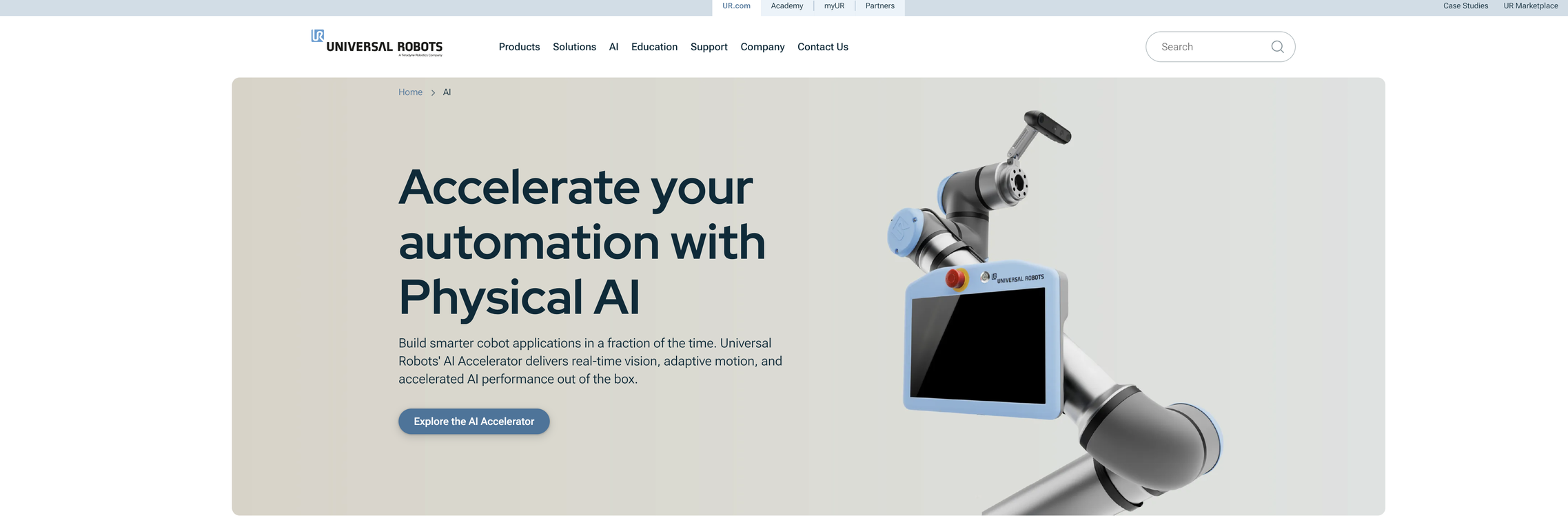
Physical AI facilitates smarter, adaptive automation by providing real-time vision and adaptive motion, improving AI performance. It lowers the need for manual reprogramming, thereby reducing changeover costs and optimizing operations. The NVIDIA-powered AI Accelerator enables rapid development of vision, perception, and motion planning applications.
What capabilities does the AI Accelerator bring to automation?
The AI Accelerator brings real-time vision, adaptive motion, and accelerated AI performance to automation. Powered by NVIDIA, it enables rapid development of vision, perception, and motion planning applications. This supercharges robotics with AI, thus enhancing innovation, precision, and adaptability at scale.
What is the role of the NVIDIA-powered AI Accelerator in the Physical AI platform?
The NVIDIA-powered AI Accelerator plays a critical role in the Physical AI platform by supercharging robotics with AI. This enables rapid development of vision, perception, and motion planning applications, resulting in faster innovation, precision and adaptability at scale.
Can you provide an overview of the high-performance AI toolkit offered by Physical AI?
The high-performance AI toolkit offered by Physical AI includes 'AI Accelerator' and 'PolyScope X'. The AI Accelerator, powered by NVIDIA Jetson™ and PolyScope X, enables quick development of vision, perception, and motion planning applications, combining advanced hardware with seamless software integration for smarter automation. PolyScope X allows developers to integrate AI seamlessly using an intuitive interface, modular architecture, and real-time data handling.
What savings and operational efficiencies can Physical AI provide?
Physical AI can provide savings and operational efficiencies by minimizing the need for manual reprogramming, reducing changeover costs and improving first-pass yield. This results in faster deployment, fewer manual interventions, and higher utilization, contributing to long-term savings on the overall cost of ownership.
How does Physical AI optimize operations?
Physical AI optimizes operations by reducing the need for manual reprogramming, thereby lowering changeover costs. Additionally, it improves the first-pass yield, effectively enhancing the operational efficiency of an industry.
How does the Physical AI Robotics accelerate automation?
Physical AI Robotics accelerates automation by providing real-time vision and adaptive motion for rapid application development. Backed by the high-performance AI Accelerator, it enables the fast and efficient development of vision, perception, and motion planning applications, thus significantly expediting the automation process.
What are the unique features of the AI-ready control platform 'PolyScope X'?
PolyScope X, the AI-ready control platform, provides a foundation for advanced robotics in the AI era. It allows developers to integrate AI seamlessly with an intuitive interface, modular architecture, and real-time data handling. It also offers high-level APIs and advanced torque control, delivering precision, adaptability, and faster innovation at scale.
What is the function of the high-performance AI toolkit 'AI Accelerator'?
The high-performance AI toolkit 'AI Accelerator' functions as a plug-and-play toolkit that supercharges robotics with AI. Powered by NVIDIA Jetson™ and PolyScope X, it enables the rapid development of vision, perception, and motion planning applications, combining advanced hardware with seamless software integration for smarter automation.
What does the collaborative innovation network in Physical AI entail?
The collaborative innovation network in Physical AI includes UR+ certified solutions and strategic alliances with technology leaders including NVIDIA. Additionally, the network includes a global network of developers, integrators, and research partners working together to make AI practical, enabling faster deployment, easier adaptation, and smarter scaling.
How does Physical AI help minimize changeover costs and improve first-pass yield?
Physical AI helps minimize changeover costs and improve first-pass yield by reducing the need for manual reprogramming, which results in less downtime and reduced engineering hours. This also helps in handling variable sizes and weights, thereby optimizing industrial operations.
How does the Physical AI provide long-term savings on overall cost of ownership?
Physical AI contributes to long-term savings on the overall cost of ownership by enabling faster deployment, reduced manual interventions, and increased utilization. This in effect lowers the total operation costs and provides measurable impact and cost savings.
How is Physical AI applied in high-mix assembly?
In high-mix assembly, Physical AI reduces downtime and engineering hours by eliminating the need for manual reprogramming. This results in reduced integration costs and improved operational efficiency.
What can Physical AI do to help in quality inspection?
In quality inspection, Physical AI improves the first-pass yield and reduces scrap. This AI-driven inspection boosts Return on Investment by improving productivity and optimizing operations.
How does Physical AI assist in material handling and palletising?
Physical AI assists in material handling and palletising by handling variable sizes and weights, thereby reducing changeover costs. It can adapt to different material handling requirements, thus improving efficiency and reducing costs.
What does path planning in logistics look like with Physical AI?
Dynamic path planning in logistics, facilitated by Physical AI, helps to avoid bottlenecks and maximize throughput for enhanced productivity. By leveraging AI technology, it enables efficient navigation and route planning, thereby enhancing operational efficiency.
How would you rate Physical AI | Universal Robots?
Help other people by letting them know if this AI was useful.