 Rocket - Think it. Type it. Launch it.

 Mini tools
eth-sri / constrained-diffusion
Constrained Decoding of Diffusion LLMs with Context-Free Grammars.
README
Constrained Decoding of Diffusion LLMs
with Context-Free Grammars





This repository contains the implementation of Constrained Decoding of Diffusion LLMs with Context-Free Grammars, including techniques for multi-region constrained generation. Our method guarantees syntactic correctness while improving functional correctness by up to 7%.
🚀 Overview
We present the first generalized method for constrained decoding of multi-region infilling and out-of-order generation models. Our approach:
- Works with SOTA diffusion LLMs like LLaDA, Dream-Coder and DiffuCoder for non-autoregressive generation
- Also works for Fill-in-the-Middle (FIM) and Multi-Region Infilling (MRI) models like StarCoder, DeepSeek Coder, and CodeGemma
- Supports multiple constraint languages through context-free grammars (examples provided are JSON Schema, C++, and SMILES)
- Guarantees syntactic correctness wrt. the grammar
- Improves functional correctness by up to 7% with minimal computational overhead
📦 Installation
Prerequisites
Setup
We recommend using a virtual environment to avoid conflicts with other Python packages.
-
Clone the repository and set up virtual enviroment:
git clone https://github.com/eth-sri/constrained-diffusion.git cd constrained-diffusion python3 -m venv venv source venv/bin/activate -
Build and install Rust bindings:
cd rustformlang_bindings pip install maturin maturin build --release pip install . cd .. -
Install the main package:
pip install -e . -
Verify installation:
pytest tests
🔧 Usage & Demo
Check out example.py for a complete example of how to use the constrained decoding mechanism.
In general, you want to first load a model and then load a constraint language, such as C++ or JSON Schema. The example below shows abbreviated code on how to use the GSAI-ML/LLaDA-8B-Instruct model with a C++ constraint.
Replace the model name with any diffusion LLM of your choice, such as apple/DiffuCoder-7B-Instruct.
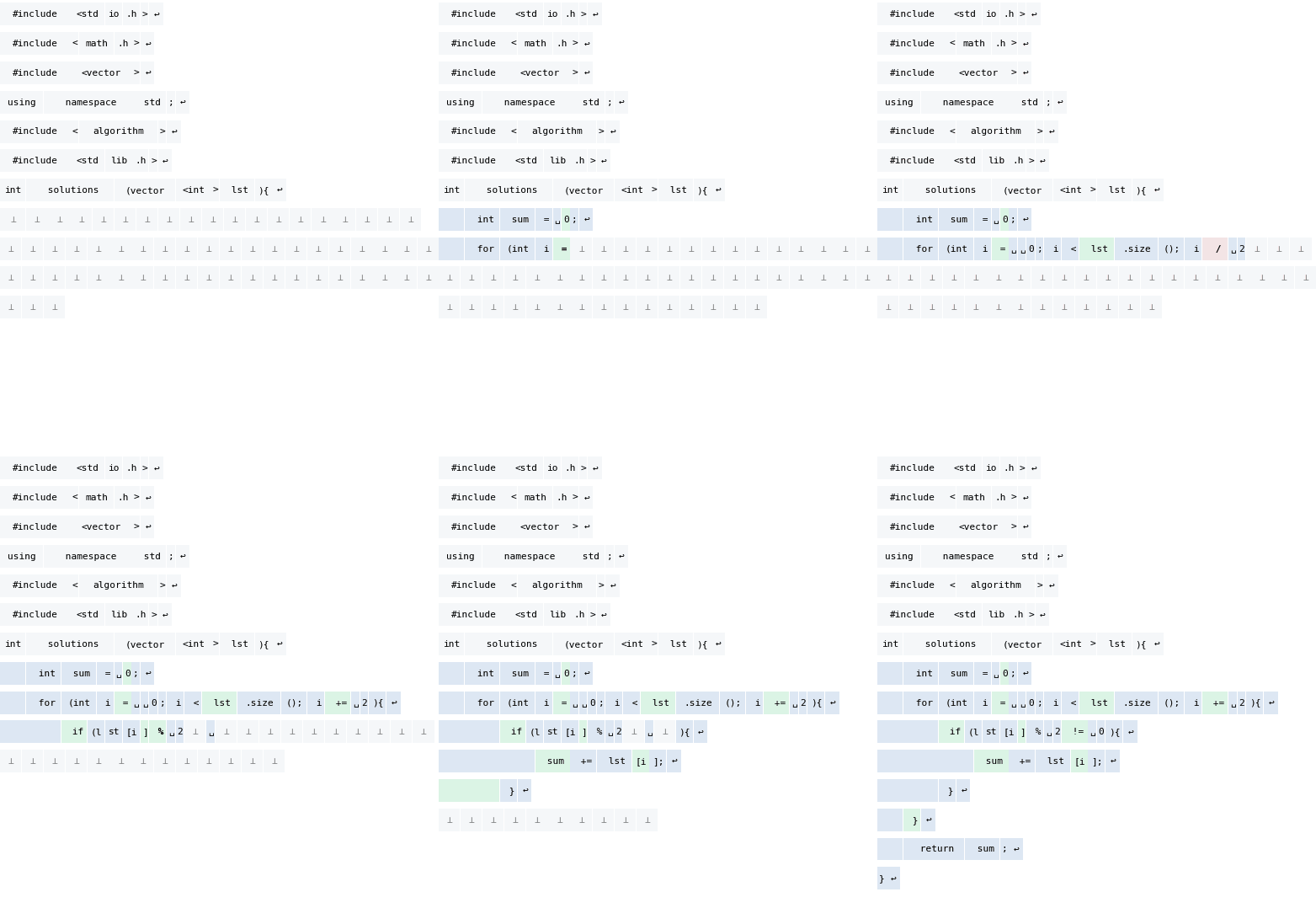
python3 example.pyThis is a visualization of our constrained decoding mechanism on output similar to that created by LLaDA 7b.
📁 Project Structure
├── constrained_diffusion/           # Main package
│   ├── constrain_utils.py            # Constraint generation utilities
│   ├── cfgs/                         # Context-free grammar definitions
│   └── eval/                         # Evaluation frameworks
│       ├── dllm/                     # Evaluation framework for DLLMs
│       └── mri/                      # Evaluation framework for Multi-Region Infilling
├── rustformlang/                     # Rust formal language library
├── rustformlang_bindings/            # Python bindings for Rust library
├── eval/                             # Evaluation scripts and results
│   ├── dllm/                         # DLLM task evaluations
│   ├── mri/                          # Multi-Region infilling evaluations
│   └── figures/                      # Result visualization
├── benchmark_generation/             # Benchmark generation tools
└── docs/                             # Project website
🧪 Evaluation
Datasets
We run MRI and diffusion LLMs on the following datasets:
| Dataset | Setting | Description | Download |
|---|---|---|---|
| C++ | MRI | C++ code generation tasks with multi-region infilling | 🤗 HuggingFace |
| C++ | DLM | C++ code generation tasks with diffusion LLMs | 🤗 HuggingFace |
| JSON | DLM | Data extraction, following a JSON Schema | 🤗 HuggingFace |
| SMILES | DLM | Chemical compound representation in SMILES | 🤗 HuggingFace |
You can download the results of our evaluation using the following link: Download Results.
Unzip the file in theresults/directory to access the evaluation results.
Running Inference
For the MRI models, we provide an execution harness for the C++ HumanEval multi-region dataset.
To execute task 11 on the 1-region dataset with constraints and traces enabled, use the following command:
python3 -m constrained_diffusion.eval.mri.generic_inference \
  --max-tokens 256 \
  --model_name deepseek-ai/deepseek-coder-6.7b-base \
  --seed 0 \
  --temp 1 \
  --dataset-name HumanEval/MRI/cpp/1 \
  --constrained True \
  --trace True \
  --task_id /11_
For the diffusion LLMs, use the following command for the JSON dataset.
python3 -m constrained_diffusion.eval.dllm.generic_inference \
  --max-tokens 256 \
  --model_name apple/DiffuCoder-7B-Instruct \
  --seed 0 \
  --temp 0.2 \
  --dataset-name jsonschema \
  --steps 32 \
  --constrained True \
  --trace True \
  --task_id _37
A general orchestration script for all experiments in the main paper is provided in eval/mri/run_mri.py and eval/dllm/run_dllm.py.
The results are stored in the results/ directory, with each configuration's results in a separate file.
Running Evaluation
Evaluation of result correctness is decoupled from the inference step. The following assumes that the inference step above was executed correctly and results lie in results.
Note: For SMILES evaluation, you need to install
rdkitandpartialsmiles:pip install rdkit partialsmiles
Make sure to have sufficient memory and CPU cores available, as the evaluation scripts can be memory-intensive.
# Evaluate all files in the results folder
bash eval/check_all_individually.sh results/*
More details
You can find more details on the evaluation scripts, for example on how to reproduce the figures from the paper, in the README in the eval/ directory: README.
🤝 Contributing
We welcome contributions! When contributing, please make sure to activate pre-commit hooks to ensure code quality and consistency. You can install pre-commit hooks with:
pip install pre-commit
pre-commit install
Adding New Constraint Languages
- Define the grammar in
constrained_outoforder/cfgs/ - Implement lexical mapping in
check_lex_map.py - Add tests in
tests/test_cfgs/ - Update documentation
Adding New Evaluation Tasks
- Create a new constraint language
- Implement a dataset in
constrained_outoforder/eval/[dllm|mri]/datasets/your_task.py - Register the dataset using
register_dataset() - Add evaluation logic in
eval/[dllm|mri]/your_task/checker.py
Adding a New Model
- Implement the model in
constrained_outoforder/eval/[dllm|mri]/models/your_model.py - Register the model using
register_model()
📄 License
This project is licensed under the MIT License - see the LICENSE file for details.
🔗 Links
- Paper: arXiv:2508.10111
- Project Website: Constrained Decoding Paper Website + Demo
- Rustformlang README: Rustformlang Docs
📚 Citation
If you use this work in your research, please cite:
@article{mundler2025constraineddiffusion,
    title={Constrained Decoding of Diffusion LLMs with Context-Free Grammars},
    author={Niels Mündler and Jasper Dekoninck and Martin Vechev},
    year={2025},
    eprint={2508.10111},
    archivePrefix={arXiv},
    url={https://arxiv.org/abs/2508.10111}
}
This work was done by the Secure, Reliable and Intelligent Systems Lab at ETH Zurich.