 Rocket - Think it. Type it. Launch it.

 Mini tools
google / clusterfuzz
Scalable fuzzing infrastructure.
README
ClusterFuzz

ClusterFuzz is a scalable fuzzing
infrastructure that finds security and stability issues in software.
Google uses ClusterFuzz to fuzz all Google products and as the fuzzing
backend for OSS-Fuzz.
ClusterFuzz provides many features which help seamlessly integrate fuzzing into
a software project's development process:
- Highly scalable. Can run on any size cluster (e.g. OSS-Fuzz instance runs on
100,000 VMs). - Accurate deduplication of crashes.
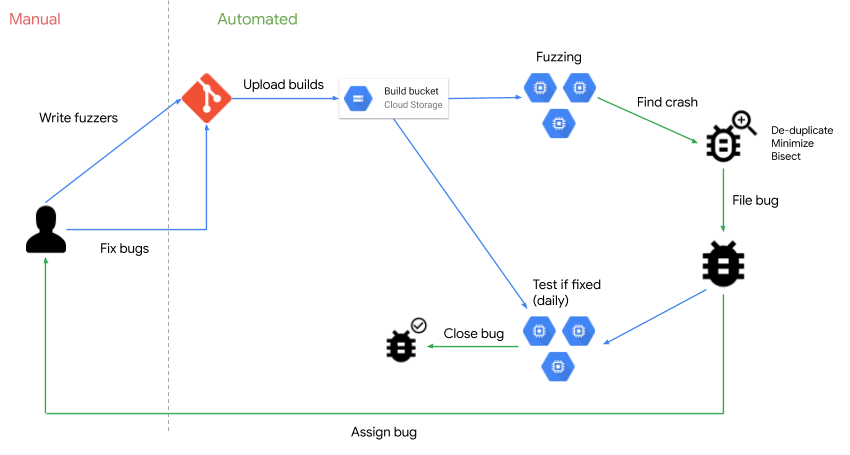
- Fully automatic bug filing, triage and closing for various issue trackers
(e.g. Monorail, Jira). - Supports multiple coverage guided fuzzing engines
(libFuzzer, AFL, AFL++ and Honggfuzz)
for optimal results (with ensemble fuzzing and fuzzing strategies). - Support for blackbox fuzzing.
- Testcase minimization.
- Regression finding through bisection.
- Statistics for analyzing fuzzer performance, and crash rates.
- Easy to use web interface for management and viewing crashes.
- Support for various authentication providers using Firebase.
Overview
Documentation
You can find detailed documentation here.
Trophies
As of February 2023, ClusterFuzz has found ~27,000 bugs in Google (e.g. Chrome). Additionally, ClusterFuzz has helped identify and fix over 8,900 vulnerabilities and 28,000 bugs across 850 projects integrated with OSS-Fuzz.
Getting Help
You can file an issue to ask
questions, request features, or ask for help.
Staying Up to Date
We will use clusterfuzz-announce(#)googlegroups.com to make announcements about ClusterFuzz.
ClusterFuzzLite
For a more lightweight version of ClusterFuzz that runs on CI/CD
systems, check out ClusterFuzzLite.