 Base44 Superagents-AI agent that does it all

 Mini tools
NVIDIA / bionemo-framework
BioNeMo Framework: For building and adapting AI models in drug discovery at scale
README
BioNeMo Framework
GPU-optimized recipes & toolkits for training transformer models at scale with biological data
<div align="left">





<div align="left">
NVIDIA BioNeMo Framework is a comprehensive suite of programming tools, libraries, and models designed for digital biology. It accelerates the most time-consuming and costly stages of building and adapting biomolecular AI models by providing domain-specific, optimized model recipes and tooling that are easily integrated into GPU-based computational resources with state-of-the-art performance.
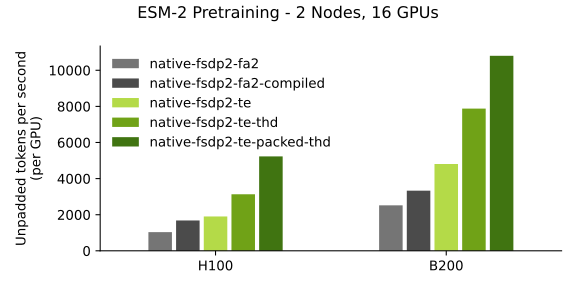 Training benchmarks for ESM-2, a well known protein sequence model using the BERT architecture.
⚡ Quick Start
# Try BioNeMo Recipes in Google Colab (Recommend A100, may be too slow or run out of memory on T4)
# Copy paste into Google Colab cells

!git clone https://github.com/NVIDIA/bionemo-framework.git
cd bionemo-framework/bionemo-recipes/recipes/esm2_native_te/

# Install transformer_engine[pytorch] from source, it takes a long time to install from PYPI
!curl -L -o transformer_engine_torch-2.8.0-cp312-cp312-linux_x86_64.whl "https://drive.google.com/uc?export=download&id=1Oz6dkkIMahv3LN_fQhhQRolZ3m-sr9SF"
!pip install --no-build-isolation transformer-engine transformer_engine_torch-2.8.0-cp312-cp312-linux_x86_64.whl

# Install dependencies
!pip install -r requirements.txt

# Run ESM2 Native Recipes with TE
!python train_ddp.py
Recent News
- 10/27/2025 CodonFM recipe released! This is an accelerated version of the original research codebase with scientific preprint.
- 09/30/2025 Megatron/NeMo 5D parallel BioNeMo Framework image v2.7 released on NGC for both x86 and ARM CPUs.
- 09/01/2025 bionemo-recipes goes live! Lightweight and portable examples with state-of-the-art training performance you can riff on to meet your needs.
Code Overview
A core use-case of the BioNeMo Framework is to help digital biology scientists accelerate and scale their model training onto a compute cluster. This repository contains 3 categories of modules for this use-case:
1. Models using fully-sharded-data-parallel (FSDP), which is possible with a number of different implementations including PyTorch’s FSDP2/FSDP1 and NVIDIA megatron-FSDP. Sharding a model with FSDP typically requires only a few lines of code changes. You can find models and ready-to-run recipes parallelized with megatron-FSDP and accelerated with NVIDIA TransformerEngine (TE) in bionemo-recipes.
<details>
<summary><b>(Click to expand) <code>bionemo-recipes</code> support matrix </b></summary>
<small>
| Directory | Description | Support Status | 5D Parallel | Megatron-FSDP | TE | Sequence Packing | FP8 | Context Parallelism |
|---|---|---|---|---|---|---|---|---|
models/<br>amplify |
TE accelerated protein BERT, pushed to HuggingFace | ✅ Active | ❌ | ✅ | ✅ | 🚧 WIP | ✅ | 🚧 WIP |
models/<br>esm2 |
TE accelerated protein BERT, pushed to HuggingFace | ✅ Active | ❌ | ✅ | ✅ | ✅ | ✅ | ✅ |
models/<br>llama3 |
TE accelerated Llama 3 | ✅ Active | ❌ | 🚧 WIP | ✅ | ✅ | 🚧 WIP | 🚧 WIP |
models/<br>geneformer |
TE accelerated single-cell BERT | 🚧 WIP | ❌ | ✅ | 🚧 WIP | 🚧 WIP | 🚧 WIP | 🚧 WIP |
recipes/<br>codonfm_ptl_te |
Recipe for CodonFM's Encodon using TE | ✅ Active | ❌ | 🚧 WIP | ✅ | ✅ | 🚧 WIP | 🚧 WIP |
recipes/<br>esm2_accelerate_te |
Recipe for ESM2 TE + HF Accelerate | ✅ Active | ❌ | 🚧 WIP | ✅ | ❌ | ✅ | 🚧 WIP |
recipes/<br>esm2_native_te |
Recipe for ESM2 TE + native PyTorch | ✅ Active | ❌ | ✅ | ✅ | ✅ | ✅ | 🚧 WIP |
recipes/<br>geneformer_native_te_mfsdp_fp8 |
Recipe for Geneformer HF model | 🚧 WIP | ❌ | ✅ | ✅ | ❌ | ✅ | 🚧 WIP |
recipes/<br>llama3_native_te |
Recipe for Llama 3 TE + native PyTorch | ✅ Active | ❌ | 🚧 WIP | ✅ | ✅ | 🚧 WIP | 🚧 WIP |
recipes/<br>vit |
Recipe for Vision Transformer | 🚧 WIP | ❌ | ✅ | ✅ | ❌ | ✅ | 🚧 WIP |
</small>
</details>
2. Models using explicit 5D parallelism (tensor parallel, pipeline parallel, context parallel, etc.), for which NVIDIA provides accelerated support with NeMo and Megatron-Core. 5D parallelism requires explicit modification of the model code to make it shardable along different dimensions. The models for this style of acceleration and parallelism can be found in the sub-packages directory. While it is possible to pip install the models, we strongly suggest using our Docker image that comes with NeMo and Megatron-Core pre-installed.
<details>
<summary><b>(Click to expand) <code>sub-packages</code> models support matrix</b></summary>
<small>
| Directory | Description | Support | 5D Parallel | Megatron-FSDP | TE | Sequence Packing | FP8 | Context Parallel |
|---|---|---|---|---|---|---|---|---|
bionemo-core |
Model Config/test data utils | ✅ Active | ✅ | N/A | ✅ | ❌ | N/A | N/A |
bionemo-evo2 |
5D parallel model | ✅ Active | ✅ | ❌ | ✅ | ❌ | ✅ | ✅ |
bionemo-example_model |
Example 5D parallel model | 🔧 Maintenance | ✅ | ❌ | ✅ | ❌ | ✅ | ✅ |
bionemo-llm |
5D parallel base model (BioBert) | ✅ Active | ✅ | ❌ | ✅ | ✅ | ✅ | ✅ |
bionemo-testing |
Testing Utilities | ✅ Active | ✅ | N/A | N/A | N/A | N/A | N/A |
</small>
</details>
3. Tooling for dataloading and in-the-training-loop processing, which are lightweight and individually pip installable. These are also in the sub-packages directory adjacent to the 5D parallel models.
<details>
<summary><b>(Click to expand) <code>sub-packages</code> tooling support matrix</b></summary>
<small>
| Directory | Description | Support | 5D Parallel | Megatron-FSDP | TE | Sequence Packing | FP8 | Context Parallel |
|---|---|---|---|---|---|---|---|---|
bionemo-moco |
Molecular Co-design tools | ✅ Active | ❌ | N/A | N/A | N/A | N/A | N/A |
bionemo-noodles |
Python API to fast FASTA file I/O | 🔧 Maintenance | ❌ | N/A | N/A | N/A | N/A | N/A |
bionemo-scspeedtest |
Single Cell Dataloading benchmark tests | ✅ Active | N/A | N/A | N/A | N/A | N/A | N/A |
bionemo-size-aware-batching |
Memory consumption aware batching | 🔧 Maintenance | N/A | N/A | N/A | N/A | N/A | N/A |
bionemo-scdl |
Modular Single Cell Data Loader | ✅ Active | ✅ Compatible | N/A | N/A | N/A | N/A | N/A |
bionemo-webdatamodule |
PyTorch Lightning module to use WebDataset | 🔧 Maintenance | N/A | N/A | N/A | N/A | N/A | N/A |
</small>
</details>
BioNeMo Framework is part of a larger ecosystem of NVIDIA Biopharma products. Get notified of new releases, bug fixes, critical security updates, and more for biopharma. Subscribe.
Documentation Resources
-
Official Documentation: Contents of
sub-packagesincluding user guides, API references, and troubleshooting, are documented on our official documentation. Nightly builds of this documentation is available on BioNeMo Framework GitHub Pages -
🚧 In-Progress Documentation 🚧:
bionemo-recipesdocumentation is currently work in progress, however the recipes are meant to be self-documented and easy to understand—we suggest you throw them into your favorite genai code assistant!
Getting Started with BioNeMo Framework - 5D Parallelism with NeMo/Megatron implementations
:warning: (This section is not relevant for bionemo-recipes)
Full documentation on using the BioNeMo Framework is provided in our documentation:
https://docs.nvidia.com/bionemo-framework/latest/user-guide/. To simplify the integration of optimized third-party dependencies, BioNeMo is primarily distributed as a containerized library. You can download the latest released container for the BioNeMo Framework from
NGC. To launch a pre-built container, you can use the brev.dev launchable or execute the following command:
docker run --rm -it \
  --gpus=all --ipc=host --ulimit memlock=-1 --ulimit stack=67108864 \
  nvcr.io/nvidia/clara/bionemo-framework:nightly \
  /bin/bash
Setting up a local development environment
Initializing 3rd-party dependencies as git submodules
The NeMo and Megatron-LM dependencies are included as git submodules in bionemo2. The pinned commits for these submodules represent the "last-known-good" versions of these packages
that are confirmed to be working with bionemo2 (and those that are tested in CI).
To initialize these sub-modules when cloning the repo, add the --recursive flag to the git clone command:
git clone --recursive [email protected]:NVIDIA/bionemo-framework.git
cd bionemo-framework
To download the pinned versions of these submodules within an existing git repository, run
git submodule update --init --recursiveDifferent branches of the repo can have different pinned versions of these third-party submodules. Ensure submodules are automatically updated after switching branches or pulling updates by configuring git with:
git config submodule.recurse trueNOTE: this setting will not download new or remove old submodules with the branch's changes.
You will have to run the full git submodule update --init --recursive command in these situations.
Build the Docker Image Locally
With a locally cloned repository and initialized submodules, build the BioNeMo container using:
docker buildx build . -t my-container-tagIf you see an error message like No file descriptors available (os error 24), add the option --ulimit nofile=65535:65535 to the docker build command.
VSCode Devcontainer for Interactive Debugging
We distribute a development container configuration for vscode
(.devcontainer/devcontainer.json) that simplifies the process of local testing and development. Opening the
bionemo-framework folder with VSCode should prompt you to re-open the folder inside the devcontainer environment.
[!NOTE]
The first time you launch the devcontainer, it may take a long time to build the image. Building the image locally
(using the command shown above) will ensure that most of the layers are present in the local docker cache.
Quick Start
See the tutorials pages
for example applications and getting started guides.