 Rocket - Think it. Type it. Launch it.
 Mini tools
NVIDIA / context-aware-rag
Context-Aware RAG library for Knowledge Graph ingestion and retrieval functions.
README
NVIDIA Context Aware RAG
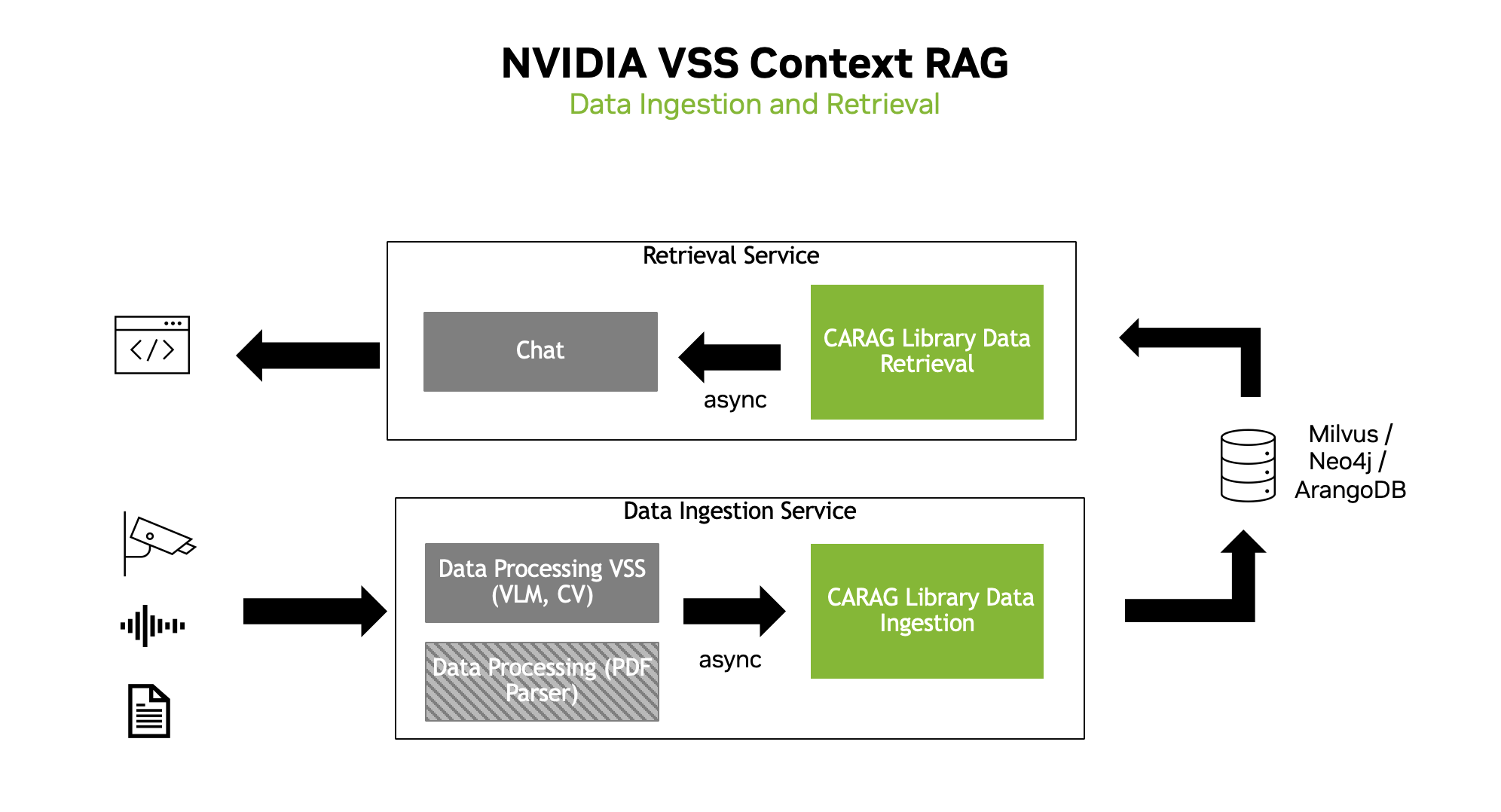
Context Aware RAG is a flexible library designed to seamlessly integrate into existing data processing workflows to build customized data ingestion and retrieval (RAG) pipelines.
Key Features
- Data Ingestion Service: Add data to the RAG pipeline from a variety of sources.
- Data Retrieval Service: Retrieve data from the RAG pipeline using natural language queries.
- Function and Tool Components: Easy to create custom functions and tools to support your existing workflows.
- GraphRAG: Seamlessly extract knowledge graphs from data to support your existing workflows.
- Observability: Monitor and troubleshoot your workflows with any OpenTelemetry-compatible monitoring tool.
- Experimental Features: CA-RAG also provides structured output mode for response and five important Model Context Protocol (MCP) tools for using CA-RAG with AI agentic workflows.
With Context Aware RAG, you can quickly build RAG pipelines to support your existing workflows.
Links
- Documentation: Explore the full documentation for Context Aware RAG.
- Context Aware RAG Architecture: Learn more about how Context Aware RAG works and its components.
- Getting Started Guide: Set up your environment and start integrating Context Aware RAG into your workflows.
- Examples: Explore examples of Context Aware RAG workflows.
- Troubleshooting: Get help with common issues.
- Release Notes: Learn about the latest features and improvements.
Getting Started
Prerequisites
Before you begin using Context Aware RAG, ensure that you have the following software installed.
Installation
Clone the repository
git clone [email protected]:NVIDIA/context-aware-rag.git
cd context-aware-rag/
Create a virtual environment using uv
uv venv --seed .venv
source .venv/bin/activate
Installing from source
uv pip install -e .Installing optional plugins
Arango
uv pip install -e .[arango]NAT
uv pip install -e .[nat]Optional: Building and Installing the wheel file
uv build
uv pip install dist/vss_ctx_rag-1.0.2-py3-none-any.whl
Service Example
Setting up environment variables
Create a .env file in the root directory and set the following variables:
   NVIDIA_API_KEY=<IF USING NVIDIA>
   NVIDIA_VISIBLE_DEVICES=<GPU ID>

   OPENAI_API_KEY=<IF USING OPENAI>

   VSS_CTX_PORT_RET=<DATA RETRIEVAL PORT>
   VSS_CTX_PORT_IN=<DATA INGESTION PORT>

   GRAPH_DB_USERNAME=<GRAPH_DB_USERNAME>
   GRAPH_DB_PASSWORD=<GRAPH_DB_PASSWORD>
   ARANGO_DB_USERNAME=root
   ARANGO_DB_PASSWORD=<ARANGO_DB_PASSWORD>
   MINIO_USERNAME=<MINIO_USERNAME>
   MINIO_PASSWORD=<MINIO_PASSWORD>
Build docker
make -C docker buildStart using docker compose
make -C docker start_composeThis will start the following services:
-
ctx-rag-data-ingestion
- Service available at
http://<HOST>:<VSS_CTX_PORT_IN>
- Service available at
-
ctx-rag-data-retrieval
- Service available at
http://<HOST>:<VSS_CTX_PORT_RET>
- Service available at
-
neo4j
- UI available at
http://<HOST>:7474
- UI available at
-
milvus
-
otel-collector
-
Phoenix
- UI available at
http://<HOST>:16686
- UI available at
-
prometheus
- UI available at
http://<HOST>:9090
- UI available at
To change the storage volumes, export DOCKER_VOLUME_DIRECTORY to the desired directory.
Stop using docker compose
make -C docker stop_composeData Ingestion Example
import requests
import json
from pyaml_env import parse_config

base_url = "http://<HOST>:<VSS_CTX_PORT_IN>"

headers = {"Content-Type": "application/json"}

### Initialize the service with a unique uuid
init_data = {"uuid": "1"}
### Optional: Initialize the service with a config file or context config
"""
init_data = {"config_path": "/app/config/config.yaml", "uuid": "1"}
init_data = {"context_config": parse_config("/app/config/config.yaml"), "uuid": "1"}
"""
response = requests.post(
    f"{base_url}/init", headers=headers, data=json.dumps(init_data)
)

# POST request to /add_doc to add documents to the service
add_doc_data_list = [
    {
        "document": "User1: Hi how are you?",
        "doc_index": 0,
        "doc_metadata": {
            "streamId": "stream1",
            "chunkIdx": 0,
            "file": "chat_conversation.txt",
            "is_first": True,
            "is_last": False,
            "uuid": "1"
        },
        "uuid": "1"
    },
    {
        "document": "User2: I am good. How are you?",
        "doc_index": 1,
        "doc_metadata": {
            "streamId": "stream1",
            "chunkIdx": 1,
            "file": "chat_conversation.txt",
            "uuid": "1"
        },
        "uuid": "1"
    },
    {
        "document": "User1: I am great too. Thanks for asking",
        "doc_index": 2,
        "doc_metadata": {
            "streamId": "stream1",
            "chunkIdx": 2,
            "file": "chat_conversation.txt",
            "uuid": "1"
        },
        "uuid": "1"
    },
    {
        "document": "User2: So what did you do over the weekend?",
        "doc_index": 3,
        "doc_metadata": {
            "streamId": "stream1",
            "chunkIdx": 3,
            "file": "chat_conversation.txt",
            "uuid": "1"
        },
        "uuid": "1"
    },
    {
        "document": "User1: I went hiking to Mission Peak",
        "doc_index": 4,
        "doc_metadata": {
            "streamId": "stream1",
            "chunkIdx": 4,
            "file": "chat_conversation.txt",
            "uuid": "1"
        },
        "uuid": "1"
    },
    {
        "document": "User3: Guys there is a fire. Let us get out of here",
        "doc_index": 5,
        "doc_metadata": {
            "streamId": "stream1",
            "chunkIdx": 5,
            "file": "chat_conversation.txt",
            "is_first": False,
            "is_last": True,
            "uuid": "1"
        },
        "uuid": "1"
    },
]

# Send POST requests for each document
for add_doc_data in add_doc_data_list:
    response = requests.post(
        f"{base_url}/add_doc", headers=headers, data=json.dumps(add_doc_data)
    )
    print(response.text)

response = requests.post(
    f"{base_url}/complete_ingestion", headers=headers, data=json.dumps({"uuid": "1"})
)
print(response.text)
Data Retrieval Example
import requests
import json


base_url = "http://<HOST>:<VSS_CTX_PORT_RET>"

headers = {"Content-Type": "application/json"}

init_data = {"config_path": "/app/config/config.yaml", "uuid": "1"}
response = requests.post(
    f"{base_url}/init", headers=headers, data=json.dumps(init_data)
)

chat_data = {
    "model": "meta/llama-3.1-70b-instruct",
    "messages": [{"role": "user", "content": "Who mentioned the fire?"}],
    "uuid": "1"
}

response = requests.post(f"{base_url}/chat/completions", headers=headers, data=json.dumps(chat_data))
print(response.json()["choices"][0]["message"]["content"])
Summary Data Retrieval Example
Summary data retrieval can be made to the system using the /summary endpoint of the Retrieval Service.
Example Query
import requests

url = "http://<HOST>:<VSS_CTX_PORT_RET>/summary"
headers = {"Content-Type": "application/json"}
data = {
    "uuid": "1",
    "summarization": {
        "start_index": 0,
        "end_index": -1
    }
}

response = requests.post(url, headers=headers, json=data)
print(response.json()["result"])
Acknowledgements
We would like to thank the following projects that made Context Aware RAG possible: