 Rocket - Think it. Type it. Launch it.
 Mini tools
Tencent / NeuralNLP-NeuralClassifier
An Open-source Neural Hierarchical Multi-label Text Classification Toolkit
README

NeuralClassifier: An Open-source Neural Hierarchical Multi-label Text Classification Toolkit
Introduction
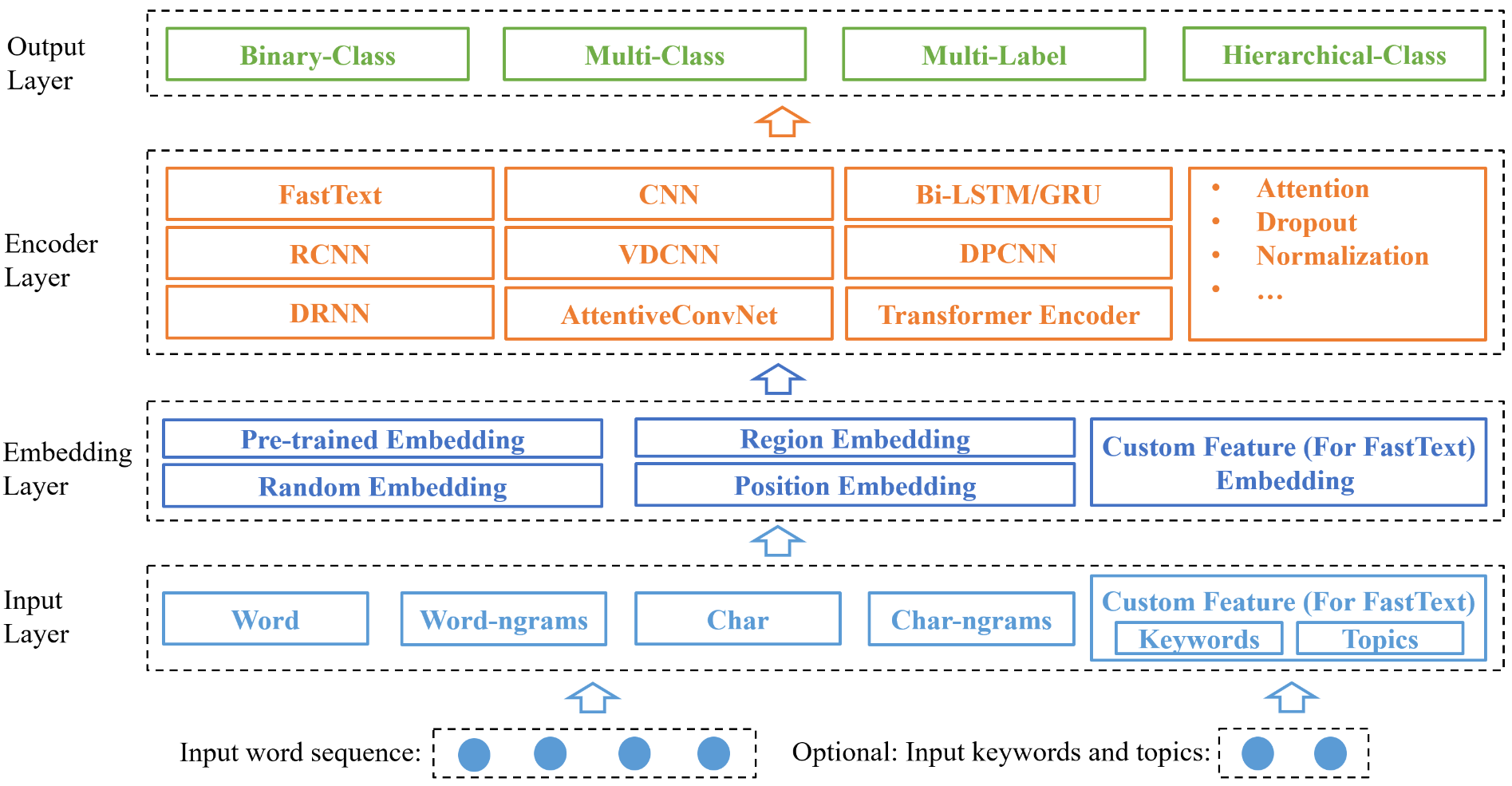
NeuralClassifier is designed for quick implementation of neural models for hierarchical multi-label classification task, which is more challenging and common in real-world scenarios. A salient feature is that NeuralClassifier currently provides a variety of text encoders, such as FastText, TextCNN, TextRNN, RCNN, VDCNN, DPCNN, DRNN, AttentiveConvNet and Transformer encoder, etc. It also supports other text classification scenarios, including binary-class and multi-class classification. It is built on PyTorch. Experiments show that models built in our toolkit achieve comparable performance with reported results in the literature.
Support tasks
- Binary-class text classifcation
- Multi-class text classification
- Multi-label text classification
- Hiearchical (multi-label) text classification (HMC)
Support text encoders
-
TextCNN (Kim, 2014)
-
RCNN (Lai et al., 2015)
-
TextRNN (Liu et al., 2016)
-
FastText (Joulin et al., 2016)
-
VDCNN (Conneau et al., 2016)
-
DPCNN (Johnson and Zhang, 2017)
-
AttentiveConvNet (Yin and Schutze, 2017)
-
DRNN (Wang, 2018)
-
Region embedding (Qiao et al., 2018)
-
Transformer encoder (Vaswani et al., 2017)
-
Star-Transformer encoder (Guo et al., 2019)
-
HMCN(Wehrmann et al.,2018)
Requirement
-
Python 3
-
PyTorch 0.4+
-
Numpy 1.14.3+
System Architecture
Usage
Training
How to train a non-hierarchical classifier
python train.py conf/train.json - set task_info.hierarchical = false.
- model_name can be
FastText、TextCNN、TextRNN、TextRCNN、DRNN、VDCNN、DPCNN、AttentiveConvNet、Transformer.How to train a hierarchical classifier using hierarchial penalty
python train.py conf/train.hierar.json
- set task_info.hierarchical = true.
- model_name can be
FastText、TextCNN、TextRNN、TextRCNN、DRNN、VDCNN、DPCNN、AttentiveConvNet、TransformerHow to train a hierarchical classifier with HMCN
python train.py conf/train.hmcn.json
- set task_info.hierarchical = false.
- set model_name =
HMCN
Detail configurations and explanations see Configuration.
The training info will be outputted in standard output and log.logger_file.
Evaluation
python eval.py conf/train.json- if eval.is_flat = false, hierarchical evaluation will be outputted.
- eval.model_dir is the model to evaluate.
- data.test_json_files is the input text file to evaluate.
The evaluation info will be outputed in eval.dir.
Prediction
python predict.py conf/train.json data/predict.json - predict.json should be of json format, while each instance has a dummy label like "其他" or any other label in label map.
- eval.model_dir is the model to predict.
- eval.top_k is the number of labels to output.
- eval.threshold is the probability threshold.
The predict info will be outputed in predict.txt.
Input Data Format
JSON example:

{
    "doc_label": ["Computer--MachineLearning--DeepLearning", "Neuro--ComputationalNeuro"],
    "doc_token": ["I", "love", "deep", "learning"],
    "doc_keyword": ["deep learning"],
    "doc_topic": ["AI", "Machine learning"]
}

"doc_keyword" and "doc_topic" are optional.
Performance
0. Dataset
<table>
<tr><th>Dataset<th>Taxonomy<th>#Label<th>#Training<th>#Test
<tr><td>RCV1<td>Tree<td>103<td>23,149<td>781,265
<tr><td>Yelp<td>DAG<td>539<td>87,375<td>37,265
</table>
- RCV1: Lewis et al., 2004
- Yelp: Yelp
1. Compare with state-of-the-art
<table>
<tr><th>Text Encoders<th>Micro-F1 on RCV1<th>Micro-F1 on Yelp
<tr><td>HR-DGCNN (Peng et al., 2018)<td>0.7610<td>-
<tr><td>HMCN (Wehrmann et al., 2018)<td>0.8080<td>0.6640
<tr><td>Ours<td><strong>0.8313</strong><td><strong>0.6704</strong>
</table>
- HR-DGCNN: Peng et al., 2018
- HMCN: Wehrmann et al., 2018
2. Different text encoders
<table>
<tr><th row_span='2'>Text Encoders<th colspan='2'>RCV1<th colspan='2'>Yelp
<tr><td><th>Micro-F1<th>Macro-F1<th>Micro-F1<th>Macro-F1
<tr><td>TextCNN<td>0.7717<td>0.5246<td>0.6281<td>0.3657
<tr><td>TextRNN<td>0.8152<td>0.5458<td><strong>0.6704</strong><td>0.4059
<tr><td>RCNN<td><strong>0.8313</strong><td><strong>0.6047</strong><td>0.6569<td>0.3951
<tr><td>FastText<td>0.6887<td>0.2701 <td>0.6031<td>0.2323
<tr><td>DRNN<td>0.7846 <td>0.5147<td>0.6579<td>0.4401
<tr><td>DPCNN<td>0.8220 <td>0.5609 <td>0.5671 <td>0.2393
<tr><td>VDCNN<td>0.7263 <td>0.3860<td>0.6395<td>0.4035
<tr><td>AttentiveConvNet<td>0.7533<td>0.4373<td>0.6367<td>0.4040
<tr><td>RegionEmbedding<td>0.7780 <td>0.4888 <td>0.6601<td><strong>0.4514</strong>
<tr><td>Transformer<td>0.7603 <td>0.4274<td>0.6533<td>0.4121
<tr><td>Star-Transformer<td>0.7668 <td>0.4840<td>0.6482<td>0.3895
</table>
- performance got with 300d pretrained glove embedding
3. Hierarchical vs Flat
<table>
<tr><th row_span='2'>Text Encoders<th colspan='2'>Hierarchical<th colspan='2'>Flat
<tr><td><th>Micro-F1<th>Macro-F1<th>Micro-F1<th>Macro-F1
<tr><td>TextCNN<td>0.7717<td>0.5246<td>0.7367<td>0.4224
<tr><td>TextRNN<td>0.8152<td>0.5458<td>0.7546 <td>0.4505
<tr><td>RCNN<td><strong>0.8313</strong><td><strong>0.6047</strong><td><strong>0.7955</strong><td><strong>0.5123</strong>
<tr><td>FastText<td>0.6887<td>0.2701 <td>0.6865<td>0.2816
<tr><td>DRNN<td>0.7846 <td>0.5147<td>0.7506<td>0.4450
<tr><td>DPCNN<td>0.8220 <td>0.5609 <td>0.7423 <td>0.4261
<tr><td>VDCNN<td>0.7263 <td>0.3860<td>0.7110<td>0.3593
<tr><td>AttentiveConvNet<td>0.7533<td>0.4373<td>0.7511<td>0.4286
<tr><td>RegionEmbedding<td>0.7780 <td>0.4888 <td>0.7640<td>0.4617
<tr><td>Transformer<td>0.7603 <td>0.4274<td>0.7602<td>0.4339
<tr><td>Star-Transformer<td>0.7668 <td>0.4840<td>0.7618<td>0.4745
</table>
Acknowledgement
Some public codes are referenced by our toolkit:
- https://pytorch.org/docs/stable/
- https://github.com/jadore801120/attention-is-all-you-need-pytorch/
- https://github.com/Hsuxu/FocalLoss-PyTorch
- https://github.com/Shawn1993/cnn-text-classification-pytorch
- https://github.com/ailias/Focal-Loss-implement-on-Tensorflow/
- https://github.com/brightmart/text_classification
- https://github.com/NLPLearn/QANet
- https://github.com/huggingface/pytorch-pretrained-BERT
Update
- 2019-04-29, init version