Can I generate multiple versions of each image with Roboflow Annotate?
Yes, Roboflow Annotate includes pre-processing and augmentation capabilities, which enables the generation of multiple versions of each image in the dataset. This helps maintain model generalization and enhances the quality and versatility of the training data.
What are the different labeling functions offered by Roboflow Annotate?
Roboflow Annotate offers different labeling functions to meet a variety of data annotation need. These functions include Object Detection, Instance Segmentation, Keypoint Detection, and Classification. These various labeling functionalities enhance the versatility of Roboflow Annotate, making it suitable for diverse computer vision projects.
How does Roboflow Annotate facilitate real-time teamwork and project management?
Roboflow Annotate has been designed to facilitate real-time teamwork and project management. It provides features that allow uploading, assigning, periodic reviewing, and approval of annotations. Furthermore, secure role-based access is provided, and it maintains a record of all changes made, making team coordination efficient and streamlined.
What annotation insights does Roboflow Annotate provide?
Roboflow Annotate provides annotation insights by maintaining a record of all changes made during the annotation process. This tool provides visibility into the labeling operation's performance and offers insights into the development stage of each dataset. These insights can help improve operational efficiency and data labeling workflows.
What are managed labeling services offered by Roboflow?
Roboflow offers managed labeling services for organizations in need of larger labeling workflows. These services help to quickly scale up operations while ensuring data quality and speed. Managed labeling services offer a way to deal with large volumes of data without compromising on quality and speed of data labeling.
What industries is Roboflow Annotate suitable for?
Roboflow Annotate is suitable for diverse industries. Given its various features designed for fast and efficient data labeling, it can be effectively used in industries such as Aerospace & Defense, Automotive, Energy & Utilities, Healthcare & Medicine, Industrial Manufacturing, Logistics Manufacturing, and more.
What is the role of dataset search and analytical features in Roboflow Annotate?
Dataset search and analytical features in Roboflow Annotate aid in curating, organizing, and visualizing data. These functionalities allow users to explore, filter and organize data to improve the quality of datasets. The analytical features provide insights into the data and help users understand where and how to make improvements.
Does Roboflow Annotate provide AI Assisted Annotation?
Yes, Roboflow Annotate provides AI-assisted annotation. The AI assistance ranges from creating polygon annotations and reducing human labeling time to automatically identifying anomalies and areas of low performance in datasets to enhance their quality.
Is role-based access provided in Roboflow Annotate and how secure is it?
Yes, Roboflow Annotate provides secure role-based access, which ensures data safety when adding labelers from within an organization or with Roboflow Labeling Services. It keeps a history of all changes made to an image which can be reviewed and thus provides an extra layer of security and accountability during the annotation process.
How does Roboflow Annotate assist in labeling images?
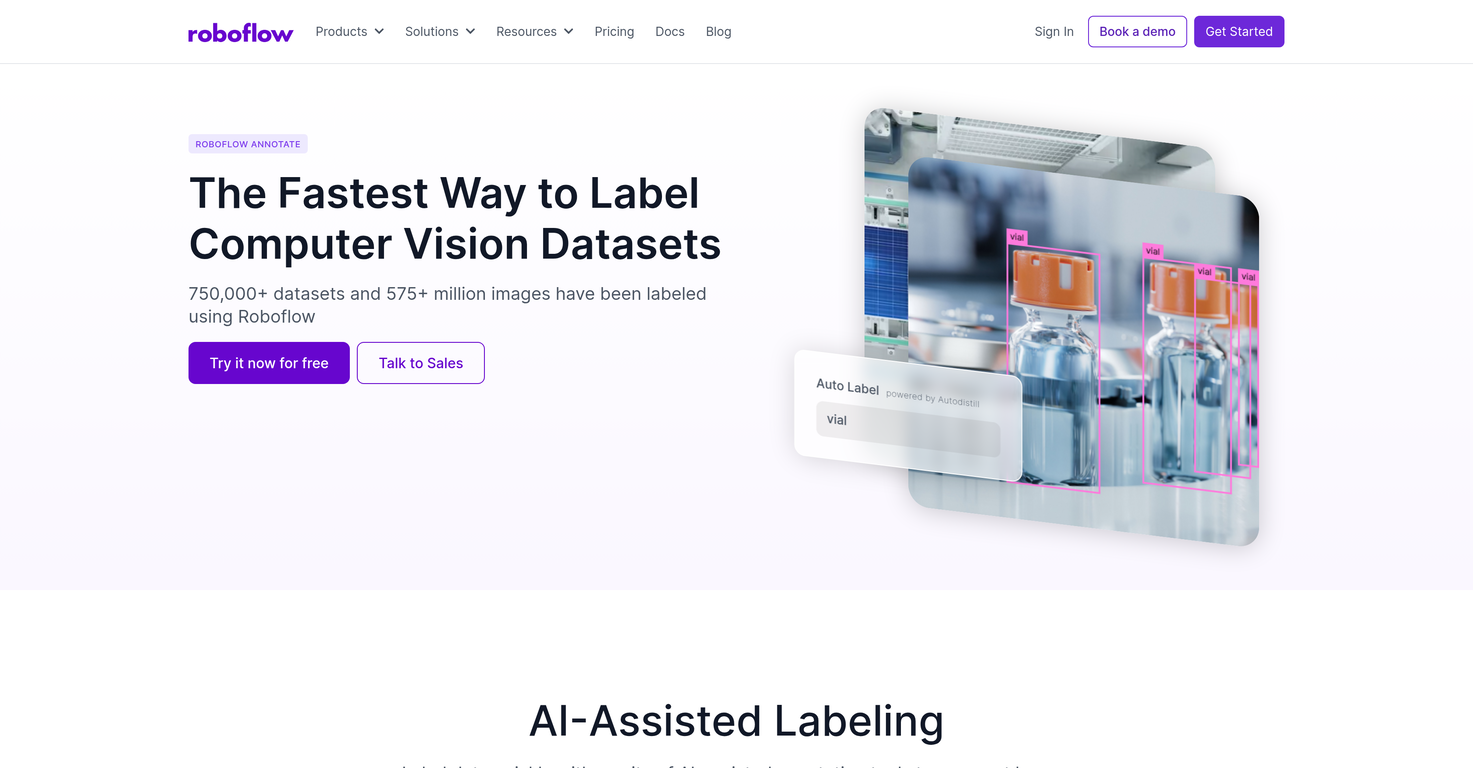
Roboflow Annotate assists in labeling images by offering fast, AI-assisted data annotation tools. It reduces human labeling time and enables the creation of polygon annotations for efficient data labeling. Additionally, it offers automation of the data labeling pipeline, making the process faster and less prone to human error.
What is the mechanism used in Roboflow Annotate for dataset management?
Roboflow Annotate uses advanced artificial intelligence for dataset management. It automatically identifies anomalies and areas of low performance, enhancing the quality of the datasets. Additionally, it includes dataset search and analytical features, thus aiding in the curation, organization, and visualization of data for creating high-quality datasets.
Can Roboflow Annotate identify areas of low performance in datasets?
Yes, Roboflow Annotate has the ability to identify areas of low performance in datasets. It automatically locates anomalies, edge cases, and low performance areas within the dataset to improve dataset quality. This ability allows for the cultivation of a more accurate dataset that subsequently results in improved model performance.
Explain the concept of pre-processing and augmentation capabilities in Roboflow Annotate?
Pre-processing and augmentation capabilities in Roboflow Annotate enable the generation of up to 50 augmented versions of each image in the dataset. These capabilities include hue adjustment, saturation, and blurring, which are used to create multiple iterations of the same image. This promotes model generalizability, improves dataset quality, and enhances the overall learning and predictive capability of the model.
Can Roboflow Annotate be used in Object Detection, Instance Segmentation, Keypoint Detection, and Classification tasks?
Yes, Roboflow Annotate can be used effectively in Object Detection, Instance Segmentation, Keypoint Detection, and Classification tasks. It offers various labeling functions to cater to different types of computer vision projects. Its versatile functionality makes it suitable for efficiently building high-quality datasets for a variety of AI and machine learning tasks.
How would you rate Roboflow Annotate?
Help other people by letting them know if this AI was useful.