How does ZenMux use bad cases to improve AI products?
For ZenMux, disappointing AI outputs are not just recorded, they are also used as learning opportunities to improve AI products. Every compensated case is deemed a high-value bad case, analyzed, anonymized, and then utilized to create a feedback loop aimed at improving the user's own AI product.
What exactly is ZenMux's radical transparency policy?
ZenMux's radical transparency policy entails verifying all models at source and conducting regular open-source, community-auditable quality benchmarks. The results of these audits are published in real-time. This policy ensures all ZenMux users have clarity over the quality and performance of the models they are using.
How does ZenMux verify the quality of AI models?
ZenMux verifies the quality of AI models at the source. It also conducts regular Human Last Exam (HLE) tests. These tests are open-source, community-auditable quality benchmarks whose results are published in real time. This process ensures that the quality of all models is verified transparently and unequivocally.
How does ZenMux provide cost visibility?
ZenMux prioritizes cost visibility by making every request, token, and cost traceable. This level of transparency helps users to keep track of their expenses and to better manage their costs associated with using the platform.
Can you explain the function of ZenMux's multi-dimensional dashboards?
ZenMux provides multi-dimensional dashboards to enable users to have unprecedented insights into their cost management. These dashboards track every request, token, and cost, thus giving users detailed visibility into their expenditure and usage trends. They facilitate smarter decision-making and optimization of costs.
What is ZenMux's approach to ensuring stable access to AI models?
To ensure stable access to AI models, ZenMux uses multi-provider failover and global edge acceleration. This means it leverages multiple providers to ensure continuous service even when one fails, while globally optimizing network routes to reduce latency and improve response speed.
How does ZenMux's model auto-routing feature work?
ZenMux's model auto-routing feature analyzes the user's prompts to automatically select the best quality model at the lowest cost. This automation ensures optimal balance between quality and price, helping users get great results without having to manually choose which model to use.
How is ZenMux compatible with different Enterprise Language Model protocols?
ZenMux's compatibility with different Enterprise Language Model protocols is achieved through its API design, which integrates seamlessly with protocols from OpenAI, Anthropic, and Google Vertex AI. This compatibility allows ZenMux to offer users a unified interface, making it easier to interact with different AI models.
How does ZenMux's insurance feature work when there is excessive latency or low throughput?
Just like with hallucinated outputs, ZenMux has an insurance mechanism in place for instances when there is excessive latency or low throughput. In such cases, ZenMux doesn't just record the instance, but also compensates the user. This not only minimizes the loss for the user but also allows ZenMux to use these instances as valuable bad cases for improving the AI product.
How can users request on-demand tests on ZenMux?
ZenMux allows users to request on-demand tests for any model channel. These tests are part of ZenMux's radical transparency policy that ensures all models on the platform are verified, undergone quality benchmarks, and the results are published in real time.
What AI model generation features does ZenMux offer?
ZenMux has a comprehensive set of AI model generation features. Alongside regular text-based applications, it also offers a graphical user interface for chat, image, or video generation. This makes ZenMux a versatile AI model utilization platform for a wide range of applications.
How does ZenMux handle user accounts and keys across different AI models?
ZenMux eliminates the need for users to maintain multiple accounts and keys across AI models. It provides one account and one API for direct access to all leading AI models. This ensures users can easily access these models without having to manage multiple accounts, keys, and protocols.
How does ZenMux help optimize AI-related costs?
ZenMux helps optimize AI-related costs by making every request, token, and cost clearly traceable and by providing multi-dimensional dashboards for unprecedented insights. This allows users to visually analyze their expenditures and make smarter decisions on resource utilization. Moreover, the model auto-routing feature optimizes cost by automatically choosing the best quality model at the lowest cost.
How does ZenMux support multi-provider failover and global edge acceleration?
ZenMux supports multi-provider failover and global edge acceleration to provide reliable and improved access to AI models. Multi-provider failover entails switching between different providers in case of failure to maintain the service. Global edge acceleration involves optimizing network routes across the globe to reduce latency and improve response speed, thus enhancing the overall user experience.
What is ZenMux?
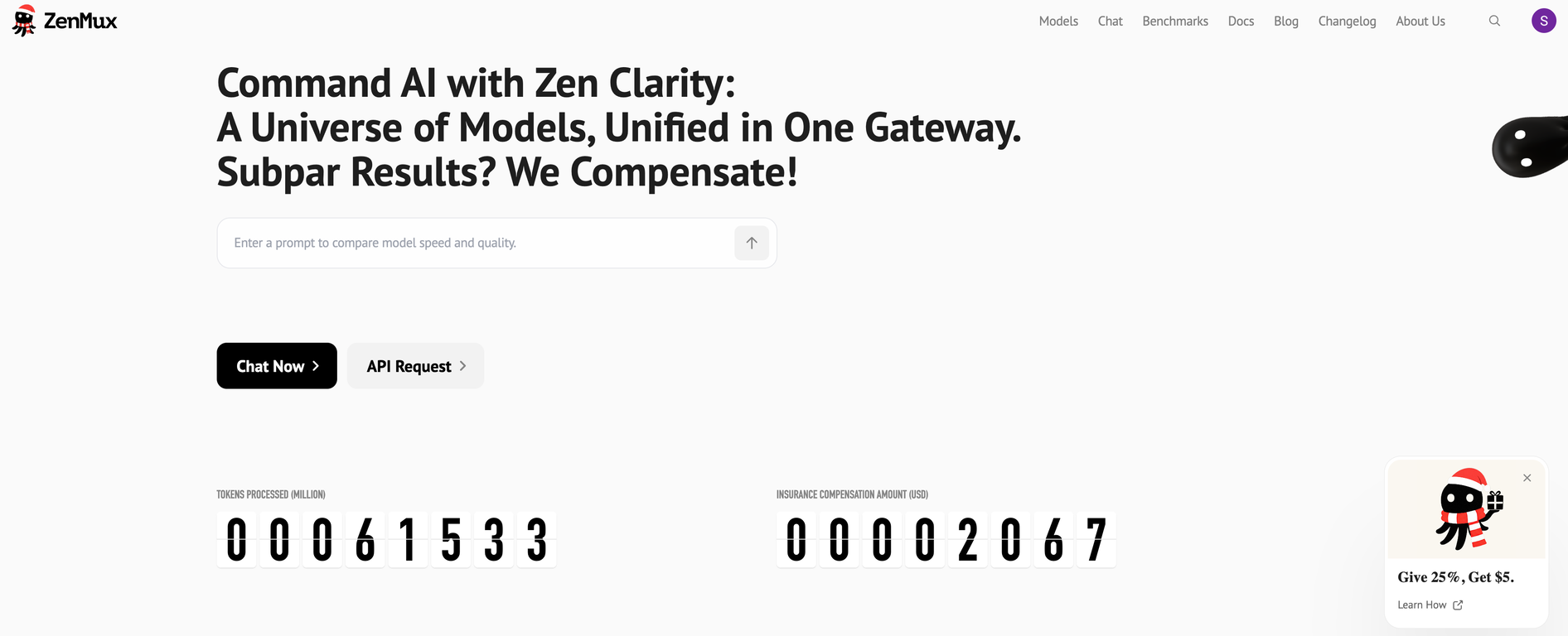
ZenMux is an Enterprise Lifetime Learning Model (LLM) platform. It provides a unified Application Programming Interface (API) allowing users to access multiple AI models from official suppliers or authorized cloud partners through a single account and API. It features a built-in insurance for subpar AI outputs, open source community-auditable quality benchmarks, cost visibility, multi-provider failover, global edge acceleration, and model auto-routing.
How does ZenMux's unified API work?
ZenMux's unified API works by consolidating multiple AI model protocols into a single access point. This design eliminates the need for users to maintain different accounts, keys, and protocols for each AI model, allowing users to access leading AI models using one account, one API, and without the need to use proxies or degraded copies.
What AI models can I access with ZenMux?
While specific models aren't mentioned on their website, it's clear that ZenMux provides access to leading AI models from official suppliers or authorized cloud partners. Users get direct access to these models without needing proxies or degraded copies.
Is ZenMux compatible with OpenAI, Anthropic, and Google Vertex AI protocols?
Yes, ZenMux is fully compatible with the protocols of OpenAI, Anthropic, and Google Vertex AI. Users can access these and other leading AI models, sourced exclusively from official providers or authorized cloud partners, with ZenMux's unified API.
How can I use ZenMux for chat, image, or video generation?
ZenMux can be used for chat, image, or video generation through their graphical user interface (GUI) using the unified API. Regardless of the application, everything flows through a single unified interface which streamlines the process and makes it user-friendly.
What is ZenMux's built-in insurance policy?
ZenMux's built-in insurance policy compensates users for instances when AI outputs aren't up to standard - this could be hallucinated outputs, excessive latency ,or low throughput. Apart from compensation, these instances are used as high-value bad cases to further refine and improve the AI products.
How does ZenMux compensate for subpar AI outputs?
ZenMux compensates its users in the event of subpar AI outputs - such as hallucinated outputs, excessive latency, low throughput - which aren't merely logged, but are analyzed, anonymized and fed back into the system to improve the overall AI product.
How does ZenMux verify the models?
ZenMux verifies all AI models at the source. This process ensures that users are always dealing with genuine models received directly from official providers or authorized cloud partners, and not with proxies or degraded copies.
What is ZenMux's radical transparency policy?
ZenMux's radical transparency policy involves verifying all models at the source and running regular open-source community-auditable quality benchmarks. The results from these checks are then published in real time. This transparency approach allows users to know exactly what they're getting and helps foster trust.
What are the ZenMux community-auditable quality benchmarks?
ZenMux conducts regular open-source, community-auditable quality benchmarks. These benchmarks are designed to evaluate the performance and reliability of the AI models. The results of these benchmarks are published in real time, ensuring transparency.
Can I request on-demand tests for any model channel in ZenMux?
Yes, with ZenMux, users can request on-demand tests for any model channel. This feature gives users the ability to validate the performance and reliability of models any time they wish.
Can I track the cost of each request or token with ZenMux?
Yes, with ZenMux, every request, token, and cent is traceable. This provides users with complete control over cost management, offering them the granularity they need to optimize their spend.
What insights and analytics does ZenMux provide for optimizing costs?
ZenMux provides multi-dimensional dashboards that offer detailed insights and analytics. This aims to help users optimize costs and make informed decisions. The platform's focus on cost visibility helps users in effectively tracking and optimizing their AI-related expenses.
What is ZenMux's multi-provider failover?
ZenMux's multi-provider failover is a feature that aims to provide a stable access to AI models. By having a failover system in place, the service can continue without interruption even when one of the providers fails.
How does ZenMux's global edge acceleration work?
ZenMux's global edge acceleration is designed to improve the delivery speed of AI models across the globe. By distributing the models closer to the user, it minimizes latency and enhances the user experience.
Can ZenMux automatically select the best quality model for me?
Yes, with ZenMux's model auto-routing feature, the system can analyze your prompt to automatically select the model that delivers the best quality at the lowest cost. By continuously learning from task patterns and historical performance, it strikes the optimal balance between quality and price.
How can ZenMux help enhance my workflow and business growth?
ZenMux can enhance workflow and business growth in multiple ways. By providing a unified API to access various AI models, reducing API management hassles, and offering model auto-routing for optimized quality and cost, businesses can increase their efficiency. Additionally, its enterprise-grade stability and global edge acceleration ensure uninterrupted and speedy services, further bolstering business operations.
What kind of applications can I use ZenMux for?
ZenMux can be used for a wide range of applications. Its compatibility with OpenAI, Anthropic, and Google Vertex AI protocols makes it versatile for various applications including chat, image, and video generation. Moreover, it could also be used for tasks where advanced AI models are required, leveraging its unified API and seamless integration features.
Can ZenMux help me avoid degraded models?
Yes, ZenMux assists its users to avoid degraded models. Through regular Human Last Exam (HLE) tests, ZenMux verifies the quality of models at the source, tracks degradation trends, and assures users they will not get degraded models, ensuring uncompromised quality at all times.
What is ZenMux's model auto-routing feature?
ZenMux's model auto-routing feature analyzes user prompts to automatically select the best quality model at the lowest cost. It continuously learns from task patterns and historical performance to find the perfect balance between quality and cost. Users don't have to manually select models, making the whole process effortless and efficient.