Mini tools
ReCode: Unify Plan and Action for Universal Granularity Control
Next paradigm for LLM Agent. Unify plan and action through recursive code generation for adaptive, human-like decision-making.
README
ReCode: Unify Plan and Action for Universal Granularity Control

If you encounter any difficulties in using or reproducing the code, please contact me at [email protected].
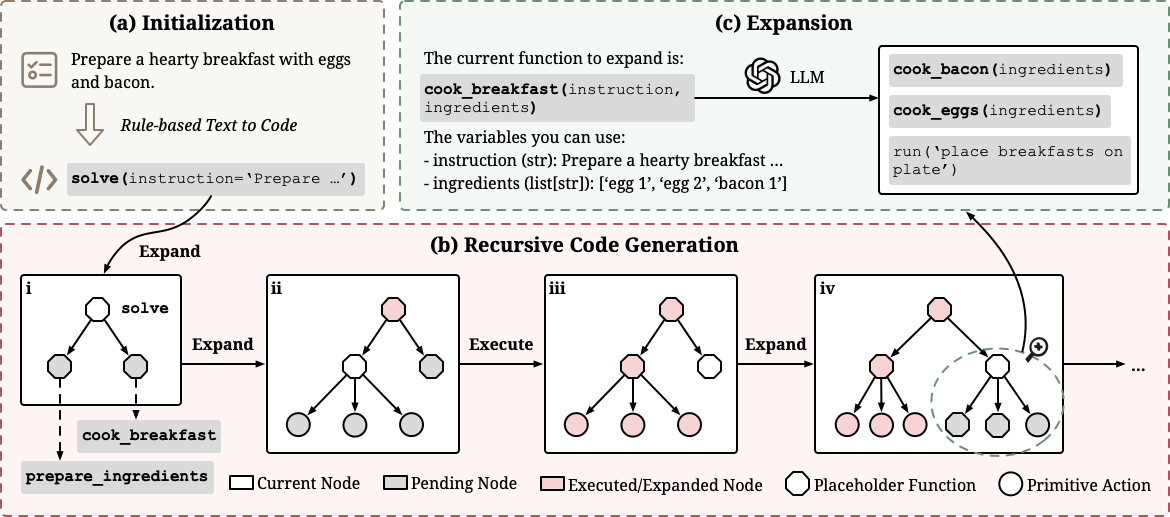
ReCode introduces recursive code generation for LLM agents, unifying plan and action into a single representation. By treating high-level plans as placeholder functions that recursively decompose into executable primitives, it achieves universal granularity control and dynamically adapts from strategic thinking to concrete actions. This repository hosts the reference implementation used in the paper, along with environment wrappers and experiment tooling.

Core Idea
ReCode adopts a divide-and-conquer strategy, decomposing complex tasks into executable code fragments:
- Tree-structured code: Organizes partial programs in a tree where each node captures one sub-task and records its execution trace.
- Recursive expansion: Placeholder functions are expanded by the LLM into more specific calls or smaller subroutines using environment-specific prompts and few-shots.
- Dynamic execution loop: Each node is executed immediately; fresh observations decide whether to expand further, retry, or finish.
- Shared executor state: A constrained Python executor maintains environment variables, validates code blocks, and exposes the toolset available to the agent.
Repository Layout
run.py– CLI entry point that instantiates agents/envs, manages concurrency, and writes run summaries.agents/recode/– ReCode agent implementation, prompt templates, and utility helpers.envs/– Environment wrappers and assets foralfworld,webshop, andsciworld.configs/– LLM profile templates and (expected) pricing metadata used by the async client.utils/– Shared components: async OpenAI wrapper, constrained executor, logging helpers, error types.figures/– Paper figures used throughout this README.
Experiments
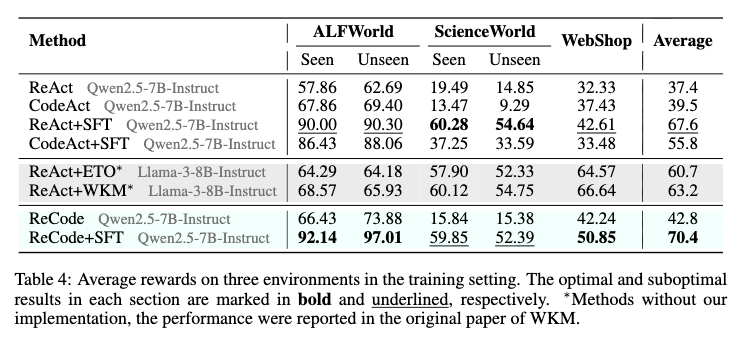
To evaluate the effectiveness of ReCode, we divide our experiments into the inference part and the training part.
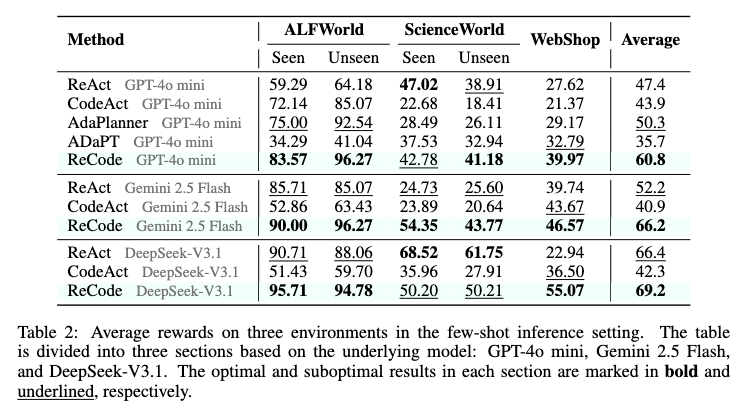
- Inference Result: we compare against several mainstream paradigm (ReAct, CodeAct) and some of the work focused on improving LLM-based agent planning (AdaPlanner and ADaPT). ReCode achieved significant performance improvements across all three environments, with an average score of 60.8, surpassing the best baseline method by 10.5 (relative 20.9%). With our tests, ReCode can achieve a perfect 100 score in ALFWorld under
claude-4-sonnet.
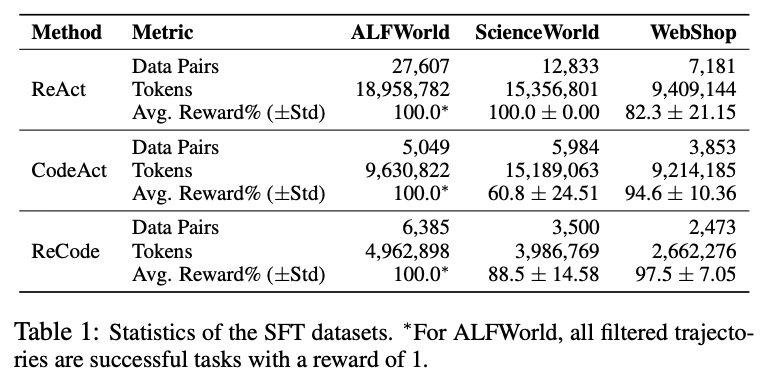
- Training Result: we conduct supervised fine-tuning (SFT) on ReCode, ReAct and CodeAct with
Qwen2.5-7B-Instruct. ReCode+SFT delivers an impressive average performance of 70.4% across all environments, outperforming both ReAct+SFT (67.6%) and CodeAct+SFT (55.8%), highlighting its exceptional data efficiency.
Quick Start
To run ReCode, we need a conda environment. The python version should be 3.10 or newer.
Then, it is necessary to configure dependencies for three environments (it has not been confirmed whether conflicts will arise in the same environment), and we suggest configuring them in three separate environments.
conda create -n recode-envname python=3.10 # Replace "envname" with the your environment name.
conda activate recode-envname
ALFWorld
-
Follow the ALFWorld instructions.
-
Set
ALFWORLD_DATAto the dataset root or editenvs/alfworld/base_config.yamlto point to your local paths:export ALFWORLD_DATA=/path/to/alfworld
ScienceWorld
- Follow the instruciton from the ScienceWorld repository.
WebShop
Thanks to ETO for providing a convenient script to configure WebShop environment.
cd envs/webshop
pip install -e .
conda install -y -c conda-forge openjdk=11
pip install "en_core_web_lg @ https://github.com/explosion/spacy-models/releases/download/en_core_web_lg-3.6.0/en_core_web_lg-3.6.0-py3-none-any.whl"
Run the provided helper to fetch the goal set and pre-built search index:
# The current path is "envs/webshop"
bash setup.sh
Install some other dependencies.
pip install -r requirements.txt # Here may not be complete, please contact me promptly if you encounter any problemsEnsure configs/profiles.yaml points to a valid API credential (copy configs/profiles_example.yaml if you need a template), then run a short dry run in any enabled environment:
python run.py -a recode -e alfworld -n 1 --split test --profile defaultReplace alfworld with webshop or sciworld once their assets are available. Logs are written to logs/<run_id>/, and the console prints a condensed summary for quick diagnostics.
Configure LLM Access
-
configs/profiles.yamlcontains named profiles. Therun.py --profileflag selects which profile to forward toAsyncLLM. Example:models: default: api_key: "sk-your_api_key" base_url: "https://api.openai.com/v1" model: "gpt-4o-mini" temperature: 0.0 track_costs: true gpt-4o: api_key: "sk-your_other_key" base_url: "https://api.openai.com/v1" model: "gpt-4o" temperature: 0.7 max_tokens: 512 -
Cost tracking loads
configs/prices.json. If you do not want to record costs, settrack_costs: falsefor the profile. -
As a fallback, you can omit the file and set
OPENAI_API_KEYin the environment; the default profile will then use it. -
A ready-to-edit template lives at
configs/profiles_example.yaml; copy it toconfigs/profiles.yamlif you're starting from scratch:cp configs/profiles_example.yaml configs/profiles.yaml
Running ReCode
run.py is the canonical entry point. It resolves agent/environment aliases, manages concurrency, streams logs, and emits a structured summary.
# ALFWorld, single instance
python run.py -a recode -e alfworld -n 1 --split test --profile default

# WebShop, 3 test goals, allow deeper recursion
python run.py -a recode -e webshop -n 3 --split test --profile default --max-depth 12

# ScienceWorld, run 5 instances with 2-way concurrency
python run.py -a recode -e sciworld -n 5 -c 2 --profile gpt-4o
Key CLI flags:
-a / --agent– class path or alias (recoderesolves toagents.recode.agent.ReCodeAgent).-e / --env– environment class or alias (alfworld,webshop,sciworld).-n / --instances– number of evaluation episodes.-c / --concurrent– max concurrent episodes (rich progress UI automatically adapts).--split,--seed,--max-depth,--profile– forwarded to both agent and environment.-C / --config– YAML file whose keys override CLI flags; useful for complex sweeps.
Example YAML (configs/example.yaml):
agent: recode
env: alfworld
instances: 10
concurrent: 2
profile: gpt-4o
split: test
task_types: ["put", "clean"] # For ALFWorld
max_depth: 12
max_retry: 4
Run it with:
python run.py -C configs/example.yamlLogging & Results
- Each run creates
logs/<run_id>/with:running_logs/run.log– aggregated stream of agent + environment logs.running_logs/instance_<id>.log– per-instance traces (when multiple instances are launched).<results.json>– structured summary written bywrite_summary, containing per-instance metrics and aggregated statistics (overall + per task type).
- The console prints a condensed summary (success rate, standard metrics, by-task breakdown) after completion.
Extending to New Environments
- Implement the
Envinterface underenvs/<your_env>/env.py. Usebase.environment.Envas the contract: implementreset,_run,is_done,is_success, andreport. Return{"observations": [...], "env_name": <name>, "env": self}fromreset. - Expose prompts and guidance in
agents/recode/resources/:prompts/<env_name>/actions.txt– concise description of validrun("...")calls/tools.fewshots/<env_name>/– one or more.txtexamples showing thought→execute patterns.- If your environment has task types, update
agents/recode/agent.py::_load_resourcesandagents/recode/utils.parse_raw_observationto parse initial observations correctly.
- Register aliases by adding your class to
ENV_ALIASESinrun.py(optional but convenient) and, if needed, plan-specific logic in the agent utilities. - Optionally add setup scripts (similar to
envs/webshop/setup.sh) to document dataset fetching.
Programmatic Use
You can embed the agent directly inside your own loop by reusing the provided utilities:
import asyncio

from agents.recode.agent import ReCodeAgent
from envs.alfworld.env import AlfworldEnv

async def solve_once():
    config = {"split": "test", "task_types": ["put"], "max_depth": 10}
    env = AlfworldEnv(logger=None)
    agent = ReCodeAgent()
    init_info = env.reset(config)
    agent.reset(config, init_info)

    observations = init_info["observations"]
    while not env.is_done():
        actions = await agent.act(observations)
        observations = await env.run(actions)

    print(env.report())
    await env.close()

asyncio.run(solve_once())
The same pattern works for any Env implementation; be sure to pass a logger if you need file-backed traces.
Citation
@misc{yu2025recodeunifyplanaction,
      title={ReCode: Unify Plan and Action for Universal Granularity Control},
      author={Zhaoyang Yu and Jiayi Zhang and Huixue Su and Yufan Zhao and Yifan Wu and Mingyi Deng and Jinyu Xiang and Yizhang Lin and Lingxiao Tang and Yingchao Li and Yuyu Luo and Bang Liu and Chenglin Wu},
      year={2025},
      eprint={2510.23564},
      archivePrefix={arXiv},
      primaryClass={cs.AI},
      url={https://arxiv.org/abs/2510.23564},
}