Mini tools
AndroidEnv - The Android Learning Environment
RL research on Android devices.
README
AndroidEnv - The Android Learning Environment
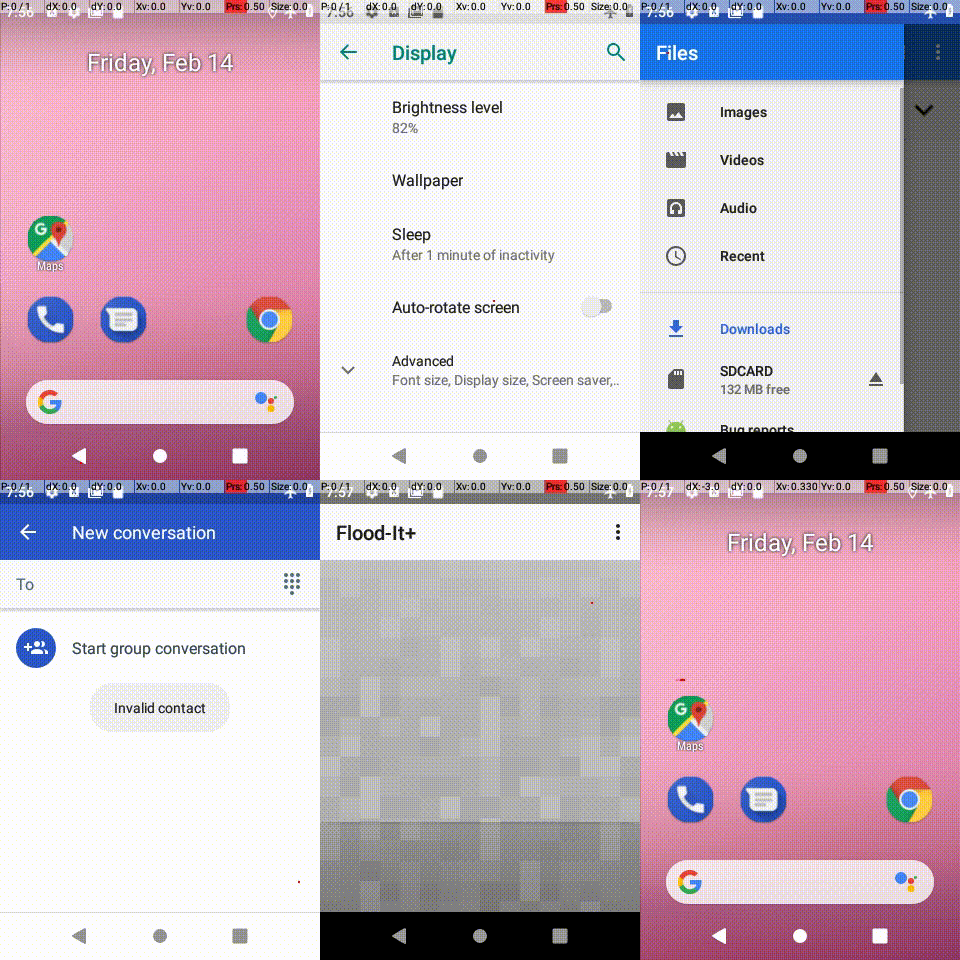
AndroidEnv is a Python library that
exposes an Android device as a Reinforcement
Learning (RL) environment. The library provides a flexible platform for defining
custom tasks on top of the Android Operating System, including any Android
application. Agents interact with the device through a universal action
interface - the touchscreen - by sending localized touch and lift events to the
system. The library processes these events and returns pixel observations and
rewards as provided by specific task definitions. For
example, rewards might be given for events such as successfully scrolling down a
page, sending an email, or achieving some score in a game, depending on the
research purpose and how the user configures the task.


Index
- Environment details
- Running AndroidEnv
- Setting up a virtual Android device
- Defining a task in AndroidEnv
- Example tasks available for download
Environment features
There are a number of aspects that make AndroidEnv a challenging yet suitable
environment for Reinforcement Learning research:
-
Allowing agents to interact with a system used daily by billions of users
around the world, AndroidEnv offers a platform for RL agents to navigate,
learn tasks and have direct impact in real-world contexts. The
environment wraps a simulated Android device, which runs independently from
the environment, completely unaltered, and works in exactly the same way as
the devices that humans use, exposing exactly the same features and
services. -
The platform offers a virtually infinite range of possible tasks, all
sharing a common action interface. The library facilitates the design of
Reinforcement Learning tasks for any existing or custom built Android
application. For example, it exposes the broad world of Android games,
ranging from card games, puzzle games, time reactive games, all requiring a
diverse set of action combinations and interaction types. -
The environment runs on top of a real-time simulation of an Android
device. In other words, the environment dynamics does not wait for the agent
to deliberate, and the speed of the simulation cannot be increased. -
The observation is a collection of RGB values corresponding to the
displayed pixels on the screen. The exact screen resolution depends on the
simulated device, but in general it will be considered relatively large in
an RL context. However, users have the option of downsampling each
observation. -
The learning environment has an interesting, complex action space unique
to the touchscreen interface of Android.- The raw, hybrid action space consists of a continuous tuple
signifying the action location, and a discrete signal determining
whether the agent wants to touch the screen or lift its virtual finger. - Raw actions are highly composable: the Android UI and most
applications were designed so that they could be intuitively navigated
via common
touchscreen gestures
such as tapping, scrolling, swiping, pinching, drag & drop etc. This is
still the case in AndroidEnv: to trigger meaningful changes in the
environment, the agent often has to perform carefully timed and
positioned sequences of raw actions. For example, in order to navigate
to the next image in a photo gallery, the agent would have to perform a
swipe, touching the screen multiple times, gradually shifting the
actions' positions to the right. Thus, in most contexts raw actions do
not trigger changes in the state of the environment unless correctly
chained together to make up a human gesture. - The action interface is closely related to the observation space, as
meaningful touch and lift events are often either co-localized or
strongly correlated to the location or movement of salient objects in
the observation. For example, the position of a button on the screen
aligns with the location of the actions that trigger the button press. - The library provides tools for flexibly altering the action
interface if needed for particular studies, such as discretization or
hard-coding gesture skills. Still, we believe that the real challenge
remains in devising agents that are capable of dealing with a large
suite of diverse tasks, through acting and learning in the complex
unifying action interface.
- The raw, hybrid action space consists of a continuous tuple
Getting started
Installation
The easiest way to get AndroidEnv is with pip:
$ python3 -m pip install android-envPlease note that /examples are not included in this package.
Alternatively, you can clone the repository from git's main branch:
$ git clone https://github.com/deepmind/android_env/
$ cd android_env
$ python3 setup.py install
Update: the environment now runs on Windows, but please keep in mind that this
option is not well-maintained or widely supported, as Unix-based systems are the
primary target platforms of this project.
Create a simulator
Before running the environment, you will need access to an emulated Android
device. For instructions on creating a virtual Android device, see the
Emulator guide.
Define a task
Then, you will want to define what the agent's task is. At this point, the
agent will be able to communicate with the emulated device, but it will not yet
have an objective, or access to signals such as rewards or RL episode ends.
Learn how to define an RL task of your own, or use one of
the existing task definitions for training.
Load and run
To find out how to run and train agents on AndroidEnv, see these
detailed instructions. Here you can also find example
scripts demonstrating how to run a random agent, an
acme agent, or a human agent on AndroidEnv.
About
This library is developed and maintained by DeepMind. \
You can find the technical report on Arxiv,
as well as an introductory
blog
post
on DeepMind's website.
If you use AndroidEnv in your research, you can cite the paper using the
following BibTeX:
@article{ToyamaEtAl2021AndroidEnv,
  title     = {{AndroidEnv}: A Reinforcement Learning Platform for Android},
  author    = {Daniel Toyama and Philippe Hamel and Anita Gergely and
               Gheorghe Comanici and Amelia Glaese and Zafarali Ahmed and Tyler
               Jackson and Shibl Mourad and Doina Precup},
  year      = {2021},
  eprint    = {2105.13231},
  archivePrefix = {arXiv},
  primaryClass = {cs.LG},
  volume    = {abs/2105.13231},
  url       = {http://arxiv.org/abs/2105.13231},
}
Disclaimer: This is not an official Google product.