Mini tools
Do Reasoning Models Enhance Embedding Models?
The official repository of the paper "Do Reasoning Models Enhance Embedding Models?"
README




Introduction
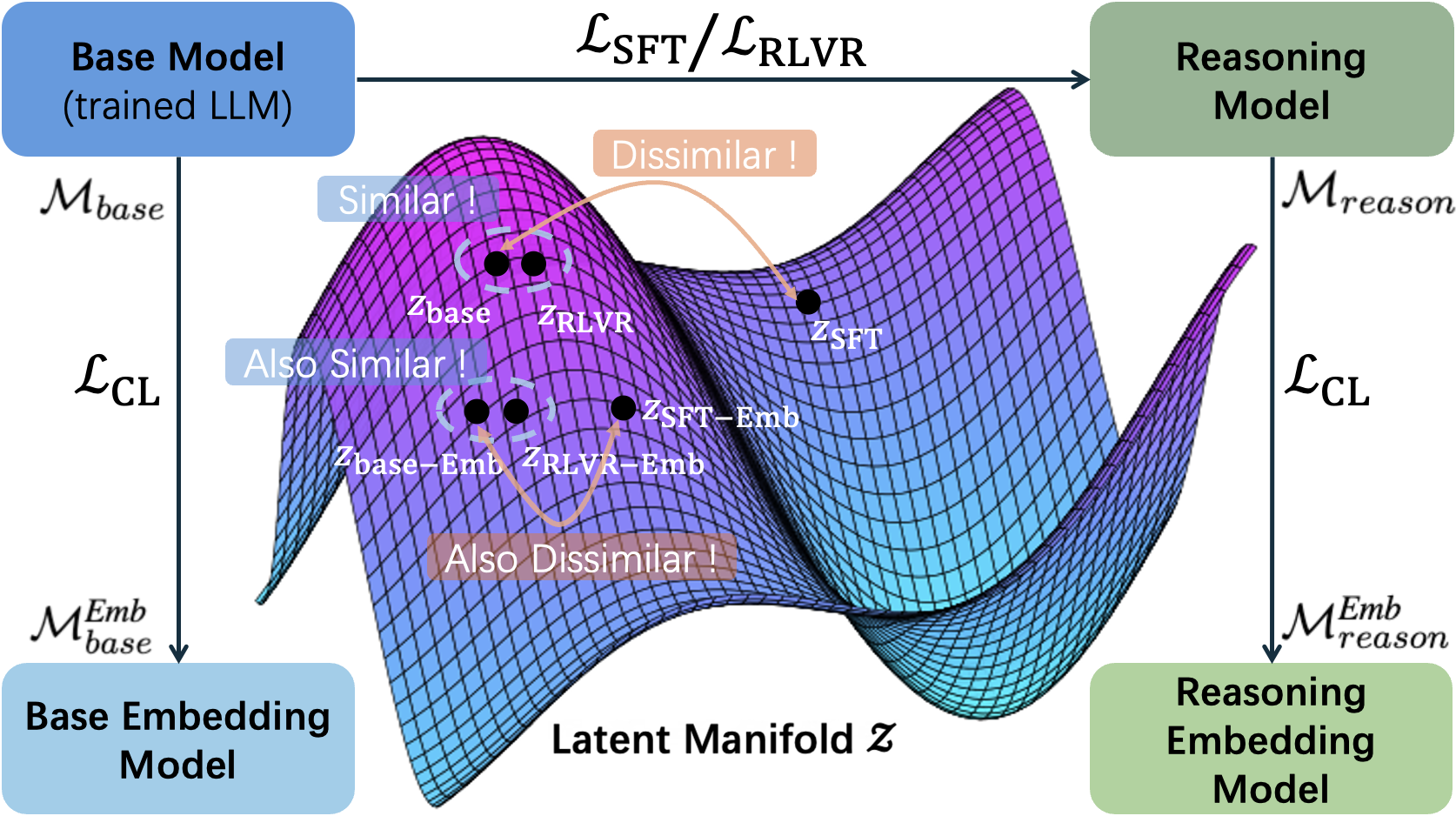
State-of-the-art embedding models are increasingly derived from decoder-only Large Language Model (LLM) backbones adapted via contrastive learning. Given the emergence of reasoning models trained via Reinforcement Learning with Verifiable Rewards (RLVR), a natural question arises: do enhanced reasoning translate to superior semantic representations when these models serve as embedding initializations? Contrary to expectation, our evaluation on MTEB and BRIGHT reveals a null effect: embedding models initialized from RLVR-tuned backbones yield no consistent performance advantage over their base counterparts when subjected to identical training recipes. To unpack this paradox, we introduce Hierarchical Representation Similarity Analysis (HRSA), a framework that decomposes similarity across representation, geometry, and function levels. HRSA reveals that while RLVR induces irreversible latent manifold's local geometry reorganization and reversible coordinate basis drift, it preserves the global manifold geometry and linear readout. Consequently, subsequent contrastive learning drives strong alignment between base- and reasoning-initialized models, a phenomenon we term Manifold Realignment. Empirically, our findings suggest that unlike Supervised Fine-Tuning (SFT), RLVR optimizes trajectories within an existing semantic landscape rather than fundamentally restructuring the landscape itself.
📑 News
[2026.01.30] Our paper is published on Arxiv! Models and data are available on HuggingFace.
🚀 Quick Start
Clone the repository and initialize the submodule:
git clone --recurse-submodules https://github.com/lucaswychan/reasoning-embedding.git
cd reasoning-embedding
Install dependencies using either uv (recommended) or pip:
# Method 1: Using uv (Install uv first: https://docs.astral.sh/uv/getting-started/installation/)
uv sync
source .venv/bin/activate
uv pip install flash-attn --no-build-isolation

# Method 2: Using pip
python3 -m venv .venv
source .venv/bin/activate
pip install -r requirements.txt
pip install flash-attn --no-build-isolation
⚠️ Important: Enable bidirectional attention (required for embedding models):
# Method 1: For transformers>=5.0.0 (default in requirements.txt and recommended.)
cp models/modeling_qwen2.py .venv/lib/python3.12/site-packages/transformers/models/qwen2/modeling_qwen2.py
cp models/modeling_qwen3.py .venv/lib/python3.12/site-packages/transformers/models/qwen3/modeling_qwen3.py

# Method 2: For transformers<5.0.0 (unless you manually changed the version, otherwise you can ignore it.)
cp models/modeling_qwen2_v4.py .venv/lib/python3.12/site-packages/transformers/models/qwen2/modeling_qwen2.py
cp models/modeling_qwen3_v4.py .venv/lib/python3.12/site-packages/transformers/models/qwen3/modeling_qwen3.py
📦 Installation & Setup
Bidirectional Attention for Embedding Models
Embedding models require bidirectional attention, which is achieved by setting is_causal=False in the model's forward pass. We provide modified modeling_qwen2.py and modeling_qwen3.py files with the necessary changes.
What we changed: Added an is_causal argument to all forward methods and set is_causal=False by default in the XXXModel class. Example modification:
class Qwen2Model(Qwen2PreTrainedModel):
    def forward(
        self,
        input_ids: Optional[torch.LongTensor] = None,
        attention_mask: Optional[torch.Tensor] = None,
        ...
        is_causal: Optional[bool] = False,  # Added: enables bidirectional attention
        **kwargs,
    ) -> BaseModelOutputWithPast:
        ...
        for decoder_layer in self.layers:
            hidden_states = decoder_layer(
                hidden_states,
                ...
                is_causal=is_causal,  # Added: pass to decoder layers
                **kwargs,
            )
Important: Use Flash Attention 2 as the attention backend. The SDPA backend has a bug that prevents bidirectional attention even with is_causal=False. See transformers#39554 for details.
For other model families (e.g., DeepSeek, Llama): Apply the same modifications—add is_causal to all forward methods and set is_causal=False in the base model class.
Ignore the documentation error: If you received the following error (or something like that):
[ERROR] `is_causal` is part of Qwen2Model.forward's signature, but not documented. Make sure to add it to the docstring of the function in <repo_path>/.venv/lib/python3.12/site-packages/transformers/models/qwen2/modeling_qwen2.py.Just ignore it. It's even a good sign to indicate your success in setting up the bidirectional attention.
📁 Project Structure
.
├── datasets/                     # Dataset processing and preparation
│   ├── mine_hard_neg.py          # Hard negative mining for contrastive learning
│   ├── filter_by_margin.py       # Margin-based dataset filtering
│   └── cot-datasets/             # Chain-of-Thought dataset generation (for analysis)
├── evaluation/                   # Embedding evaluation benchmarks
│   ├── evaluate_mteb.py          # MTEB benchmark evaluation
│   ├── evaluate_bright.py        # BRIGHT benchmark evaluation
│   └── summary.py                # Results summarization
├── hrsa/                         # Hierarchical Representation Similarity Analysis
│   ├── run_metrics.py            # Main CLI entry point for HRSA metrics
│   ├── metrics/                  # Metric implementations (CKA, Procrustes, etc.)
│   └── [metric_name].py          # Individual metric classes
├── models/                       # Modified model implementations
│   ├── modeling_qwen2.py         # Qwen2 with bidirectional attention support
│   └── modeling_qwen3.py         # Qwen3 with bidirectional attention support
├── scripts/                      # Evaluation scripts
│   ├── evaluate_mteb.sh
│   └── evaluate_bright.sh
└── train/gritlm-re/              # Embedding model training (modified GritLM)
🔬 HRSA Framework
The HRSA (Hierarchical Representation Similarity Analysis) framework decomposes model similarity across three levels: representation, geometry, and function. All metrics are implemented under the hrsa/ directory.
Available Metrics
| Metric | Description |
|---|---|
| Linear CKA | Measures representation space similarity using centered kernel alignment |
| Orthogonal Procrustes | Finds optimal orthogonal transformations to align representation spaces |
| Dimension-wise Correlation | Computes Pearson correlations between corresponding dimensions |
| k-NN Overlap | Compares k-nearest neighbor sets to measure local geometry preservation |
| Cross-Model Linear Probe | Evaluates transfer of linear classifiers between model representations |
Running HRSA Metrics
Use run_metrics.py as the unified CLI entry point:
python3 hrsa/run_metrics.py \
    --metric linear_cka \
    --model_1 Qwen/Qwen2.5-1.5B \
    --model_2 hkust-nlp/Qwen-2.5-1.5B-SimpleRL-Zoo \
    --dataset HuggingFaceH4/MATH-500 \
    --dataset_split test \
    --text_column solution \
    --dataset_subset default \
    --num_sentences 500 \
    --device cuda:0 \
    --batch_size 4
Available metrics for the --metric flag:
linear_cka- Linear CKAprocrustes- Orthogonal Procrustes Analysiscorrelation- Dimension-wise Correlationknn_overlap- k-NN Overlaplinear_probe- Cross-Model Linear Probe
Output Structure
Results are saved to: metric_results/<metric>/<model1>__vs__<model2>/<dataset>/
Each metric generates:
- Configuration files (JSON)
- Visualization plots (PNG)
- Statistics tables (TSV/JSON)
- Raw data (PyTorch tensors)
📊 Dataset Preparation
Training Data Pipeline
graph LR
    A["Raw Data<br/>(query-positive pairs)"] --> B["mine_hard_neg.py<br/>(add hard negatives)"]
    B --> C["filter_by_margin.py<br/>(quality filtering)"]
    C --> D["Training-ready<br/>Dataset"]
Hard Negative Mining
Use mine_hard_neg.py to mine hard negatives for contrastive learning:
python3 datasets/mine_hard_neg.py \
    --input_file data/queries-with-positives.jsonl \
    --output_file data/queries-with-hard-negatives.jsonl \
    --model_name Qwen/Qwen2.5-0.6B-Instruct \
    --num_negatives 3
What it does: Uses a reference embedding model (e.g., Qwen2.5-0.6B) to find challenging negative passages with small margins from positive passages.
Margin-based Filtering
Use filter_by_margin.py to filter datasets by embedding quality:
python3 datasets/filter_by_margin.py \
    --input_file data/queries-with-hard-negatives.jsonl \
    --output_file data/filtered-dataset.jsonl \
    --margin_threshold 0.7 \
    --max_samples 350000
What it does: Filters examples where positive_score - max(negative_scores) > threshold, keeping high-quality training examples.
Chain-of-Thought Dataset Generation (Optional)
The datasets/cot-datasets/ directory contains tools for generating reasoning traces from math problems using Qwen3-32B. This is used for analyzing reasoning model outputs and is optional for embedding training.
🎯 Embedding Model Training
Training code is located in the train/gritlm-re/ submodule (modified from GritLM). We use only the embedding training components (no generative training).
Training Workflow
graph LR
    A[Prepared Dataset] --> B[Train Model<br/>train_embonly.sh]
    B --> C[Checkpoint]
    C --> D[Reformat State Dict<br/>reformat_statedict.py]
    D --> E[Save Model<br/>save_model.py]
    E --> F[Final Model]
Setup
Navigate to the training directory and install dependencies:
cd train/gritlm-re
uv venv .venv --python 3.12
source .venv/bin/activate
uv pip install -r requirements.txt
uv pip install flash-attn --no-build-isolation

# Optional: Install GradCache for memory-efficient training
cd gritlm/training/GradCache
uv pip install -e .
cd ../../..
Training
Run the embedding-only training script:
bash scripts/training/train_embonly.shConfiguration: Edit scripts/configs/config_8gpusfsdp_qwen.yml to adjust FSDP settings, GPU count, and other hyperparameters. All training arguments are documented in gritlm/training/arguments.py.
Post-Training: Save Model
After training, reformat the state dict and save the final model:
# Step 1: Remove 'model.' prefix from state dict keys
python3 utils/reformat_statedict.py <checkpoint_path>

# Step 2: Save as safetensors format
python3 utils/save_model.py <checkpoint_path> \
    --base_model_name Qwen/Qwen2.5-1.5B \
    --is_peft  # Add this flag if using LoRA
📈 Embedding Model Evaluation
Quick Reference
| Benchmark | Script | Description |
|---|---|---|
| MTEB | scripts/evaluate_mteb.sh |
Standard embedding benchmarks (Classification, Clustering, Retrieval, STS, etc.) |
| BRIGHT | scripts/evaluate_bright.sh |
Domain-specific retrieval with hard negatives (Math, Science, Code, etc.) |
Running Evaluations
# MTEB evaluation
bash scripts/evaluate_mteb.sh

# BRIGHT evaluation
bash scripts/evaluate_bright.sh
Customize MTEB benchmark: Edit the benchmark variable in scripts/evaluate_mteb.sh:
benchmark="MTEB(Multilingual, v2)"
# benchmark="RTEB(beta)"
# benchmark="MTEB(Code, v1)"
Results Location
Results are saved to: metric_results/mteb_results/<model_name>/results/<model_full_name>/<model_revision>/
Summarize Results
Analyze and print evaluation results:
python3 evaluation/summary.py \
    metric_results/mteb_results/<model_name>/results/<model_full_name>/<model_revision> \
    --benchmark "MTEB(Multilingual, v2)"
📚 Citation
If you find this work useful, please cite our paper:
@misc{chan2026reasoningmodelsenhanceembedding,
      title={Do Reasoning Models Enhance Embedding Models?},
      author={Wun Yu Chan and Shaojin Chen and Huihao Jing and Kwun Hang Lau and Elton Chun-Chai Li and Zihao Wang and Haoran Li and Yangqiu Song},
      year={2026},
      eprint={2601.21192},
      archivePrefix={arXiv},
      primaryClass={cs.AI},
      url={https://arxiv.org/abs/2601.21192},
}
📞 Contact
Lucas Wun Yu CHAN
[email protected] / [email protected]