Mini tools
NeurIPS-2024: Noise Prediction Can Be Adaptively Skipped for Different Prompts Without Training!
[NeurIPS'24] Training-Free Adaptive Diffusion with Bounded Difference Approximation Strategy
README



NeurIPS-2024: Noise Prediction Can Be Adaptively Skipped for Different Prompts Without Training!
[Paper] [Project page] [Huggingface]
Introduction
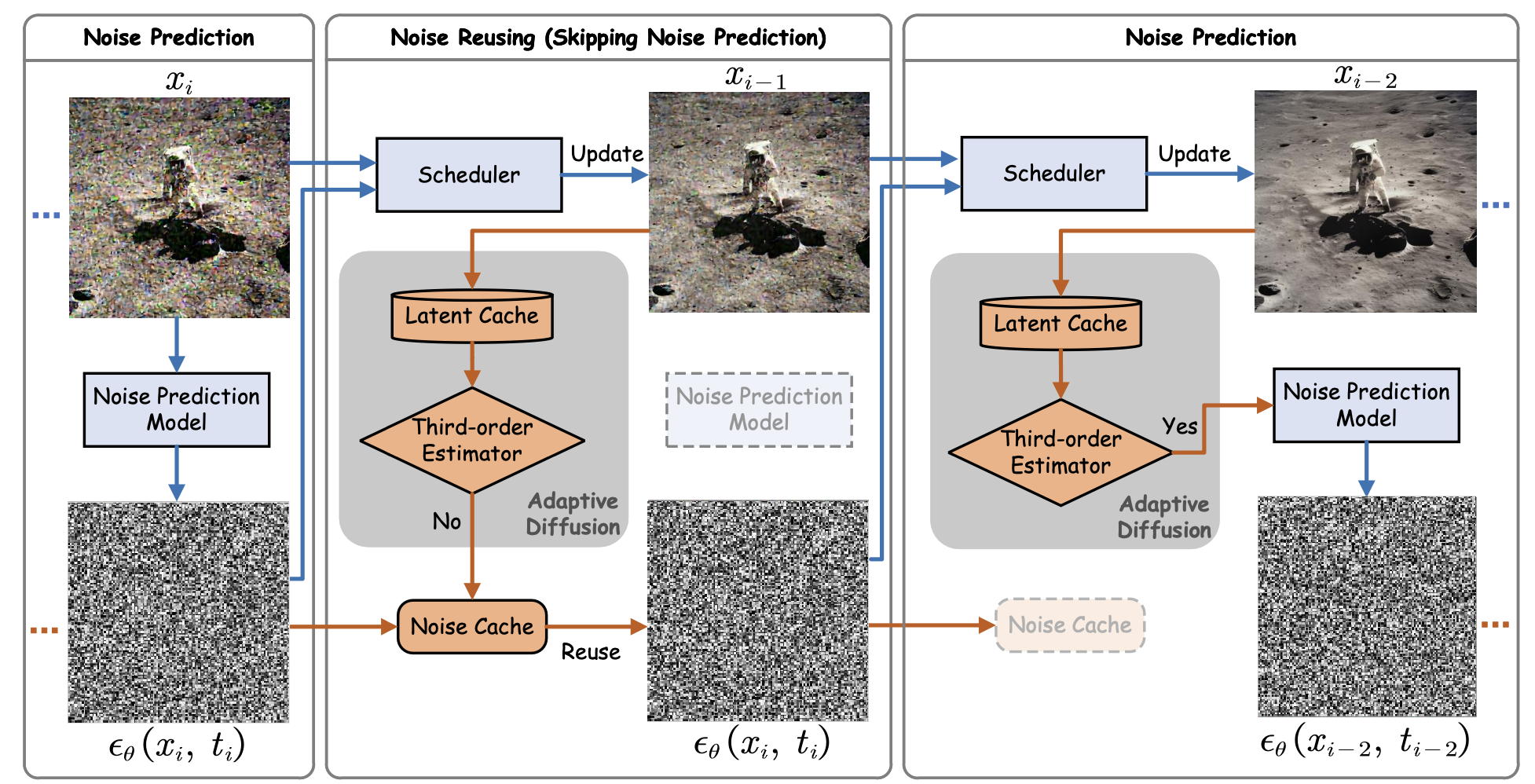
This is the up-to-date official implementation of AdaptiveDiffusion in the paper, Training-free Adaptive Diffusion with Bounded Difference Approximation Strategy. AdaptiveDiffusion is a novel adaptive inference paradigm containing a third-order latent differential estimator to determine whether to reuse the noise prediction from previous timesteps for the denoising of the current timestep. The developed skipping strategy adaptively approximates the optimal skipping strategy for various prompts based on the third-order latent differential value.
AdaptiveDiffusion offers three core components:
- Training-free adaptive diffusion acceleration pipelines from the step number reduction of noise predictions that makes different skipping paths for different prompts.
- Unified skipping strategy for both image and video generation models.
- Interchangeable noise schedulers for different diffusion speeds and output quality.
Installation
Please follow the installation to complete the installation. If the evaluation is required, clean-fid should be installed for images and videos.
pip install git+https://github.com/zhijian-liu/torchprofile datasets torchmetrics dominate clean-fidQuickstart
Thanks to the unified inference pipelines in diffusers, it is easy to deploy the third-order estimator on various diffusion pipelines to achieve adaptive diffusion.
Step One
Select the target pipeline that you attempt to accelerate. For the comparison with original diffusion results, you can copy the pipeline classes to sparse_pipeline.
Step Two
Modify the pipeline you just copied into the sparse_pipeline. There are four places that need modification.
-
Pipeline Initialization
class TargetPipeline( #... existing code... ): def __init__( #... existing code... threshold: float = 0.01, # default_threshold max_skip_steps: int = 4, # default max skipping time steps ) #... existing code... self.prev_latents = [] self.mask = [] self.diff_list = [] self.max_skip_steps = max_skip_steps self.threshold = threshold -
Estimatorfunction design andResetfunction definition in the target class.class TargetPipeline( #... existing code... ): #... existing code... def estimate_skipping(self, latent): prev_latent = self.prev_latents[-1] prev_diff = self.diff_list[-1] prev_prev_diff = self.diff_list[-2] cur_diff = (latent - prev_latent).abs().mean() self.diff_list.append(cur_diff) if len(self.mask) > 4 and not any(self.mask[-self.max_skip_steps:]): return True if abs((cur_diff + prev_prev_diff) / 2 - prev_diff) = 3: self.mask.append(self.estimate_skipping(latents)) self.prev_latents.append(latents) #... existing code... -
Modify the inference code.
import sys
sys.path.append('/path/to/examples/AdaptiveDiffusion')
from acceleration.sparse_pipeline import TargetPipeline as AdaptiveTargetPipeline
import torch
threshold = 0.01
max_skip_steps = 4
pipeline = AdaptiveTargetPipeline.from_pretrained(..., threshold=threshold, max_skip_steps=max_skip_steps)
pipeline.scheduler = ... # in case you want to try more schedulers
pipeline.to("cuda")
pipeline("An image of a squirrel in Picasso style").images[0]
### Evaluation
To evaluate the generation quality of AdaptiveDiffusion, we follow [Distrifuser](https://github.com/mit-han-lab/distrifuser) to evaluate the generation similarity between the original and our adaptive diffusion model. After you generate all the images, you can use our script [`compute_metrics_image.py`](https://github.com/UniModal4Reasoning/AdaptiveDiffusion/blob/master/examples/AdaptiveDiffusion/compute_metrics_image.py) and [`compute_metrics_video.py`](https://github.com/UniModal4Reasoning/AdaptiveDiffusion/blob/master/examples/AdaptiveDiffusion/compute_metrics_video.py) to calculate PSNR, LPIPS and FID. The usage is
```python
python scripts/compute_metrics_image.py --input_root0 $IMAGE_ROOT0 --input_root1 $IMAGE_ROOT1
where $IMAGE_ROOT0 and $IMAGE_ROOT1 are paths to the image folders you are trying to compare.
Evaluation on AIGCBench
For the evaluation on the image-to-video generation task, we randomly select 100 samples from the validation set of AIGCBench. The sample list is provided in Huggingface. After generating all the videos by generate_video.py, you can use our script compute_metrics_video.py to calculate PSNR, LPIPS and FVD. The usage is
python scripts/compute_metrics_video.py --input_root0 $VIDEO_ROOT0 --input_root1 $VIDEO_ROOT1where $VIDEO_ROOT0 and $VIDEO_ROOT1 are paths to the video folders you are trying to compare.
Demo
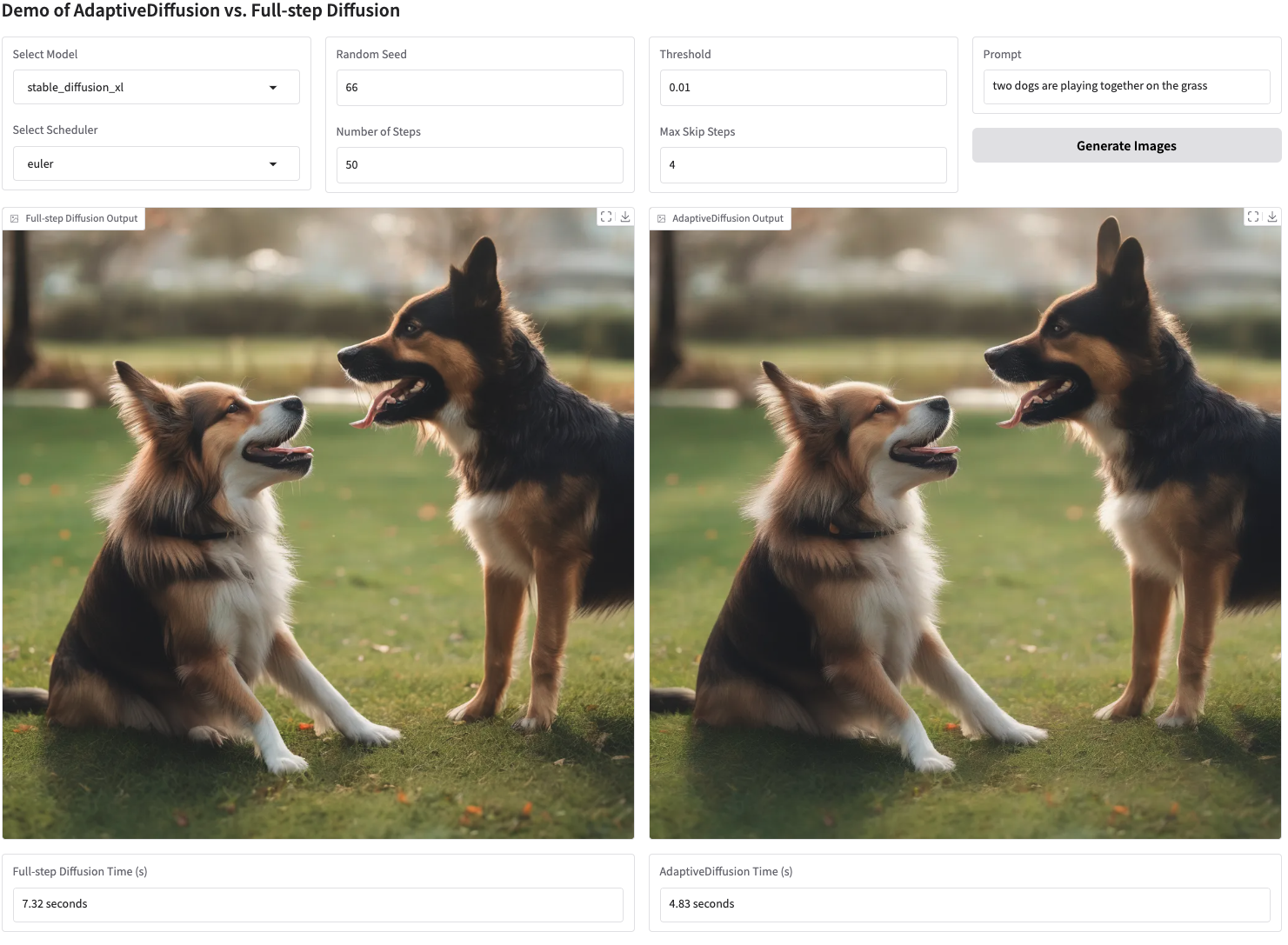
You can also try our demo by
cd examples/AdaptiveDiffusion && python demo.pyThen, open the URL displayed in the terminal (For example, http://127.0.0.1:7860) and you can change the model, seed, threshold, and so on in the WebUI. The additional package required for the demo is gradio, and you can use pip install gradio to install it.
Citation
@misc{adaptivediffusion24ye,
  author = {Hancheng Ye and Jiakang Yuan and Renqiu Xia and Xiangchao Yan and Tao Chen and Junchi Yan and Botian Shi and Bo Zhang},
  title = {Training-Free Adaptive Diffusion with Bounded Difference Approximation Strategy},
  year = {2024},
  booktitle = {The Thirty-Eighth Annual Conference on Neural Information Processing Systems}
}
Acknowledgements
We greatly acknowledge the authors of Distrifuser, Torchsparse, and Diffusers for their open-source codes. Visit the following links to access their more contributions.