 Base44 Superagents-AI agent that does it all
 Mini tools



 So You Want To Be A Writer?
 Ancient AI powered spirits
 Minka
Minka
 Jvb ai
 somacguffin
 Cuty
Cuty
 Superfly Stoner

 OnSpace.AI - No Code App Builder
 Cursor
 Kilo Code
 CodingFleet
 Programming Helper
 Github Copilot
 Devra
Devra
 Codeium
 Autocoder.cc
 Qoder
Qoder
 Phala Cloud
 Warp
Warp
 Qodo (Formerly Codium)
 Verdent
 Who Codes Best?
 Jovu
Jovu
 Google Antigravity
 GoCodeo
 Refraction
 Zzzcode




Json-Render
 DevLensPro
 1UI
1UI
Overview
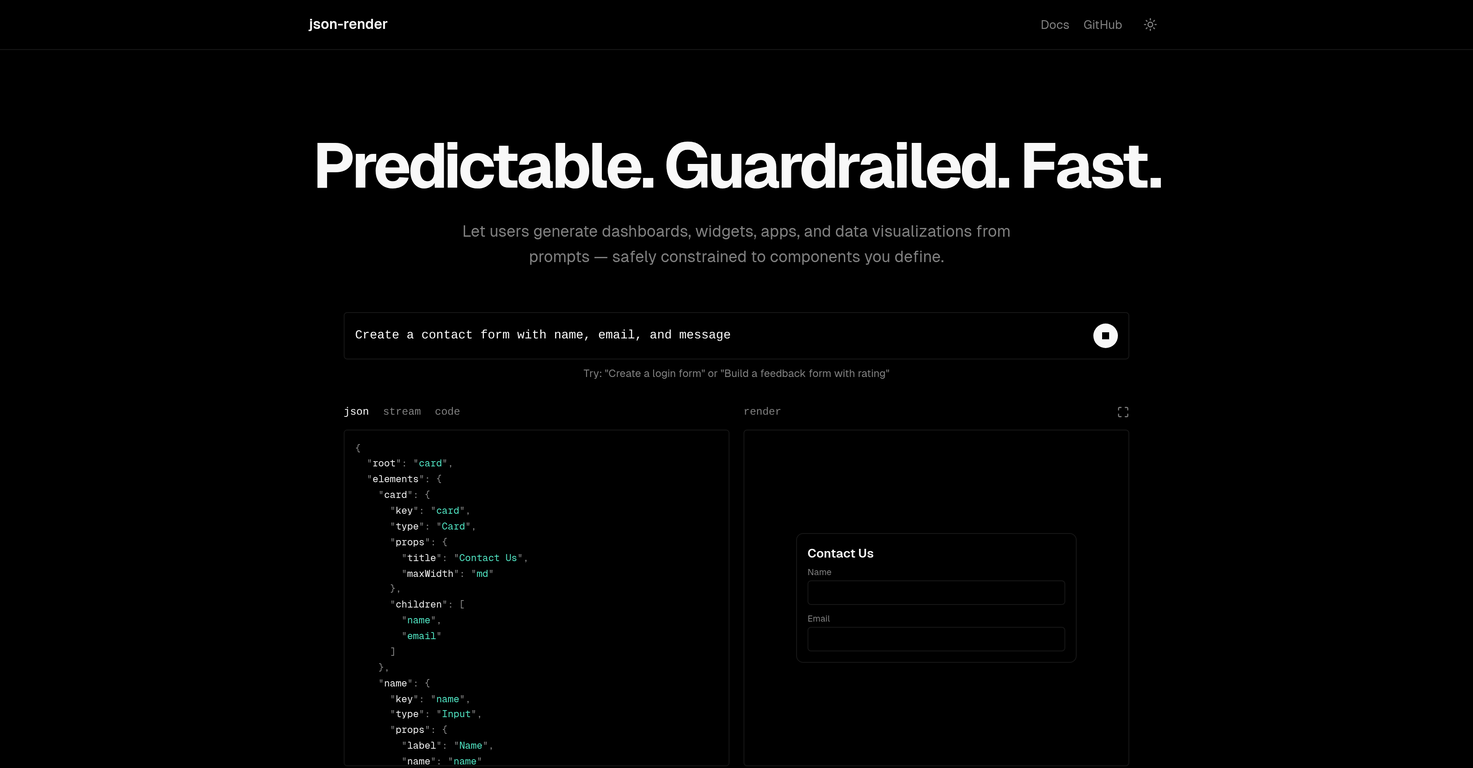
Json-render is an AI-enabled user interface (UI) tool that allows users to generate UI components such as dashboards, widgets, apps, and data visualizations.
It works by receiving user prompts and employing AI to produce JSON code aligned to the constraints set by the developer. This offers developers an ability to define a catalog of components, actions, and data bindings which the AI tool could utilize in generating the UI.
The catalog could include components, such as a card with title and description properties or a metric with label, value path, and format properties. It also supports the definition of specific actions and respective parameters.
The tool provides a 'Guardrails' feature where the AI tool is only permitted to utilize components defined in the catalog, ensuring a predictable and controlled output.
The generated JSON output is rendered natively by your components. It provides features like progressive rendering where components render incrementally as JSON data is received from the stream and two-way data binding with JSON Pointer paths.
Additionally, it offers to handle named actions by your application, to show or hide UI components based on data or authentication status and built-in and custom validation functions to ensure the integrity of the data.
Releases
Top alternatives
-
 AI transforms ideas into detailed software specs.Open




Related topics
 0
0





How would you rate Json-Render?
Help other people by letting them know if this AI was useful.