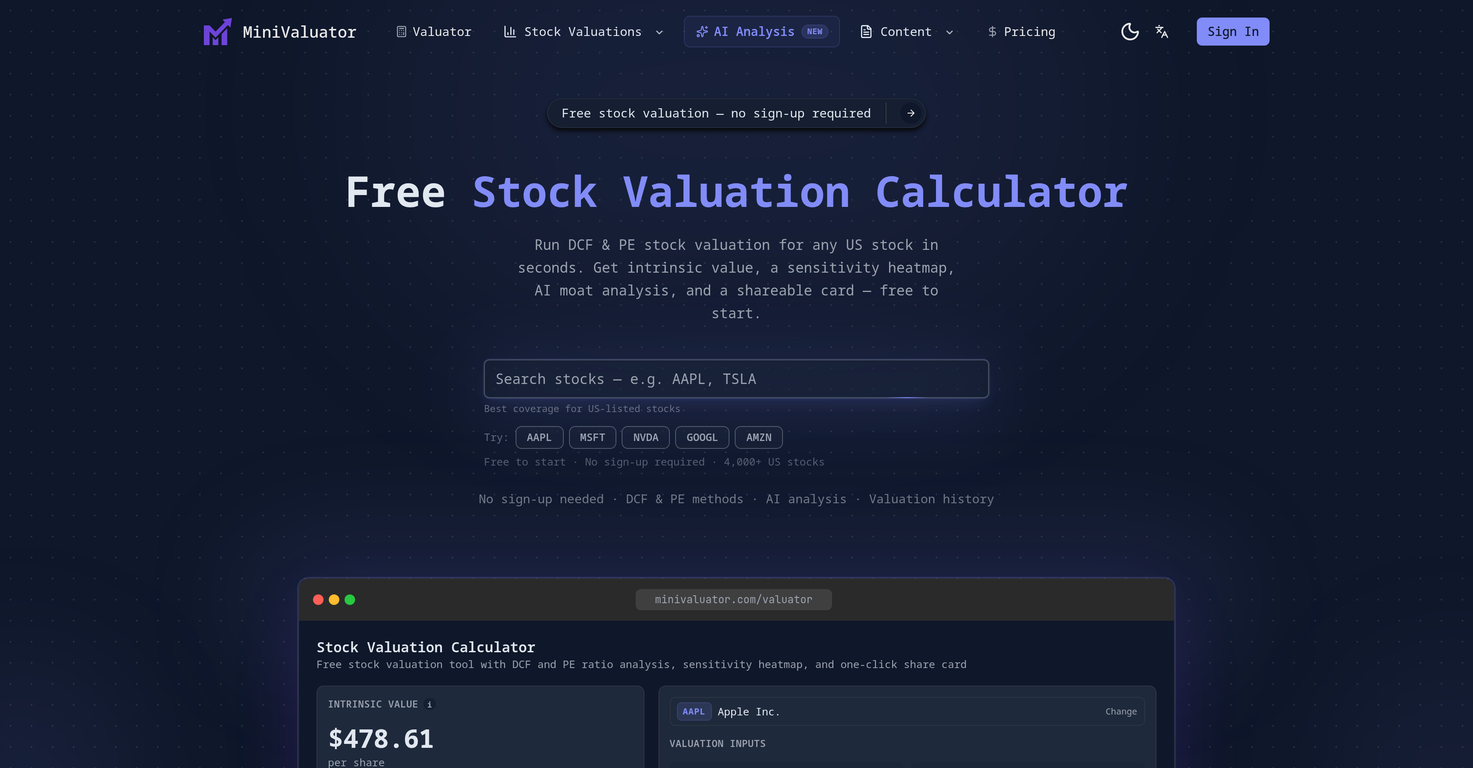
Can I input my own assumptions for stock valuation in MiniValuator?
Yes, MiniValuator allows users to input their own assumptions for stock valuation. While certain fields are auto-filled with market data and analyst estimates, these can be updated according to the user's preferences.
What is the DCF Calculator and PE Calculator features in MiniValuator?
The DCF Calculator and PE Calculator are features in MiniValuator that help users calculate a stock's valuation. The DCF Calculator uses the Discounted Cash Flow method, while the PE Calculator uses the Price to Earnings ratio method. Both tools aid in comparing different stock valuations.
What is the Sensitivity Analysis Heatmap in MiniValuator?
The Sensitivity Analysis Heatmap in MiniValuator is a tool that visualizes how intrinsic value changes across different scenarios of Weighted Average Cost of Capital (WACC) and terminal growth rate.
How does MiniValuator provide AI-generated analysis of a company's competitive moat and key risk factors?
MiniValuator uses AI to generate an analysis of a company's competitive moat and key risk factors. It extracts information from public data and highlights three major moat drivers and three potential risks.
Can I export valuation data from MiniValuator?
Yes, you can export valuation data from MiniValuator. The tool enables users to export their data as polished images that can be easily shared.
Can MiniValuator valuation data be shared on social media?
Yes, MiniValuator valuation data can be shared on social media. The tool allows users to export their valuation data as polished images, optimized for platforms like Twitter and Reddit, as well as for messaging apps.
Is MiniValuator suitable for investment reports?
Yes, MiniValuator's valuation data is suitable for investment reports. The tool enables users to export their valuation data as polished images, ideal for investment reports.
What does MiniValuator mean by 'intrinsic value'?
In the context of MiniValuator, 'intrinsic value' refers to the actual value of a company or a stock, which is calculated using available financial data and using valuation methods like DCF and PE ratio.
What is WACC and terminal growth rate in MiniValuator?
In MiniValuator, WACC stands for Weighted Average Cost of Capital. It, alongside the terminal growth rate, is visualized through the Sensitivity Analysis Heatmap, showing how the intrinsic value of stocks changes with different ranges.
How does MiniValuator use public data in its analysis?
MiniValuator's AI system extracts information from public data to help map three moat drivers and three risks for a company. This public data utilization aids in a comprehensive analysis of the company.
How does MiniValuator's AI system map moat drivers and risks?
MiniValuator's AI system identifies three key moat drivers and risks from publicly available data, providing valuable insights into the company's competitive environment and potential risks.
Can I use MiniValuator for any US-listed stock?
Yes, you can use MiniValuator for any US-listed stock. The tool allows for the valuation of over 4,000 US stocks.
What is a shareable valuation card in MiniValuator?
In MiniValuator, a shareable valuation card refers to a document or image that contains all the results of a stock's valuation. Users can easily export and share these cards.
How is valuation data presented in MiniValuator?
In MiniValuator, valuation data is presented in a clear and straightforward manner, including the intrinsic value calculation, a sensitivity analysis showing how the intrinsic value changes with different assumptions, and an AI-generated analysis of the company's competitive moat and key risk factors.
How does MiniValuator ensure transparency in valuation?
MiniValuator ensures transparency in valuation by enabling users to enter their own assumptions and view the results based on those assumptions. Moreover, the pre-filled inputs can be updated, adhering to the inherent transparency and methodological rigor of valuation approaches.
Can MiniValuator help me understand the potential variability of valuations?
Yes, MiniValuator can help users understand the potential variability of valuations through the Sensitivity Analysis Heatmap which visualizes how intrinsic value changes across varying Weighted Average Cost of Capital (WACC) and terminal growth rate.
What is the primary functionality of MiniValuator?
MiniValuator primarily serves as an online tool to evaluate US-listed stocks. It does this by utilizing Discounted Cash Flow (DCF) and Price to Earnings (PE) ratio methods, offering a minimalist tool for individuals to manage their stock valuations.
How does MiniValuator analyze US-listed stocks?
MiniValuator scrutinizes US-listed stocks by incorporating two metrics: Discounted Cash Flow (DCF) and Price to Earnings (PE) ratio. It pulls market data and analyst estimates to pre-fill data fields, which the user can then modify according to their unique assumptions. Following the valuation, the AI system examines the company's competitive moat and key risk factors using publicly available data.
What is the valuation calculation method used in MiniValuator?
MiniValuator uses the Discounted Cash Flow (DCF) and Price to Earnings (PE) ratio methods to compute the valuation of stocks. These robust analytical methodologies allow the intrinsic value of stocks to be calculated with relative precision.
Can I manually input assumptions in MiniValuator?
Absolutely, MiniValuator gives users the liberty to input their individual assumptions. These assumptions can be variations in growth rate, discount rate, and terminal value. Despite the auto-filling of certain data fields with market data and analyst estimates, the user retains the ability to adjust these inputs.
Can MiniValuator provide a comparative valuation of stocks?
MiniValuator indeed permits comparative valuation of stocks. It features both a DCF Calculator and a PE Calculator, allowing users to compare different stock valuations side by side.
What is the Sensitivity Analysis Heatmap provided by MiniValuator?
The Sensitivity Analysis Heatmap presented by MiniValuator is a visual exhibit of how intrinsic stock value alters across different ranges of Weighted Average Cost of Capital (WACC) and terminal growth rates. This diagram enables users to understand the potential variability of stock valuations under varying economic conditions.
What does AI-generated analysis after the stock valuation in MiniValuator reveal?
Following the main stock valuation, MiniValuator applies an AI-fueled examination that gives insights into a company's competitive moat and key risk factors. This examination maps three moat drivers and three risks using publicly accessible data.
How is competitive moat analysis conducted by MiniValuator?
MiniValuator carries out competitive moat analysis post-evaluation through its artificial intelligence (AI) system. Based on public data, the AI maps out three major drivers of a company's competitive moat, providing insights into elements that could give a company a significant advantage over its competitors.
How does MiniValuator analyze risk factors for a company?
MiniValuator employs its AI system to dissect risk factors for a company. Taking into account public data, it maps out three significant risks, providing useful insights on potential downsides or threats that the company may face.
Can I share the valuation data from MiniValuator on social media?
Certainly, MiniValuator enables users to share their valuation data on social media. Users can export their individual valuation data as polished images that are compatible for sharing on various social media platforms, investment reports, or messaging apps.
Does MiniValuator require sign-up?
No, MiniValuator doesn't necessitate any sign-up. Users can straightaway approach the tools and commence their stock valuations without the need for creating an account.
What is meant by real-time calculation in MiniValuator?
Real-time calculation in MiniValuator means that the tool instantly computes the intrinsic value of a share as soon as a user inputs or changes a variable. There is no need to submit a form or reload the page. The calculation result updates quickly, providing instant insights.
How does MiniValuator assist novice investors?
MiniValuator aids novice investors through its user-friendly and straightforward interface. It requires no sign-up, auto-fills certain data fields, and offers methodological transparency, making it easy for beginners to get started with stock valuation and learn the process.
How does MiniValuator benefit seasoned investors?
MiniValuator provides seasoned investors with an efficient and direct approach to carry out valuations of US-listed stocks using recognized techniques such as DCF and PE ratio methods. The tool's capability to adapt to individualized assumptions and its provision of AI-generated analyses of a company's competitive moat and risk factors delivers sophisticated insights that experienced investors might find valuable.
Can MiniValuator present data visualizations?
Yes, MiniValuator can display data visualizations. An example of this is the Sensitivity Analysis Heatmap, which visually represents how intrinsic value changes across different ranges of Weighted Average Cost of Capital (WACC) and terminal growth rate.
How can I export results from MiniValuator?
One can export results from MiniValuator as high-quality PNG images, ideal for sharing on social media platforms, embedding into investment reports, or dissemination via messaging applications.
How does the autofill feature work in MiniValuator?
In MiniValuator, the autofill feature automatically inputs certain data fields using current market data and analyst estimates. However, users maintain the ability to override these pre-filled inputs if they wish to apply their own assumptions.
What kind of assumptions can I input in MiniValuator?
In MiniValuator, users can input a variety of assumptions including the growth rate, discount rate, and terminal value. These input variations offer users the flexibility to custom-tailor their valuation process based on their individual investment assumptions and strategies.
Can the intrinsic value per share be calculated in real time with MiniValuator?
Definitely, with MiniValuator, users can calculate the intrinsic value per share in real time. This is achieved by entering inputs for variables like growth rate, discount rate and terminal value. The system then immediately calculates and displays the intrinsic value per share.
How does MiniValuator use public data for its analysis?
MiniValuator incorporates publicly available data in its AI-generated analyses. Information such as the company's competitive moat, key risk factors, and other influencing elements are mapped out from public data, providing a comprehensive, automated analysis.