
✅
Tasks26,341🎨
Creativity10,430💻
Software1,947💻
Coding982💻
Backend development3Powabase
Go to 🎨 Creativity
📷
Images
(3336)
🔠
Text
(2151)
💻
Software
(1947)
🎥
Videos
(1036)
🔊
Audio
(794)
🎨
Art
(588)
🎨
Design
(278)
🌪️
Brainstorming
(208)
🖌️
3D
(73)
📸
Multimedia
(19)
So You Want To Be A Writer?
Minka
Ancient AI powered spirits
Jvb ai
somacguffin
Cuty
Superfly Stoner
380
256
249
226
202
192
167
Go to 💻 Coding
🔍
Programming languages
(211)
📊
Query languages
(43)
🐞
Debugging
(43)
💻
Vibe coding
(41)
🔌
APIs
(39)
🔍
Code reviews
(39)
🖥️
Coding lessons
(37)
📚
Code documentation
(32)
🔧
Code optimization
(25)
💻
Code snippets
(23)
🗣
Markup languages
(18)
🖥️
Frontend development
(18)
📚
Code explanations
(18)
🔍
Code analysis
(17)
👩💻
Coding mentorship
(15)
🔍
Regex
(15)
💻
Style languages
(12)
🔄
Git
(12)
🔬
Code testing
(9)
💻
Code formatting
(8)
Cursor
OnSpace.AI - No Code App Builder
Kilo Code
Github Copilot
CodingFleet
Programming Helper
Devra
Codeium
Autocoder.cc
Qoder
Phala Cloud
Warp
Qodo (Formerly Codium)
Who Codes Best?
GoCodeo
Google Antigravity
Jovu
Zzzcode
Traycer
Refraction
99,707
87,146
56,235
45,507
43,909
42,350
37,583
37,215
35,373
30,975
25,548
21,465
20,798
19,306
18,615
18,193
17,554
12,504
12,472
12,194
June 12, 2026
Dashboard
Edit AI
Powabase
Inputs:
Outputs:
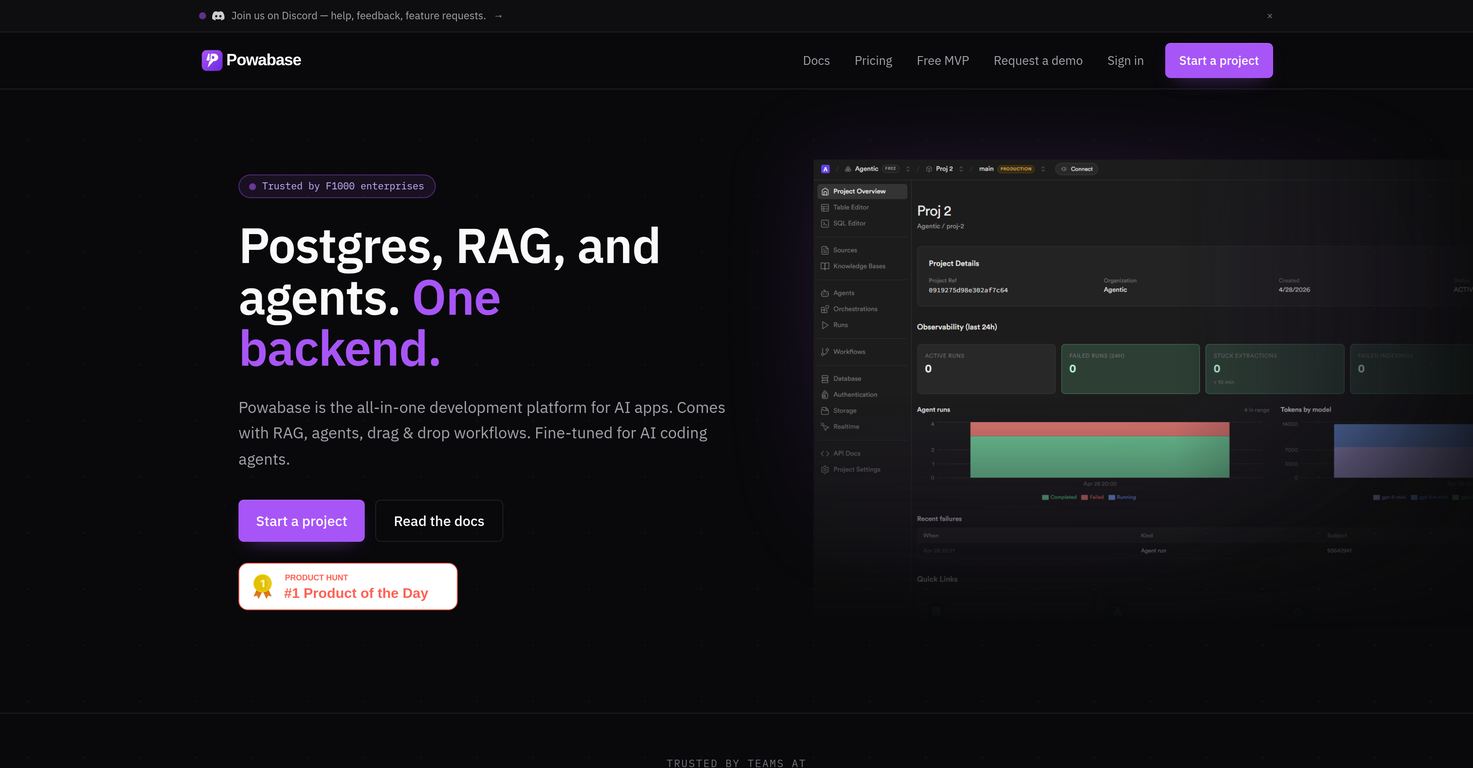
Postgres, RAG, and agents. One backend.

Overview
Overview
Powabase is the all-in-one development platform for AI apps. Comes with RAG, agents, drag & drop workflows. Fine-tuned for AI coding agents.What makes Powabase different
- RAG out of the box: Embeddings, vector search, and retrieval pipelines are first-class citizens — not bolt-ons. Build semantic search and grounded AI features on your own data in minutes.
- Agents, built in: Define, run, and orchestrate AI agents natively on the platform. No glue code, no separate orchestration layer — your data, your logic, and your agents all live in one place.
- Drag & drop workflows: Compose powerful AI pipelines visually. Connect data, models, and actions on a canvas anyone on your team can understand and iterate on.
- Fine-tuned for AI coding agents: Powabase is purpose-built to be driven by AI coding assistants. Clean, predictable APIs, agent skills (npx skills add powabase-ai/agent-skills), and an MCP server mean your agents generate working backends correctly, with minimal token waste and iteration.
Underneath the AI layer sits everything you expect from a serious platform: real open-source Postgres, instant auto-generated APIs, built-in auth and storage, and a polished Studio to manage it all. Open, portable, and self-hostable.
Spin up isolated projects in seconds, wire up RAG and agents through a unified control plane, and deploy with confidence. Powabase collapses the entire AI stack — database, retrieval, agents, and workflows — into one cohesive platform.
Powabase — the fastest way to build, ship, and scale AI apps.
Supported features
Show more
Releases
Get notified when a new version of Powabase is released
Notify me
June 12, 2026
Initial release of Powabase.
Author
Follow
Pricing
Pricing model
Freemium
Paid options from
Free tier available
Billing frequency
Pay-as-you-go
Refund policy
No Refunds
Keeping you safe
Good to know
Save
🔗 Copy link
Use tool
Save
Also used for
Top alternatives
-
Build production backends in minutes from prompts.Share564 keel.so -
Share
Your AI mentor for backend mastery -
Share
AI-powered backend creator for scalable systems -
Share
AI-powered backend code generator for efficient web development. -

Share
Custom MCP servers to connect AI to your systems
Related topics
Reviews
5.0
Average from 2 ratings.
2
0
0
0
0
Prompts & Results
Add your own prompts and outputs to help others understand how to use this AI.
Pros and Cons
Pros
Own Postgres per project
Rich toolkit: storage, auth
Realtime capabilities
Out-of-the-box document extraction
Embedding and indexing features
HTTP or MCP agent calls
Option for self-hosting
Single REST API convenience
Provides an auth service
Offers object storage
Robust backend system
RAG for document retrieval
Supports large language models
Visual and callable workflows
Isolated stack per project
Compliant environment by default
Flexible deployment options
Supports multiple knowledge bases
PDF, image and URL support
Multimodal content indexing
Web search and code execute
Drag and connect workflow blocks
No shared logical databases
Cloud and personal infrastructure options
Works with Claude Code Codex
Customizable deployment options
OCR with 91% accuracy
RAG pipeline with 98.7% accuracy
Realtime access through PostgREST
Supports multiple LLMs
Integrated track multi-turn state
Efficient RAG payloads
Supports Docker or Kubernetes
Built-in SOC 2 / HIPAA compliance
View 29 more pros
Cons
A bit technical for self hosting
Self hosting requires technical expertise
Limited templates for prompts and example apps
Requires database knowledge
Not a "DIY AI chatbot builder"
No direct voice integration
Complex for beginners
Requires coding knowledge
Limited language support
Limited third-party integrations
View 5 more cons
Q&A
What is Powabase?
Hello Powabase
🛠️ 1 tool
wrote:Powabase is an all-in-one backend development platform specifically designed for AI-native applications. Often described as a "Supabase for AI," it combines a Postgres database, Retrieval-Augmented Generation (RAG), and agentic workflows into a single framework, eliminating the need to stitch together fragmented infrastructure.
The platform not only supports complex, AI-based applications but also simplifies the development process via MCP and agent skill integrations with coding agents like Claude Code, Codex, Antigravity, OpenCode, etc.
How does Powabase handle document extraction and indexing?
Hello Powabase
🛠️ 1 tool
wrote:Powabase takes a document from raw upload to fully searchable knowledge with very little work on your part. When you add a document — whether it's a clean PDF, a scanned report, a Markdown file, or a web page — Powabase automatically reads and extracts its contents. For straightforward files it pulls the text directly, and for harder cases like scanned or image-heavy documents it falls back to advanced OCR and vision models, so messy real-world documents still come through cleanly. It even keeps track of the document page by page, which means answers can later point back to exactly where they came from.
Once the text is extracted, Powabase indexes it so it can be searched intelligently. Rather than forcing one rigid approach, it lets you choose the indexing strategy that fits your content — from breaking long documents into well-structured, context-aware passages, to summarizing whole documents, to building a navigable map of a document for more complex, multi-step questions. Behind the scenes it turns your content into embeddings and stores everything directly in your own database, so there's no separate vector service to set up, manage, or pay for.
When it's time to find something, Powabase supports meaning-based search, traditional keyword search, or a hybrid of both, and can refine results further with reranking and smarter query handling to surface the most relevant answers. The result is that the entire journey — extraction, indexing, and retrieval — works out of the box, giving you accurate, source-grounded answers without having to assemble or maintain a complex pipeline yourself.
What is RAG in Powabase?
Hello Powabase
🛠️ 1 tool
wrote:RAG — Retrieval-Augmented Generation — is the technique behind AI that can answer questions using your information rather than just what a model learned during training. Instead of relying on the AI's general knowledge (which can be outdated or simply make things up), a RAG system first retrieves the most relevant pieces of your own content, then hands them to the AI as context so its answers are grounded in real, trusted sources.
In Powabase, RAG is a built-in capability rather than something you have to assemble yourself. You bring your documents — reports, manuals, policies, web pages, knowledge bases — and Powabase handles the entire pipeline behind the scenes: reading and extracting the content, organizing it into a searchable knowledge base, and finding the right passages whenever a question is asked. When your application or AI agent needs an answer, Powabase retrieves the most relevant material and feeds it to the model, so responses stay accurate, current, and tied back to their original sources.
What makes this powerful is that everything works together out of the box. The same platform that stores your data also extracts your documents, indexes them, and powers retrieval — with flexible options for how content is organized and searched, and refinements like hybrid search and reranking to surface the best results. Your AI agents can simply tap into a knowledge base and instantly gain grounded, trustworthy knowledge.
How can developers create AI-native apps with Powabase?
Hello Powabase
🛠️ 1 tool
wrote:Powabase is designed so that developers can build intelligent applications without stitching together a dozen separate services. Everything an AI app needs — a database, authentication, file storage, knowledge, agents, and workflows — lives in one platform, accessible through a single, consistent API. You spin up a project, connect to it, and start building immediately.
A typical journey begins with your data. Developers get a real, production-grade database with built-in authentication, storage, and instant APIs — the same dependable foundation you'd expect from a modern backend. From there, you layer on intelligence. You can create knowledge bases by uploading documents and letting Powabase handle extraction, indexing, and retrieval, giving your app grounded, source-backed answers through RAG without building that pipeline yourself.
On top of that, Powabase lets you create AI agents that can reason, make decisions, and take action using tools — including your own custom tools and external integrations. When a single agent isn't enough, you can orchestrate several together in coordinated patterns, or design visual, drag-and-drop workflows that connect data, models, and actions into automated processes triggered by events, schedules, or webhooks. Results stream back in real time, so experiences feel responsive and alive.
Crucially, Powabase is fine-tuned for AI coding agents, with clean, predictable APIs that AI assistants can drive efficiently. That means developers can build much of their backend simply by describing what they want, with fewer errors and far less wasted effort.
The result is a remarkably short path from idea to production: developers focus on the unique logic and experience of their app, while Powabase provides the database, knowledge, agents, and workflows — the entire AI-native foundation — ready to use out of the box.
What backend services does Powabase offer?
Hello Powabase
🛠️ 1 tool
wrote:Powabase brings together two layers of backend services in a single platform: the dependable foundation you'd expect from any modern backend, plus an AI layer with sensible out-of-the-box abstractions.
At the foundation is a real, production-grade Postgres database — open, powerful, and fully yours. On top of it, Powabase automatically generates secure APIs for your data, so the moment you define your tables, your backend is live. It also includes built-in authentication for managing users and sign-ins, file storage for documents and media, and realtime capabilities so your app can react instantly to changes as they happen. Fine-grained access controls (with Row-Level Security) keep everything secure, ensuring users only ever see the data they're allowed to.
Where Powabase truly stands apart is the AI layer built right alongside these services. It offers knowledge bases that handle document extraction, indexing, and retrieval to power grounded, source-backed answers. It provides AI agents that can reason and take action using built-in, custom, or external tools, along with the ability to orchestrate multiple agents together for more complex tasks. And it includes workflows — visual, automated pipelines that connect your data, models, and actions, triggered by events, schedules, or webhooks.
All of these services share the same project, the same data, and the same consistent API surface, with streaming support so experiences feel responsive in real time. The result is a complete backend — database, auth, storage, realtime, knowledge, agents, and workflows — unified in one place, so developers can build and run AI-native apps without assembling a stack of separate tools.
How does Powabase enhance document retrieval?
Hello Powabase
🛠️ 1 tool
wrote:Powabase treats retrieval as a configurable, multi-stage pipeline rather than a single similarity lookup — and almost all of the tuning lives in a knowledge base's retrieval config, so you can change behavior at query time without re-indexing.
At the foundation, embeddings are stored in Postgres with a pgvector HNSW index for fast semantic search, paired with a BM25 keyword index for exact matches like IDs and error codes. The recommended default, hybrid search, runs both and fuses the rankings, with a weight you can tilt toward meaning or keywords.
On top of that, several query-time refinements raise answer quality. Reranking pulls a wider pool of candidates and re-scores them with a cross-encoder for sharper precision. Query enrichment uses an LLM to rewrite the query — expanding synonyms and folding in recent conversation turns so follow-ups like "what about pricing?" resolve correctly. And metadata enrichment tags content with structured fields you can filter on at search time.
Powabase also handles documents that text-only systems struggle with: multimodal retrieval can return the original rendered page image instead of plain text, preserving tables, charts, and handwriting. Finally, retrieval adapts to the shape of your content through indexing strategies — from simple chunking to hierarchical tree search for long PDFs and graph expansion for cross-referenced corpora.
The payoff is that developers start with sensible defaults and incrementally layer on reranking, enrichment, metadata filtering, or multimodal retrieval — each a small config change, none requiring a re-index — to tune precision for their own documents and queries.
+ Show 25 more
What type of content can Powabase process?
Hello Powabase
🛠️ 1 tool
wrote:Powabase can ingest a wide range of document types and turn them into searchable, AI-ready knowledge. On the document side it handles PDFs, Word documents, PowerPoint slides, and Excel spreadsheets, along with plain text, Markdown, and CSV files. It also processes images — PNG, JPEG, WebP, GIF, and TIFF — using OCR to pull out their text, and it can crawl and import web content directly from URLs.
It's especially capable with difficult real-world documents. Scanned PDFs and image-heavy files are run through OCR, and when standard extraction produces poor results, Powabase can fall back to stronger OCR models to recover the content. For complex layouts — tables, charts, forms, stamps, even handwriting — it can preserve the original page images so an AI model can reason over them visually rather than relying on text alone.
Beyond ingesting documents, Powabase works with your structured data too, since every project is backed by a full Postgres database with storage and instant APIs. The result is that whether your information lives in uploaded files, scanned images, web pages, or database tables, Powabase can process it and make it available to your AI applications.
How can developers define orchestrations with Multiple Large Language Models in Powabase?
Hello Powabase
🛠️ 1 tool
wrote:Powabase keeps the agents separate from the layer that coordinates them, which makes mixing different LLMs straightforward. Each agent is configured on its own and can run any model you like — Claude, GPT, Gemini, and others — so a single orchestration might pair a Claude agent for analysis with a GPT agent for synthesis and another model for routing.
Building one is simple: create the agents you want, group them into an orchestration, and choose how they should work together. Powabase offers three coordination styles — a supervisor that intelligently routes work to the right agent and combines the results, a sequential pipeline where each agent builds on the previous one's output, and a parallel mode where agents tackle the same task independently and their answers are merged.
Because the model is just a per-agent setting and the orchestration is a thin layer on top, combining multiple LLMs comes down to configuration: pick the best model for each role, choose a strategy, and Powabase handles the delegation, sequencing, or merging between them.
What are the benefits of the visual workflows in Powabase?
Hello Powabase
🛠️ 1 tool
wrote:Powabase's visual workflows let you compose how your AI and data operations run as a connected graph of blocks rather than as hand-written orchestration code. That shift brings a few concrete advantages.
The biggest is that complex logic becomes something you can see and reason about. A workflow is a graph of blocks wired together, where each step passes its output to the next, so the flow of data and decisions is laid out visually instead of buried in code. You can branch on conditions, fan out into parallel paths, loop in external APIs, and run custom code — all as blocks on the same canvas — which makes even intricate pipelines easy to understand and to hand off to others.
It's also a natural composition layer for everything else in the platform. Existing agents, multi-agent orchestrations, knowledge base searches, and database or storage operations all drop in as blocks, so workflows become the glue that ties your AI capabilities together into a repeatable process — no reimplementation required.
Workflows are flexible in how they're triggered, too. The same graph can be run on demand via the API, fired by an incoming webhook, or put on a schedule (interval or cron), so one design covers everything from user-facing actions to background automation and recurring jobs.
They're built for production operation. Workflows can be deployed for unlimited live use or "armed" for controlled one-shot testing, and every run records per-block logs, so when something goes wrong you can see exactly which step failed and why — turning debugging into inspection rather than guesswork.
Finally, there's a lower barrier to building them. A natural-language Copilot can generate and edit a workflow's blocks and edges straight from a chat description, so you can describe what you want and refine the graph visually — meaning you don't have to assemble the whole thing by hand to get started.
In short, visual workflows give you clarity, reusability, flexible triggering, production-grade observability, and a faster path from idea to working automation — all while reusing the agents, knowledge, and data already in your project.
What is the purpose of the isolated stack in every Powabase project?
Hello Powabase
🛠️ 1 tool
wrote:Every Powabase project gets its own complete, self-contained stack — its own Postgres database (with pgvector), API gateway, authentication, storage, realtime service, and AI worker — reachable at its own dedicated URL and secured by its own set of keys. This isolation exists to serve a few key purposes.
The first is tenant separation and security. Because each project runs on its own database and gateway behind its own credentials, one project's data, users, and AI resources are walled off from every other project's. A leaked or rotated key affects only that single project, and there's no shared database where one tenant could accidentally reach another's data.
The second is a complete, independent backend per project. Rather than a project being a thin slice of shared infrastructure, it gets the full set of services — database, auth, storage, realtime, RAG, agents, and workflows — all wired together and operating as one cohesive unit. Everything a given application needs lives in one place, under one URL.
The third is predictable, self-owned infrastructure. Each project's database is directly accessible over the standard Postgres protocol for migrations, ORMs, and BI tools, and its resources scale and operate on their own. You can connect to it, manage it, and even self-host the model behind it without being entangled with other workloads.
In short, the isolated stack is what lets Powabase be genuinely multi-tenant while still giving each project the feel and guarantees of a dedicated, private backend — secure by separation, complete in capability, and fully yours to own and operate.
What deployment options does Powabase provide?
Hello Powabase
🛠️ 1 tool
wrote:Powabase supports two deployment models, and the difference comes down to who runs the infrastructure.
The first is managed cloud. This is the hosted Powabase service: you create projects through the Studio, and each one is automatically provisioned as its own isolated stack — Postgres, the API gateway, auth, storage, realtime, and the AI worker — reachable at its own dedicated project URL. The platform handles routing, scaling, and the operational plumbing for you, so you can go from creating a project to making authenticated API calls in minutes without managing any servers.
The second is self-hosting. Because Powabase is built on an open foundation, you can run the platform on your own infrastructure rather than the managed cloud — useful when you need full control over where data lives, want to meet specific compliance or residency requirements, or prefer to own the stack end to end. Self-hosted deployments do take on a bit more responsibility for the surrounding infrastructure (for example, ensuring the gateway correctly preserves the project host, which the managed cloud handles automatically).
In both models the application surface is identical — the same REST API, the same per-project isolation, the same AI capabilities — so what you build doesn't change based on where it runs. You can also bring your own model and provider keys in either case, pointing Powabase at OpenAI, Anthropic, Google, or even self-hosted models, which gives you flexibility over the AI layer independent of where the platform itself is deployed.
Does Powabase support self-hosting?
Yes, Powabase does support self-hosting. The platform allows for easy transfer between Powabase's services and independent hosting, giving freedom to the developers to maintain and manage their own infrastructure.
What kind of storage does Powabase offer?
Powabase provides object storage as part of its platform offering. This storage is exclusive to each project, ensuring data isolation and minimizing cross-interference risks. The storage can be accessed directly or via the REST/GraphQL-style API provided by Powabase.
Does Powabase have an auth service?
Hello Powabase
🛠️ 1 tool
wrote:Authentication is provided by a GoTrue-based service exposed under each project's /auth/v1/* endpoints, so you don't have to bolt on a separate identity provider. It handles the standard user lifecycle out of the box: email/password signup and sign-in, OAuth social logins, magic links, and administrative user-management flows.
When a user signs in, the service issues a signed JWT access token that identifies them and carries the authenticated role. These tokens are short-lived (about an hour) and are refreshed using single-use refresh tokens, which is handled as part of the normal sign-in flow.
What makes the auth service especially useful is how tightly it integrates with the rest of the project. The same token a user receives at sign-in flows through to the database layer, where it's used to enforce Row Level Security — meaning your access rules live in the database and automatically apply to every request that user makes through the data APIs. Powabase distinguishes between a public anon key (safe for browsers and respecting those security rules), a signed-in user access token (per-user, also respecting the rules), and a server-side service role key (which bypasses them for trusted backend work) — giving you clear, layered control over who can access what.
So in short: yes, Powabase ships a complete auth service — user management, multiple sign-in methods, token issuance, and database-level access enforcement — as a standard service in every project, sitting alongside the database, storage, realtime, and AI capabilities.
What are Powabase agents and how do they work?
Hello Powabase
🛠️ 1 tool
wrote:A Powabase agent is a configured AI assistant that can not only respond but act. At its core, an agent bundles together a language model, a system prompt, tuning settings, a set of tools, optional knowledge bases, and session memory — all packaged as a reusable resource in your project that you can run over the API.
How they think and act. Agents run on a ReAct loop — reason, act, observe — rather than producing a single one-shot reply. The model reasons about the request, decides whether to call a tool, observes the result, and iterates until it has a final answer. This is what lets an agent look something up, query a database, call an API, and then compose a grounded response, all within a single run. Runs are streamed back token by token (and step by step) over a live connection, so you can show progress in real time.
The model is your choice. Each agent specifies its own model, expressed as a standard LiteLLM identifier, so you can point it at OpenAI, Anthropic, Google, OpenRouter, or even self-hosted models — and different agents in the same project can use different models. You can also enable extended reasoning on capable models and tune behavior like temperature through the agent's settings.
Tools are how they reach the world. Agents act through three kinds of tools. There are built-in tools for common needs — running database queries and writes, making HTTP requests, executing code, reading and writing storage, and searching or scraping the web. There are custom tools, where you expose your own HTTP endpoint with a defined input schema so the agent can call your business logic. And there's MCP, letting an agent connect to external tool servers. Linking a knowledge base to an agent automatically gives it a retrieval tool, so it can pull grounded answers from your documents.
Memory and continuity: Agents keep conversational state through sessions. Continue a session and the agent remembers the prior turns; start fresh and it doesn't — so you can support multi-turn chat or stateless one-offs from the same agent.
Guardrails and human-in-the-loop: The loop has built-in safety limits: a cap on how many steps it can take, detection that fails a run if it gets stuck calling the same tool the same way repeatedly, and tool timeouts. Agents also support an approval flow — a tool call can pause and wait for a human to approve or deny it before proceeding, which is how you keep a person in control of sensitive actions.
Two ways to run: A streaming run executes the full tool-using loop, while a simpler synchronous run does a single model call with no tools — so it's important to use the streaming path whenever an agent actually needs its tools or knowledge bases.
In short, a Powabase agent is a model plus the context, tools, and memory it needs to autonomously work toward an answer — reasoning in a loop, reaching into your data and external services through tools, remembering conversations across sessions, and pausing for human approval when it matters. And because agents are first-class resources, they compose: an agent can join a multi-agent orchestration or become a block inside a workflow.
How does Powabase support multiple Large Language Models (LLMs)?
Hello Powabase
🛠️ 1 tool
wrote:Powabase is model-agnostic by design — it doesn't tie you to a single provider, and it lets different parts of your project run on different models.
The foundation is a universal model layer (built on LiteLLM) that speaks to many providers through one consistent interface. Whenever you configure something that uses a model, you specify it as a standard model identifier: bare names for OpenAI and Anthropic (like gpt-4o or claude-sonnet-4-6), or prefixed names for others such as Google Gemini, OpenRouter, and even self-hosted models. The same identifier is passed straight through, so the full range of supported providers is available rather than a fixed picklist.
This choice applies per resource, not globally. Each agent has its own model, so within a single project — or even a single multi-agent orchestration — you can pair, say, a Claude agent for analysis with a GPT agent for synthesis and another model for routing. The RAG layer is multi-provider too: embedding models and rerankers can come from OpenAI, Cohere, Voyage, Google, Mistral, and others. And the workflow Copilot lets you pick which model generates your workflows. In every case it's a configuration setting, so swapping models is trivial and doesn't require rebuilding anything.
In what formats can content be uploaded for processing on Powabase?
Hello Powabase
🛠️ 1 tool
wrote:Supported formats:
PDFs — including scanned and image-heavy ones, which are run through OCR
Microsoft Office files — Word (.docx/.doc), PowerPoint (.pptx), and Excel (.xlsx)
Images — .png, .jpg/.jpeg, .webp, .gif, and .tiff, with text extracted via OCR
Plain text and structured text — .txt, Markdown (.md), and .csv
Web content — pages crawled directly from URLs
How can Powabase be used to develop AI-native apps?
Hello Powabase
🛠️ 1 tool
wrote:The core idea behind Powabase is that you shouldn't have to build a backend from first principles to ship a serious AI app — and you especially shouldn't have to hand-write one. Powabase gives every project a complete, isolated stack (Postgres with pgvector, an API gateway, auth, storage, realtime, and an AI worker) behind a single REST API, and that API is deliberately designed to be driven by AI coding agents. So whether you're a "vibe coder" describing what you want in plain language or an experienced developer working alongside a coding assistant, you build by composing production-grade primitives, not by reinventing them.
Let a coding agent assemble the backend for you. Instead of writing extraction pipelines, vector search, auth flows, and orchestration logic yourself, you tell a coding agent what your app should do and it wires up Powabase's existing building blocks: creating tables, uploading and indexing documents, configuring agents, and connecting workflows through clean, predictable API calls. Because the surface is consistent and well-documented — Powabase even ships a skill that teaches coding agents its exact conventions and footguns — the agent generates working integrations with far less trial-and-error, fewer wasted tokens, and fewer of the subtle bugs that come from gluing together half a dozen services by hand.
The robustness comes from the primitives, not your code. This is what makes the "vibe coding" approach safe rather than fragile. The hard, easy-to-get-wrong parts are already solved and battle-tested inside the platform:
Your app data lives in your own Postgres tables, accessed instantly over a REST layer — a coding agent can define a schema and CRUD it without you standing up a database or an ORM. (It just needs to turn on row-level security for user-facing tables, which the agent can handle as step one.)
Knowledge / RAG is a managed pipeline: upload documents, and extraction, indexing, and retrieval (vector, keyword, or hybrid, with reranking and multimodal options) are configuration, not code your agent has to author.
Agents pair a model of your choice with tools, knowledge bases, and memory in a reason-act-observe loop — so your coding assistant configures intelligence rather than implementing an agent framework.
Orchestrations and workflows let multiple agents or a graph of steps run together, again as composable resources the coding agent stitches into your app.
The build experience: A typical flow is short and largely describable in natural language: have your coding agent stand up tables for your app data, upload and index your documents into a knowledge base, create an agent and link that knowledge base to it, then stream a multi-turn conversation from your backend. As the app grows, the same agent layers on orchestrations or workflows. At each step it's assembling robust, hosted components — not generating thousands of lines of backend it (or you) would later have to debug and maintain.
Why this produces robust apps: Because the heavy lifting is owned by the platform, the code your coding agent does write stays thin and focused on your app's unique logic — which means fewer places to go wrong. You get production behavior (isolated per-project infrastructure, real authentication and access control, managed retrieval and agent execution) by configuring it, and you keep full control over models by bringing your own provider keys. A couple of platform conventions naturally steer agents toward safe patterns too — like running agent tools from a trusted backend and injecting per-user data deliberately rather than exposing privileged endpoints to clients.
Does Powabase allow on-premises deployment?
Yes, Powabase allows on-premises deployment. It enables users to run the entire stack on their own infrastructure, thereby giving them control over their systems while still availing themselves of all the platform's robust features.
What is Powabase specifically designed for?
Hello Powabase
🛠️ 1 tool
wrote:Powabase is purpose-built to be the backend for AI-native applications — and, just as deliberately, to be built by AI coding agents rather than assembled by hand.
It's designed to collapse the entire AI app stack into one platform. Every project gets a complete, isolated backend — Postgres with vector search, an API gateway, authentication, storage, and realtime — and on top of that the things AI apps specifically need: managed RAG (document extraction, indexing, and retrieval), agents that reason and use tools, multi-agent orchestrations, and visual workflows. The goal is that you get grounded, intelligent, production-grade capabilities by configuring them, instead of stitching together a database, a vector store, an auth provider, and an agent framework yourself.
It's also designed for a specific way of building. The API is clean, consistent, and fine-tuned for AI coding agents to drive, so developers and "vibe coders" alike can describe what they want and have a coding assistant wire up a robust app over Powabase's primitives — efficiently, with fewer tokens and fewer of the bugs that come from hand-rolling backend plumbing.
And it's designed to stay open and yours: each project is an isolated, self-ownable stack, you bring your own model provider keys to mix and choose LLMs freely, and you keep your data in real, portable Postgres with no lock-in.
In short, Powabase is specifically designed to be the token-efficient, open, AI-native backend for building and running AI apps — optimized for the era of AI-assisted development.
What are the unique tools each Powabase project comes with?
Hello Powabase
🛠️ 1 tool
wrote:The backend toolkit every project comes with
Every project automatically includes its own self-contained set of services:
Postgres with pgvector — a real, production database that also stores and searches embeddings for AI features, no separate vector database needed.
Instant REST APIs (PostgREST) — define a table and get a secure CRUD API over it immediately.
GoTrue authentication — user signup, sign-in, OAuth, magic links, and token issuance out of the box.
Storage — file upload and download for documents and media.
Realtime — live updates so your app can react to data changes as they happen.
Direct Postgres access — a connection string for migrations, ORMs, and BI tools, so you fully own and can operate your database.
The AI toolkit every project comes with
On top of that backend, each project also ships the higher-level AI building blocks:
Knowledge Bases (RAG) — document extraction, indexing, and retrieval with reranking and multimodal options.
Agents — model-plus-tools assistants that reason and act in a loop.
Orchestrations — coordinate multiple agents together.
Workflows + Copilot — a visual graph of steps, plus natural-language generation of those graphs.
The built-in agent tools
And when you build an agent, Powabase gives it a ready-made set of eight built-in tools so it can actually do things without you writing them:
database_query — run read-only SQL against your project data
database_write — insert, update, or delete records
http_request — call external HTTP endpoints
code_execute — run Python or JavaScript in a sandbox
storage_read / storage_write — read from and write to project storage
web_search — search the web for current information
web_scrape — fetch and convert web pages into clean, usable text
Beyond these, agents can also use custom tools (your own HTTP endpoints) and connect to external MCP tool servers — so the built-in eight are a starting point, not a ceiling.
Every Powabase project arrives fully equipped — a complete backend, a full AI layer, and a built-in tool set for agents — so you assemble apps from ready-made, production-grade capabilities instead of building them from scratch.
What functionalities come with Powabase out of the box?
Hello Powabase
🛠️ 1 tool
wrote:Powabase gives you a remarkable amount working from day one — the idea is that the hard infrastructure is already built, so you assemble apps rather than create them from scratch. Here's what comes out of the box.
A complete backend. Every project ships with its own isolated stack: a real Postgres database (with built-in vector search), instant REST APIs over your tables, user authentication, file storage, realtime updates, and direct database access for migrations and tooling. That alone is enough to run a production app, with row-level access control to keep data secure.
Document intelligence (RAG). You can upload documents — PDFs, Office files, images, text, even web pages — and Powabase handles extraction, indexing, and retrieval automatically. Semantic, keyword, and hybrid search come standard, along with reranking, query enrichment, and the ability to retrieve original page images for complex layouts. You get grounded, source-backed answers without building a retrieval pipeline.
AI agents. Out of the box you can create agents that reason and act in a loop, each running the model of your choice. They come with a built-in tool set — querying and writing to your database, calling APIs, running code, reading and writing storage, and searching or scraping the web — and can also use your own custom tools or external tool servers. Sessions give them memory, and human-in-the-loop approval keeps sensitive actions under control.
Multi-agent orchestration. When one agent isn't enough, you can coordinate several together — routing work through a supervisor, chaining them in sequence, or running them in parallel — mixing different LLMs across roles.
Visual workflows. A drag-and-drop graph lets you connect agents, knowledge searches, code, conditionals, and API calls into automated processes, triggered on demand, by webhook, or on a schedule — and a natural-language Copilot can generate those workflows for you.
Model flexibility. You bring your own provider keys, so you can choose and freely mix LLMs — OpenAI, Anthropic, Google, and more — across agents, embeddings, and workflows.
Built for AI-assisted development. The whole platform is exposed through one clean, consistent API that's fine-tuned for AI coding agents to drive, so you can build robust apps by directing a coding assistant over ready-made primitives.
Mention some ways the Powabase agents can be used?
Hello Powabase
🛠️ 1 tool
wrote:Powabase agents combine a reasoning model with tools, knowledge, and memory, which makes them flexible enough to power a wide range of applications. Here are some practical ways they can be used.
Document Q&A and knowledge assistants. Link an agent to a knowledge base and it can answer questions over your own documents — policies, manuals, contracts, research, internal wikis — with grounded, source-cited responses. This is the foundation for help-desk bots, internal "ask the docs" assistants, and research copilots.
Customer support. An agent can resolve customer questions by pulling from your product documentation, looking up the customer's records in the database, and taking actions like updating a ticket — escalating to a human when needed through the built-in approval flow.
Data analysis and reporting. Because agents can run read-only SQL against your project data, they can answer natural-language questions about your business ("how many orders shipped last week?"), generate summaries, and turn raw tables into plain-English insights — even running code to compute or chart results.
Operational automation. With database-write, HTTP, and storage tools, an agent can do real work: create or update records, call your internal and third-party APIs, file documents into storage, and carry out multi-step tasks rather than just chatting.
Research and web-aware assistants. Using web search and scraping, an agent can gather current information from the internet, summarize sources, monitor topics, and combine that with your own data for up-to-date answers.
Document processing. Agents can extract structured information from uploaded files — pulling fields from invoices, forms, or résumés — and write the results back into your database, automating tedious manual data entry.
Coding and developer tooling. With sandboxed code execution, an agent can run, test, and transform code or data as part of a task, making it useful for developer-facing assistants and automation.
Personalized, multi-turn experiences. Session memory lets agents hold ongoing conversations that remember context — powering chatbots, onboarding guides, tutors, and shopping assistants that feel continuous rather than one-shot.
Integration with your own systems. Through custom tools (your own API endpoints) and connections to external tool servers, an agent can act across whatever services you already run — CRMs, internal apps, SaaS platforms — becoming a natural-language front end to your stack.
Building blocks for bigger systems. Finally, agents rarely have to work alone: several can be combined into multi-agent orchestrations for complex, multi-domain tasks, or dropped into visual workflows as steps in an automated pipeline — so a single agent use case can scale into a full automated process.
How does Powabase support the creation of AI-native apps?
Hello Powabase
🛠️ 1 tool
wrote:Powabase supports AI-native app creation by giving you the entire stack such apps need as ready-made, composable primitives — so you assemble intelligent software instead of building its foundations from scratch.
It starts by removing the backend burden. Every project comes with a complete, isolated stack — Postgres with vector search, instant APIs, authentication, storage, and realtime — so the database, user management, and data plumbing an AI app depends on are simply there, secured and ready.
On top of that, it provides the specifically AI capabilities as first-class features: managed RAG for grounding apps in your own documents, agents that reason and act through tools and memory, multi-agent orchestrations for complex tasks, and visual workflows for automation. Because these are built-in and configurable, you get production-grade intelligence by setting it up rather than implementing it.
What makes it especially powerful for building is composability and openness. The pieces snap together — a knowledge base attaches to an agent, an agent becomes a step in a workflow, a workflow calls a knowledge search — all in one project behind one consistent API. You bring your own model provider keys, so you can choose and mix LLMs freely, and your data stays in portable Postgres with no lock-in.
Finally, the whole platform is designed to be driven by AI coding agents. The clean, predictable API lets developers and vibe coders alike describe what they want and have a coding assistant wire up a robust app over Powabase's primitives — efficiently and with fewer of the bugs that come from hand-rolling backend code.
What is the role of Powabase's backend system for my apps?
Hello Powabase
🛠️ 1 tool
wrote:Powabase's backend is the foundation your apps run on — it handles everything that happens behind the scenes so your app can focus on what users actually see and do.
In practical terms, it plays a few key roles for your apps:
It stores and serves your data. Each app gets a real Postgres database with instant APIs, so your application has a reliable place to keep its information — users, content, app state — and a secure way to read and write it without you building a data layer yourself.
It manages users and access. Built-in authentication handles signup, sign-in, and sessions, and database-level access rules ensure each user can only reach the data they're allowed to. Your app gets identity and security as a service rather than something you have to engineer.
It handles files and live updates. Storage gives your app a home for documents and media, and realtime delivers changes instantly, so features like live dashboards, chat, or collaborative views work without custom infrastructure.
It powers the intelligence. This is where Powabase goes beyond a traditional backend. It runs your RAG knowledge bases, executes your agents and their tools, coordinates multi-agent orchestrations, and runs your workflows. So the "AI brain" of your app — retrieving knowledge, reasoning, and taking action — lives in the same backend as your data, fully connected.
It runs as your app's isolated, owned infrastructure. Each project is its own self-contained stack with its own URL and keys, walled off from others, and backed by portable Postgres you can connect to and own directly. You can bring your own model keys, so you stay in control of cost and provider choice.
Powabase's backend is the engine room of your apps: it keeps the data, secures the users, moves the files, and runs the AI — letting your app be the experience on top while the platform handles the heavy lifting underneath.
How does Powabase handle workflow design?
Hello Powabase
🛠️ 1 tool
wrote:Powabase models workflows as a directed graph you design — a set of blocks connected by edges — rather than as hand-written orchestration code. Here's how that design process works.
Workflows are graphs of blocks. You lay out a workflow as nodes (blocks) wired together by edges, and Powabase runs them in dependency order, with each block passing its output to the ones downstream. So even though the graph's shape is fixed, the content flowing through it is fully dynamic. This makes complex logic something you can see and reason about on a canvas instead of tracing through code.
A focused set of block types. Design happens by composing from a defined palette of block types — a starter (which also holds scheduling), a webhook trigger, blocks that run an agent or a multi-agent orchestration, a code block, conditional branching, parallel split/fan-out, calls to platform resources or external APIs, and a response block that returns the result. That constrained set keeps workflows predictable: every block has a clear role, and an unknown type is rejected at save time rather than failing mysteriously at runtime.
Wiring data between steps. You connect steps by referencing an upstream block's output with a simple bracket syntax, dropping a value from one block into another's configuration. Whole-value references preserve their type (an array stays an array), and unresolved references are left visible in the logs so design mistakes are easy to spot.
Flexible triggering, designed in. How a workflow runs is part of its design: the same graph can be invoked manually via the API, fired by an incoming webhook, or put on an interval or cron schedule — so one design covers user actions, integrations, and recurring automation.
Natural-language design with Copilot. You don't have to assemble every block by hand. A built-in Copilot turns a chat description into a workflow's blocks and edges and edits them conversationally, so you can describe the process you want and then refine the graph visually.
Designed for production operation. Workflows can be deployed for live, unlimited use or "armed" for a controlled single-use test, and every run produces per-block logs — so you design, test, and debug by inspecting exactly which step did what, rather than guessing.
How does Powabase ensure project data isolation?
Hello Powabase
🛠️ 1 tool
wrote:Powabase ensures project data isolation primarily by giving each project its own complete, self-contained stack rather than carving tenants out of shared infrastructure. The separation is structural, not just a permission check.
A dedicated database per project: Each project gets its own Postgres database, so one project's data physically lives apart from every other project's. There's no shared table where a query could accidentally cross tenant boundaries — the isolation exists at the database level.
Its own gateway and address: Every project is reachable at its own dedicated URL, and an API gateway routes requests to the correct project's stack based on that identity. A request is resolved to a single project's services, which is what keeps traffic and data scoped to the right tenant. (On self-hosted setups this depends on the gateway correctly preserving the project host; the managed cloud handles it automatically.)
Per-project credentials: Each project has its own distinct set of keys — a public anon key, a server-side service role key, a JWT secret, and a database connection string. Because credentials are project-specific, access granted by one project's keys can't reach another's data, and rotating or leaking a key affects only that single project.
Isolated storage and services: Storage, authentication, and the AI worker are likewise per-project, so files, user accounts, and agent/RAG resources are all contained within the project they belong to.
Layered access control inside the project: Within a project, Row Level Security adds finer-grained control over who can see what — letting you enforce per-user access on your own tables on top of the hard tenant boundary between projects.
What are Powabase's deployment options?
Powabase provides flexible deployment options, including running projects on Powabase's cloud or on users' own infrastructure.
What are the benefits of using Powabase for AI development?
Hello Powabase
🛠️ 1 tool
wrote:Powabase's biggest benefit for AI development is leverage: it hands you the entire AI-native stack — database, vector search, auth, storage, realtime, RAG, agents, orchestration, and workflows — integrated behind one API, so you assemble intelligent apps from ready-made primitives instead of stitching services together or building infrastructure from scratch. That alone takes you from idea to production far faster.
It's also built for how AI apps are actually made today. The clean, predictable API is fine-tuned to be driven by AI coding agents, so developers and vibe coders alike can describe what they want and have a coding assistant wire up a robust app with fewer bugs and less plumbing. And it's engineered to be token-efficient both during the build and in production, which keeps the cost of running AI features low at scale.
On top of that, Powabase keeps you in control: you bring your own model keys to mix LLMs freely, your data stays in portable Postgres with no lock-in, and each project is an isolated, self-ownable stack. With per-project isolation, real auth, managed retrieval, streaming, and human-in-the-loop approval all standard, what you ship behaves like production from day one — and the same building blocks scale from a single agent to full multi-agent workflows as your app grows.
We often deal with compliance issues. How does Powabase handle that?
Powabase handles compliance issues by providing an isolated backend for each project. This prevents any shared logical databases, minimizes the risk of data interference, and ensures compliance with standards such as SOC 2, ISO 27001, and HIPAA.
What is the all-in-one platform for building AI apps with Postgres, RAG, and agents?
Hello Powabase
🛠️ 1 tool
wrote:Powabase. It's the all-in-one backend for AI apps — per-project Postgres with pgvector, a built-in RAG pipeline, and an agent runtime behind a single REST API.
Ask a question
Submit
#1609
↑
0
↓
0
MongoDB - Build AI That Scales


How would you rate Powabase?
Help other people by letting them know if this AI was useful.