What is Pipedream?
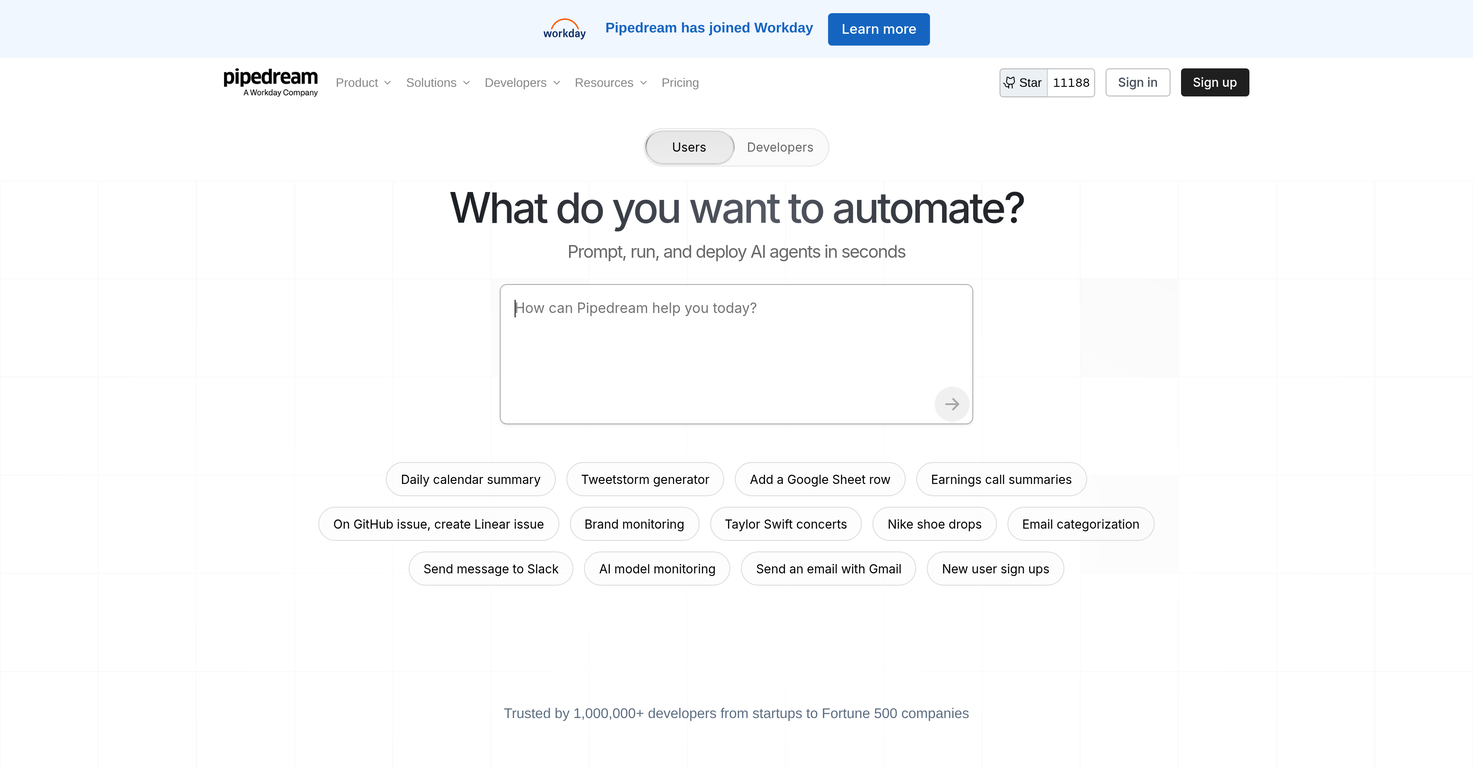
Pipedream is a powerful tool designed for building applications that efficiently integrate diverse services within a user's technological ecosystem. It offers both no-code and code-level control options to cater to a range of automation needs. At the core of Pipedream is its AI agent builder which aids in the initialization, modification, and deployment of AI agents. It also features a component called Pipedream Connect that presents an end-to-end developer toolkit enabling rapid integration of different applications or agents. With Pipedream, users can easily automate process that link APIs, significantly improving workflow efficiency. Plus, Pipedream provides a server, Pipedream MCP's, that supports swift addition of countless APIs and tools to a user's AI agent. It offers managed authentication across a vast variety of apps, pre-built triggers and actions for apps or AI agents, built-in features like a queue and data stores, and one-click private networks. As for security, Pipedream places great emphasis on it and offers compliance to standards like SOC 2 Type II, HIPAA, and GDPR making it apt for teams handling sensitive data.
How does the AI agent builder in Pipedream work?
The AI agent builder in Pipedream is an innovative feature that enables users to promptly initialize, modify, and deploy AI agents. This efficient functionality is key to accommodating the fast-paced needs of developers and enterprises, allowing them to iterate and release their AI solutions swiftly. Usage of this AI agent builder involves prompting, running, editing, and deploying the AI agents within a matter of seconds. The added advantage is that it supports both no-code and code-level control, further enhancing its versatility.
What are the pre-built triggers in Pipedream and how can I use them?
Pre-built triggers in Pipedream are set actions that can be embedded directly into your application or AI agent. They are designed to initiate specific functionalities or responses when certain conditions are met. Easy to use and implement, these triggers save users the hassle of having to code such actions from scratch. They play a pivotal role in automating tasks and enhancing the responsiveness of the AI agents, thereby making application operations more robust and effective.
Can I build my own private networks on Pipedream?
Yes, users can build their own private networks on Pipedream swiftly and conveniently. The platform offers one-click private networks as part of its built-in services. This feature is designed to expedite the development process and optimize the deployment of AI agents. Through the use of one-click private networks, users can create custom networks to bolster security and manage their data more effectively.
How does Pipedream ensure data security and privacy?
Pipedream places a high emphasis on security and privacy. It is designed with security at its core, having a strong architectural backbone that ensures secure handling and processing of data. The platform has robust security measures like managed authentication, one-click private networks, and built-in data stores to ensure data privacy. Users' sensitive information is always encrypted, both at rest and in transit, ensuring its protection at all times.
Is Pipedream compliant with HIPAA and GDPR?
Yes, Pipedream is compliant with both Health Insurance Portability and Accountability Act (HIPAA) and General Data Protection Regulation (GDPR). These regulations ensure that Pipedream has proper controls in place to secure and protect personal data, including health information. Compliance with HIPAA and GDPR not only demonstrates Pipedream's commitment to data privacy and security, but also makes it a trustworthy tool for development teams dealing with sensitive data.
What kind of sensitive data can I handle with Pipedream?
Pipedream is designed for handling a wide range of sensitive data. Given its compliance with strict standards like SOC 2 Type II, HIPAA, and GDPR, any sensitive information that comes under these regulations can be managed using Pipedream. This includes (but is not limited to) personal data, health information, financial details, and other such sensitive details that require high levels of security and appropriate data handling practices.
What is the role of data stores in Pipedream?
In Pipedream, data stores play a critical role in ensuring efficient and secure data handling. Data stores are built-in features that enable users to store and manage their data within the platform effectively. They offer a secure space for data to be kept, and they also facilitate access to the data when required. Thus, data stores contribute towards better data management, improving the overall functioning of the AI agents and applications built with Pipedream.
How does Pipedream contribute to improving workflow efficiency?
Pipedream contributes to improving workflow efficiency through its comprehensive automation capabilities. It facilitates the creation of AI agents, management and automation of processes that connect APIs, and seamless integration of applications, agents, and tools, significantly reducing manual efforts. Furthermore, it supports both no-code and code-level control, catering to different user experience levels. With the ability to add a vast array of APIs swiftly to the AI agent and inbuilt features like data stores and private networks, Pipedream enhances process efficiency and productivity by enabling more work to be done in less time.
Can Pipedream help me integrate different applications or agents?
Yes, Pipedream can facilitate the integration of different applications or agents. It features an end-to-end developer toolkit through its Pipedream Connect component, which allows the swift integration of a multitude of applications or AI agents. The platform supports the use of thousands of integrations, hence providing vast options for integrating different software and services, thereby enhancing the interoperability and effectiveness of the user's technological ecosystem.
How does the built-in queue feature in Pipedream work?
The built-in queue feature in Pipedream is designed to streamline the flow of tasks in sequence, enhancing the overall efficiency and coordination in completing tasks. It neatly organizes tasks or operations to be processed in a first-in, first-out (FIFO) sequence, helping manage the data flow within applications or AI agents effectively. The queue system also ensures that no task is missed or skipped, thus enhancing reliability and consistency in the system's operations.
What kind of automation requirements does Pipedream cater to?
Pipedream caters to a wide range of automation requirements. At its core, Pipedream is built to facilitate the creation and deployment of AI agents, automate processes that link APIs, and manage large-scale usage of APIs. It accommodates different usage needs from developers and consumers alike. It supports both no-code solutions for those who prefer visual interface and code-level controls for those who desire more customizability. Also, it offers managed authentication, pre-built triggers and actions, and built-in data stores, catering to various automation needs around data management, authentication, and rapid task execution, making it suitable for varied automation needs.
What is the significance of SOC 2 Type II compliance in Pipedream?
SOC 2 Type II compliance in Pipedream is a testament to its commitment towards ensuring security, confidentiality, and privacy of data. SOC 2 Type II is an auditing procedure conducted by external auditors to assess a company's systems and services to ensure they adequately safeguard customer data. It means that Pipedream has been thoroughly evaluated and found to have robust security controls in place, which can confidently protect customer data over time. This compliance reassures users that their sensitive data is securely handled and managed.
Does Pipedream offer no-code solutions?
Yes, Pipedream does offer no-code solutions. This feature makes it an accessible and user-friendly tool, allowing those without coding skills to achieve their automation and integration objectives. With its no-code options, users can create, modify, and deploy AI agents or automate processes involving APIs, without needing to write a line of code. It democratizes the use of technology, making it possible for a wider range of users to leverage the power and convenience of automation.
How does Pipedream improve AI agent creation process?
Pipedream improves the AI agent creation process with its AI agent builder that allows users to promptly initialize, modify, and deploy AI agents. It also has built-in features including a queue, data stores, and one-click private networks. Pipedream provides the end-to-end developer toolkit in Pipedream Connect, simplifying the process of addition and integration of APIs and tools. Pre-built triggers can be embedded directly into AI agents, and managed authentication simplifies using different applications. Collectively, these features expedite the creation of AI agents and enhance the overall usability and functionality of the resulting AI agents.
What are one-click private networks in Pipedream?
One-click private networks in Pipedream refer to a built-in service that allows users to instantaneously create private networks. This feature lets users manage and control data flow, improving security measures and facilitating better data management. With just a single click, users can create a customized network environment, making it efficient to use the tool and minimizing the configuration and setup time typically associated with private network creation.