 Tendem
 Mini tools
 Base44
 biela.dev
 Rocket
 Mocha
Mocha
 Trickle Magic Canvas
 Emergent
 Floot
Floot
 Lovable
 OnSpace.AI - AI Mobile App Builder
 devlo
devlo
 Devento
 AppIsUp
 Sebastian.run
 Softgen
 OnSpace.AI - Build AI Apps, No Code & No API Keys
 Durable AI Website Builder
 Dreamlit AI
 AppWizzy
 UX Pilot
 Pulse Editor: Vibe Code & Automate
 Creative Minds Think Alike
 GoEnhance
 Remini
 Ceacle tools
 Apple Creator Studio
 cre8tiveAI
 Unboring
 So You Want To Be A Writer?
 Ancient AI powered spirits
 Minka
Minka
 somacguffin
 Jvb ai
 Cuty
Cuty
 Superfly Stoner


 OnSpace.AI - No Code App Builder
 Cursor
 Kilo Code
 Programming Helper
 CodingFleet
 Github Copilot
 Devra
Devra
 Codeium
 Autocoder.cc
 Phala Cloud
 Qoder
Qoder
 Warp
Warp
 Qodo (Formerly Codium)
 Verdent AI
 Who Codes Best?
 Jovu
Jovu
 Google Antigravity
 Refraction
 Zzzcode
 Jit Codes
Bubble

Overview
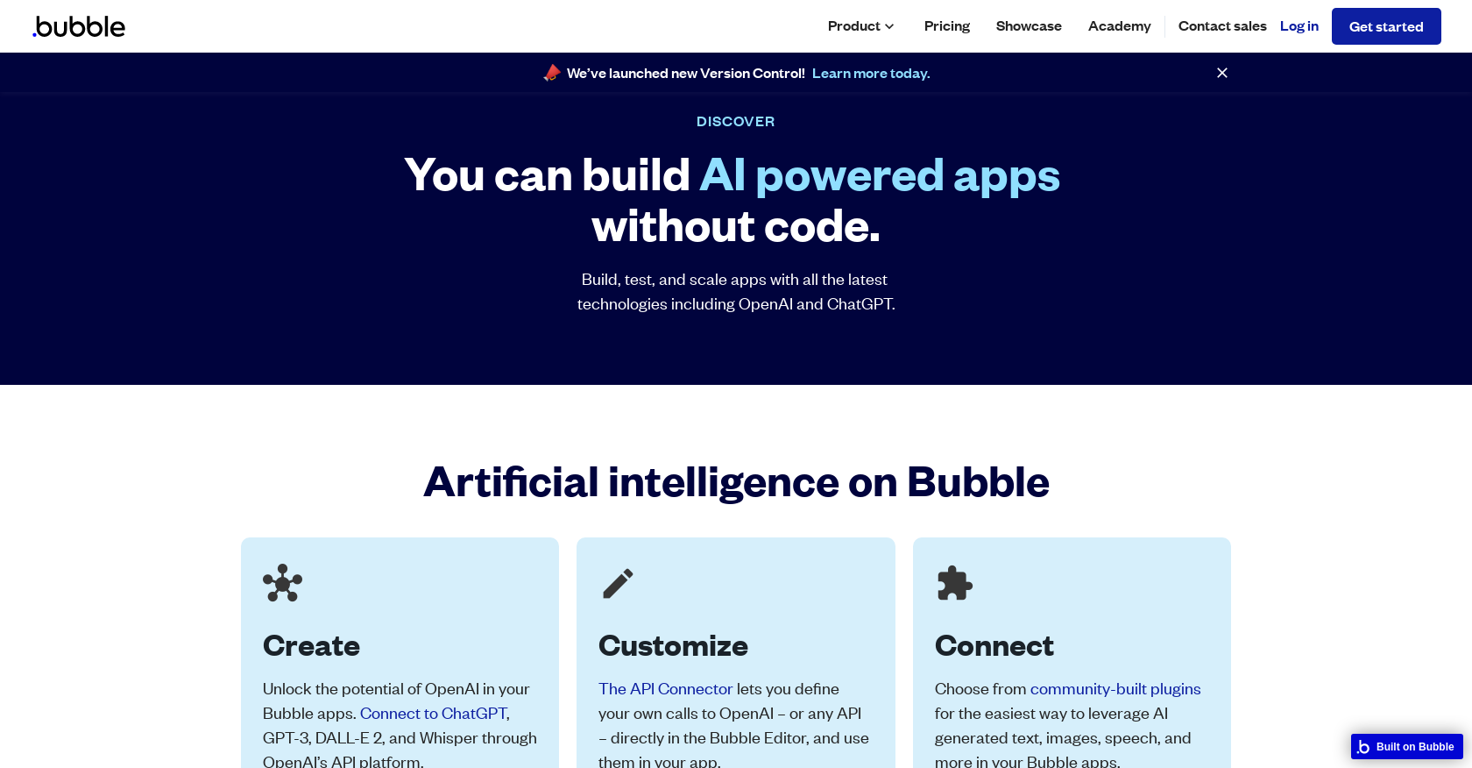
Bubble is a no-code platform that allows users to build, test, and scale applications that are powered by artificial intelligence (AI). With the help of the AI-powered OpenAI and ChatGPT, users can easily create applications without writing any code.
Bubble provides a range of AI features that can be customized according to the needs of users. These features include API connectors that can be used to define custom calls to OpenAI, as well as community-built plugins that offer easy ways to leverage AI-generated text, images, and speech in applications.
Bubble's AI tools are constantly evolving, and users can stay updated through various community-created resources, such as tutorials, courses, and chat groups.
Through Bubble's AI-powered platform, users can create complete applications that can compete with those of traditional platforms. Bubble also offers several other features such as responsive design and version control that help users in building applications with ease.
Overall, Bubble is an excellent AI tool for users who have little or no coding experience. With Bubble, users can build powerful applications without worrying about programming languages or complex algorithms.
Releases

Pricing
Top alternatives
-
Daniel Edri🛠️ 1 tool 🙏 23 karmaOct 20, 2025@Base44Base44 is an AI-powered platform for building fully-functional apps with no code and minimal setup hassle. The platform leverages advanced AI technology to translate simple, natural language descriptions into working apps. Let’s make your dream a reality. Right now.
-
Purely magic. It increases the productivity by a lot and the process is pretty addictive. I've been building websites like there's not tomorrow.
-
Rocket is fast as heeeelll for spinning up prototypes when an idea hits. I've shipped small tools and MVPs with this as the foundation, saves days of boilerplate setup. Great one :)
-
-
It’s super easy to use! Trickle can handle everything from forms to analytics, and you can deploy your project in no time. Impressive!
-
Emergent is the first agentic vibecoding platform built for serious builders. If you’re pouring time, money, and energy into building a product that matters, you deserve a platform that takes your ambition seriously. As your AI-native product engineering partner—wired to think in systems, not snippets—Emergent transforms natural conversations into production-grade, full-stack applications without requiring developers. It doesn’t just ”help you code”—it builds end-to-end: real databases, working APIs, secure authentication, production-ready infrastructure, and all the glue in between. Emergent conducts thorough research and deep product planning, developing





 1
1