 Rocket - Think it. Type it. Launch it.
 Mini tools





 55club
 Personal Performance
 The Mid Life Magic Woman
 Auramind
 SchoolAI
 Khanmigo
 MagicSchool
 SCHOOL SCHEMES OF WORK
 Loopydoopdedoop education
 Education Counciler AI
 TeAIcher
 SchoolBote
 NEGE-AI
 Education
 Coaching
 Thabo Assistant Ai
 Scholarcy
 Scispace
 OpenRead
 Elicit
 Scite
Scite
 Papers
 Wonders AI - Research Workspace
 Semantic Scholar
 Mirrorthink
 Epsilon
 Free Research Paper Generator
 Avidnote
 Afforai
 Undermind
 bundleIQ
 Enago Read
 Research Idea Generator
 Academic Research Agent
 ASK-A-LIBRARIAN
 Academic Research Assistant

ResearchRabbit
 LuminixAI
Overview
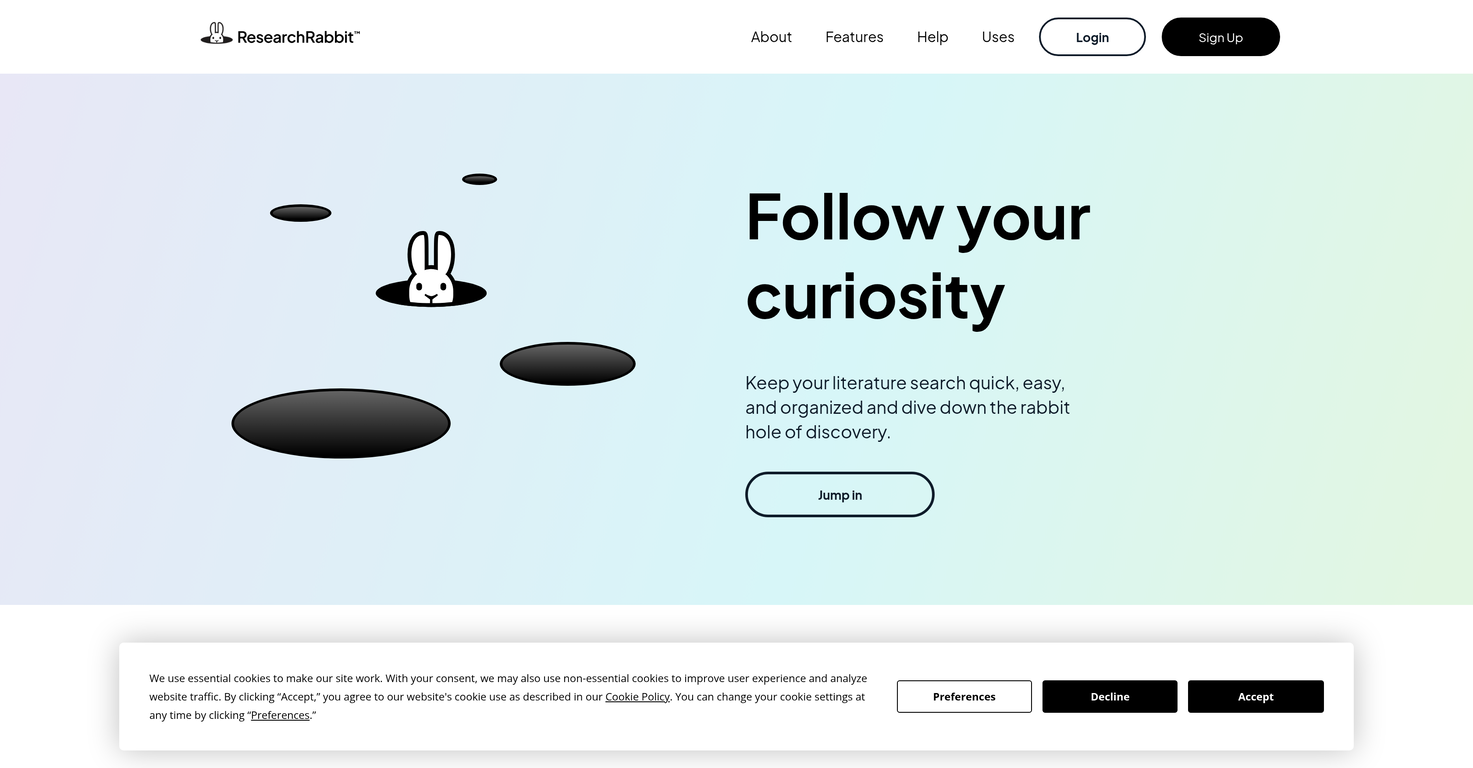
ResearchRabbit is an AI-powered tool designed to aid in the literature review process. With a focus on making literature searches quicker, easier, and more organized, ResearchRabbit helps users find related papers and track research trends.
It offers features that enable users to build citation maps to visually explore the literature, starting with one paper and expanding the search by adding new authors, related works, and emerging topics.
It also facilitates the connection of papers and authors to the broader context, helping users understand how topics relate to each other and evolve over time by using built-in visualizations.
Beyond this, ResearchRabbit assists in managing and connecting notes, which can prove useful in overcoming writer's block and ensuring no ideas get left out.
The tool is used by numerous researchers worldwide and by various reputable institutions like Stanford, Oxford, Peking University, and the National University of Singapore.
ResearchRabbit offers access to an extensive collection of academic papers and is designed to meet the needs of researchers, students, and academic professionals.
Releases
Top alternatives
-
 Podcasts, scholarships, literature reviews - study and work faster with AIOpenShivaprasad Ramarao🙏 8 karmaDec 28, 2024@Seaml.esits paid only tool
 -
 Search real papers and write literature reviews without AI hallucinations.Open
 -
 AI-powered literature reviews with precision and clarity.Open
 -
 Open
Open -
 AI-powered literature review assistant for academic research.Open

 0
0