What capabilities does Splunk provide for security?
Splunk provides an AI-powered SecOps platform that integrates Threat and Incident Detection and Response (TDIR). It has a variety of capabilities, including a Security Information and Event Management system (SIEM), Security Orchestration, Automation, and Response (SOAR), User and Entity Behavior Analytics (UEBA), automated threat analysis, and asset and risk discovery.
What are some features of Splunk's Observability tools?
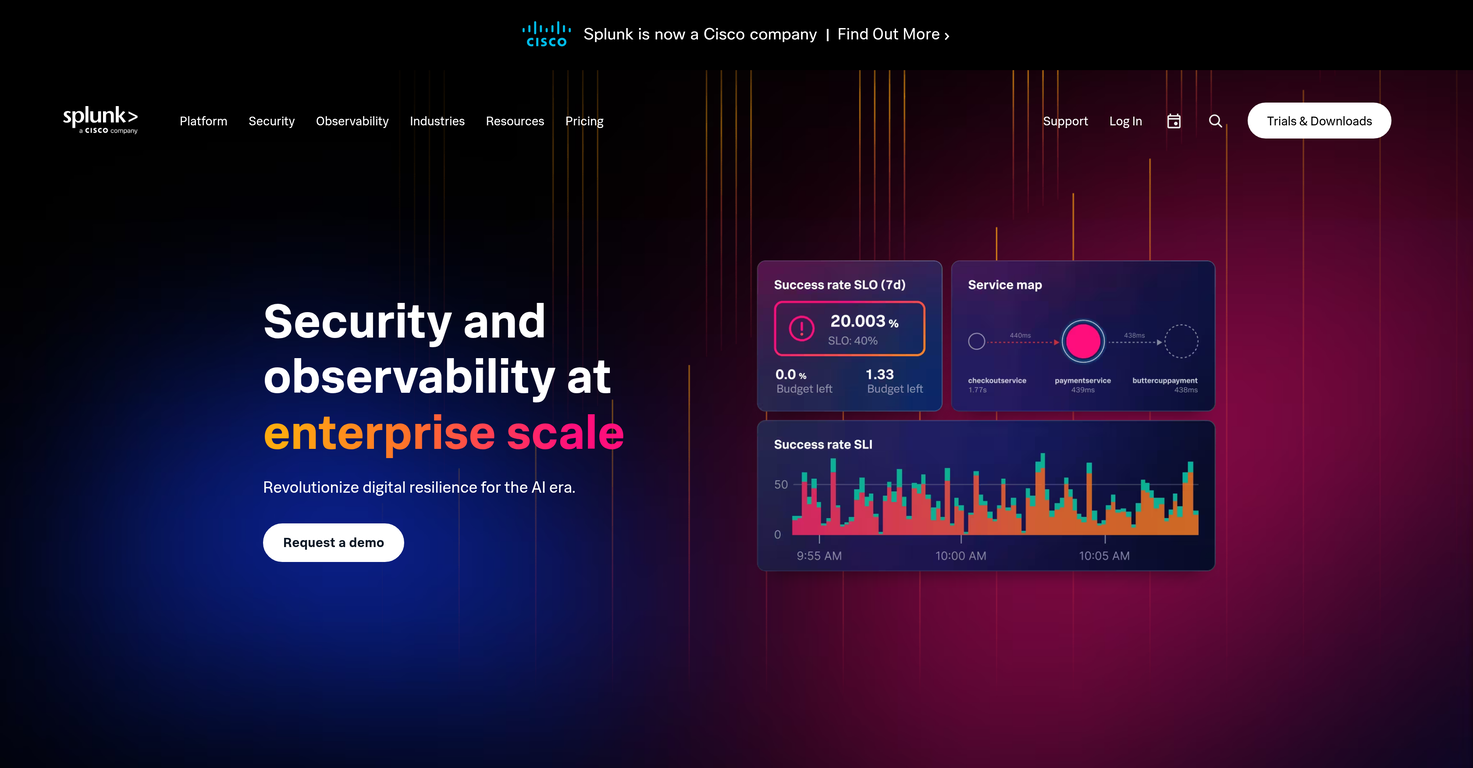
Splunk's Observability tools offer real-time visibility across various environments, enhancing service performance with AI operations, and optimizing applications with comprehensive insights. These tools assist in prioritizing alerts, troubleshooting issues faster, preventing user-impacting issues, and diagnosing root causes in microservices.
What is Splunk's approach to threat and incident detection and response?
Splunk takes an integrated approach to threat and incident detection and response (TDIR). This involves using an AI-powered SecOps platform that provides capabilities such as Security Orchestration, Automation, and Response (SOAR), User and Entity Behavior Analytics (UEBA), automated threat analysis, and asset and risk discovery to rapidly identity and respond to threats.
How does Splunk use AI to enhance enterprise security?
Splunk incorporates artificial intelligence in its Security Operations platform, which uses AI-based processes to enhance enterprise security. AI is utilized to automate threat analysis, offering more efficient and accurate risk discovery. Furthermore, Splunk's AI assists in User and Entity Behavior Analytics (UEBA), providing effective anomaly detection and response.
What industries can benefit from using Splunk?
Splunk's tools and capabilities can be used by a wide range of industries to enhance security and observability at an enterprise level. Industries such as Aerospace and Defense, Communications and Media, Energy and Utilities, Financial Services, Healthcare, Higher Education, Manufacturing, Nonprofits, Online Services, Public Sector, Retail, and Technology can benefit from Splunk's diverse services.
How does Splunk support network resilience and AI implementation?
Splunk plays a pivotal role in supporting network resilience and optimal AI implementation. By offering a versatile platform and a range of tools that enhance IT service health, modernize IT, and address security threats, Splunk assists organizations in strengthening their network resilience. For AI implementation, Splunk offers a strategic approach that includes AI-powered data analytics, AI-driven security tools, and AI operations (AIOps).
What kind of insights does Splunk provide for application optimization?
Splunk provides comprehensive insights for application optimization through its Observability tools. These insights facilitate the detection of anomalies and performance bottlenecks in applications, making it easier to optimize application performance. The insights also aid in prioritizing alerts and diagnosing root causes in microservices.
What role does Splunk play in digital transformation?
Splunk plays a significant role in digital transformation by enhancing enterprise resilience. Through its AI-powered data analytics and flexible data platform, Splunk facilitates the management of critical data, modernization of IT practices, and accelerated digital transformation initiatives.
What does the SIEM system provided by Splunk entail?
Splunk's Security Information and Event Management (SIEM) system is part of its security tools. The SIEM system allows organizations to gain a comprehensive view of their security data and events. It offers real-time analysis of security alerts generated by applications and network hardware, thereby enhancing their ability to quickly identify and respond to threats.
How can Splunk assist in discovering assets and assessing risks?
Splunk assists in asset discovery and risk assessment through its AI-powered SecOps platform. By integrating automated threat analysis with asset and risk discovery, Splunk effectively helps organizations to identify security vulnerabilities, understand their risk exposure, and prioritize remedial actions based on risk levels.
What is the purpose of User and Entity Behavior Analytics (UEBA) in Splunk?
In Splunk, User and Entity Behavior Analytics (UEBA) is a key component of the AI-powered SecOps platform. UEBA utilizes machine learning algorithms to understand normal behavior patterns for users and entities within a system, and alerts security teams of abnormal or potentially malicious activities that deviate from these patterns.
What is the significance of AIOps in Splunk's services?
The significance of AI operations (AIOps) in Splunk's services lies in its ability to leverage artificial intelligence and machine learning for automating routine tasks and improving efficiency in IT operations. AIOps is a key component of Splunk's Cloud Platform, playing a crucial role in IT modernization efforts.
How does Splunk help in troubleshooting issues and diagnosing root causes in microservices?
Splunk aids in troubleshooting issues and diagnosing root causes in microservices through its Observability tools. These tools provide real-time visibility across different environments, allowing for faster issue troubleshooting and root cause analysis. They also help in preventing user-impacting issues.
How can Splunk enhance service performance using AI?
Splunk enhances service performance using AI through its Observability tools. These tools provide a combination of real-time visibility, AI operations, application optimization, and comprehensive insights to ensure high-level service performance across various environments.
What is the scope of real-time visibility provided by Splunk Observability tools?
Splunk Observability tools offer real-time visibility across diverse environments. This encompasses a variety of system components including applications, services, infrastructure, and network, presenting a unified view of system performance and operations, and enabling faster detection and resolution of issues.
Why is Splunk considered key to enterprise resilience?
Splunk is considered key to enterprise resilience due to its robust platform that accelerates digital transformation and mitigates major issues in organizations. By offering AI-powered data analytics, security tools, and observability tools, Splunk helps organizations enhance their resilience and tackle potential challenges more efficiently.
What are the components of Splunk's AI-powered SecOps platform?
The components of Splunk's AI-powered SecOps platform include a Security Information and Event Management system (SIEM), Security Orchestration, Automation, and Response (SOAR), User and Entity Behavior Analytics (UEBA), automated threat analysis, and asset and risk discovery.
How would you rate Splunk?
Help other people by letting them know if this AI was useful.