 MongoDB - Build AI That Scales
 Mini tools







 Creative Minds Think Alike
 GoEnhance
 Ceacle tools
 Apple Creator Studio
 Remini
 cre8tiveAI
 Unboring
 So You Want To Be A Writer?
 Ancient AI powered spirits
 Minka
Minka
 Jvb ai
 somacguffin
 Cuty
Cuty
 Superfly Stoner


Overview
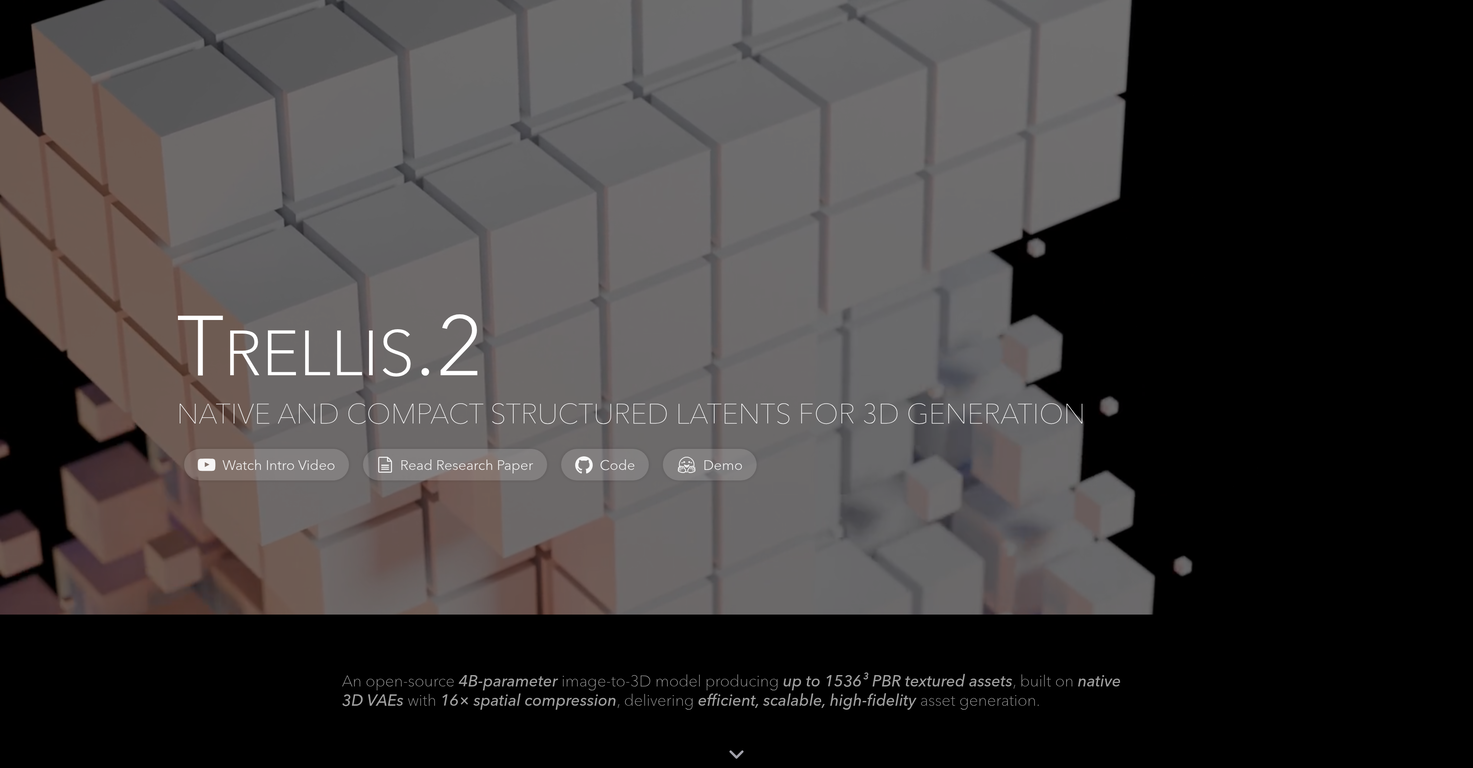
TRELLIS.2 is an open-source image-to-3D model generator, designed to produce high fidelity textured assets using native 3D VAEs. Its core feature makes use of native and compact structured latents, providing both high fidelity and compression capabilities.
The method can handle complex structures, including open surfaces, non-manifold geometry, and enclosed interior structures, thus overcoming the limitations of iso-surface fields.
TRELLIS.2 also has the ability to model arbitrary surface attributes such as Base Color, Roughness, Metallic, and Opacity, thereby facilitating Physically Based Rendering (PBR) and photorealistic relighting.
This tool optimizes the pre- and post-processing of data for training and inference, allowing for quick conversions that are free from rendering and optimization.
It utilizes 'O-Voxel', a novel 'field-free' sparse voxel structure designed to encode detailed geometry and complex appearance simultaneously. A Sparse Compression VAE component is deployed to compress voxel data efficiently, encapsulating fully textured 3D assets into a compact representation with minimal perceptual degradation.
This enables efficient large-scale generative modeling. Its worth noting that TRELLIS.2 is purely a research project with Responsible AI considerations factored into all stages of its development.
Releases
Pricing
Other tools by Microsoft
-
 Oleg John🛠️ 2 tools 🙏 53 karmaAug 19, 2025@Microsoft Designerquick to pick up, slick results. turned my prompts into clean logo drafts n poster layouts fast; pixel-art style worked after a couple tweaks. wish it had true vector export and tighter font control, but for fast art ideas it’s great. 5/5
 -
 Improve Your Productivity with Copilot–Your AI-Powered ChatAssistantOpenCopilot on mobile keeps me sharp during sales calls. I use it to quickly draft follow up emails right after meetings or pull contract language on the fly. Voice input works smooth and it formats responses professionally.






Related topics
 0
0