 MongoDB - Build AI That Scales
 Mini tools
 The Drive AI
 TidyDocs
 AetheriumAI
 Desktop Docs
 AODocs
 Document CoPilot
 Bit.ai
 UPDF AI Assistant
 Qypt AI
 FilePower AI
 Macro.com
 Layup
Layup
 Clivio
 JotBot
 Wrapsody
 IntelliParse
 Send AI
 My Own Document Vault
 Younet
 FirstSign AI
 Bika.ai
 CleeAI
 Avataar's GenAI Creator
 Activepieces
 Kong.ai
 BigTeam
 Olivya
 Sreda.ai
 Neferdata
 AI Agents
 Abstra
 DoubleO
 Pipefy
 Quixl
Quixl
 Cubeo
Cubeo
 Sema4.ai
 Ridvay
 Calk AI
 genset



Tygra





Overview
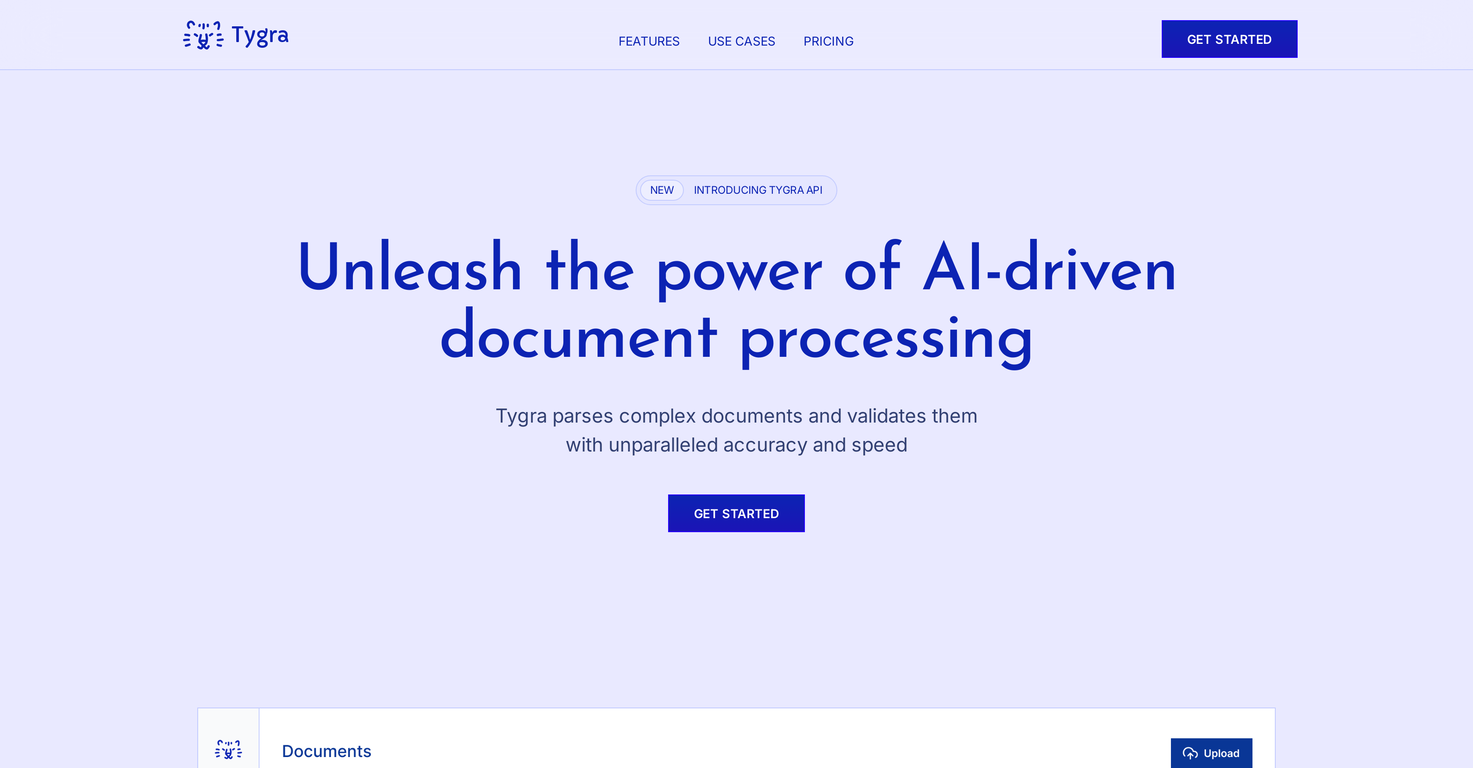
Tygra is an AI-driven document processing tool designed to parse and validate complex documents efficiently. With its robust capabilities, Tygra transforms unstructured documents into insightful data, allowing users to define custom schemas for precise content extraction tailored to their business needs.
The system offers notable features such as reliable data extraction, accurate verification, and superior data security. The newly launched API can automatically parse PDF, JPG, and PNG documents, extracting fields, tables, values, and barcodes from various document types including invoices, statements, and orders.
It also allows validation of these documents based on customized policies, complex regulations, and specific requirements.The strength of Tygra lies in its use of advanced machine learning models, beyond traditional OCR techniques, to understand more complex and specialized documents.
It extends its applications across various sectors including finance (for tasks like fraud detection and loan applications), logistics (managing freight receipts and purchase orders), and insurance (processing risk assessments and claim forms).Tygra's flexible pricing plans fit a range of needs, from infrequent usage to high volume processes, offering both pre-trained and customized models.
With Tygra, enterprises can automate and streamline their document processing, reducing manual effort while ensuring accuracy and validation.
Releases
Top alternatives
-
Sebastian Lorentz🙏 67 karmaSep 14, 2025@TidyDocsI was part of the beta trials and TidyDocs has made it so much easier to manage my receipts and invoices.
-
No answer. I sent the documents several times and got no reply.
-








Related topics
 0
0