Mini tools
 Claude
 Gemini
 Mistral AI
 Ollama
 Subquadratic
 LLaMA
LLaMA
 GOODY-2
 Z.ai
Z.ai
 Numind
 Hippocraticai
 Qualcomm AI Hub
 Langbase
 Prem AI
 Heimdall
 Gemini Enterprise Agent Platform
 Wingman
 Meta AI
 Custom Large Language Model Generator
 anyAInow
 Replicate
 GetSpiced
 CleeAI
 Starnus
 Activepieces
 Avataar's GenAI Creator
 Olivya
 Abstra
 Pipefy
 DoubleO
 Quixl
Quixl
 Neferdata
 Cubeo
Cubeo
 Sema4.ai
 Ridvay
 Tray.io
 Cognition by Mindcorp
 GoodWork
 Mr David
 UiPath
 Super Amplify
 Mistral AI Studio
 Belva
Belva
 Elham.ai
 Superface
 BotX
BotX
 Buildship
 Geekflare Connect
 Emly Labs
 Retool
 Aureo
Aureo
 Api4ai
 Kortical
 Hopsworks
 BraintrustData
 Intelligent Internet
 Nitro
Nitro
 iyed
iyed
 DataRobot Generative AI
 Momo
Momo
 Zues
Zues
 ZenMux
 Teachable Machine
 H2O.ai
 Codenull.ai
 Lmql
Lmql
 Brancher
 Obviously AI
 Lightning AI
 Gradio
 Remyx
Remyx
 SapientML
 Nexa SDK
 ModelAtlas
 OneRouter
 EmpirioLabs AI
 Reactor
 Arcee AI
 Yourself commercial model figure
 Leilani
LongLLaMa








Overview
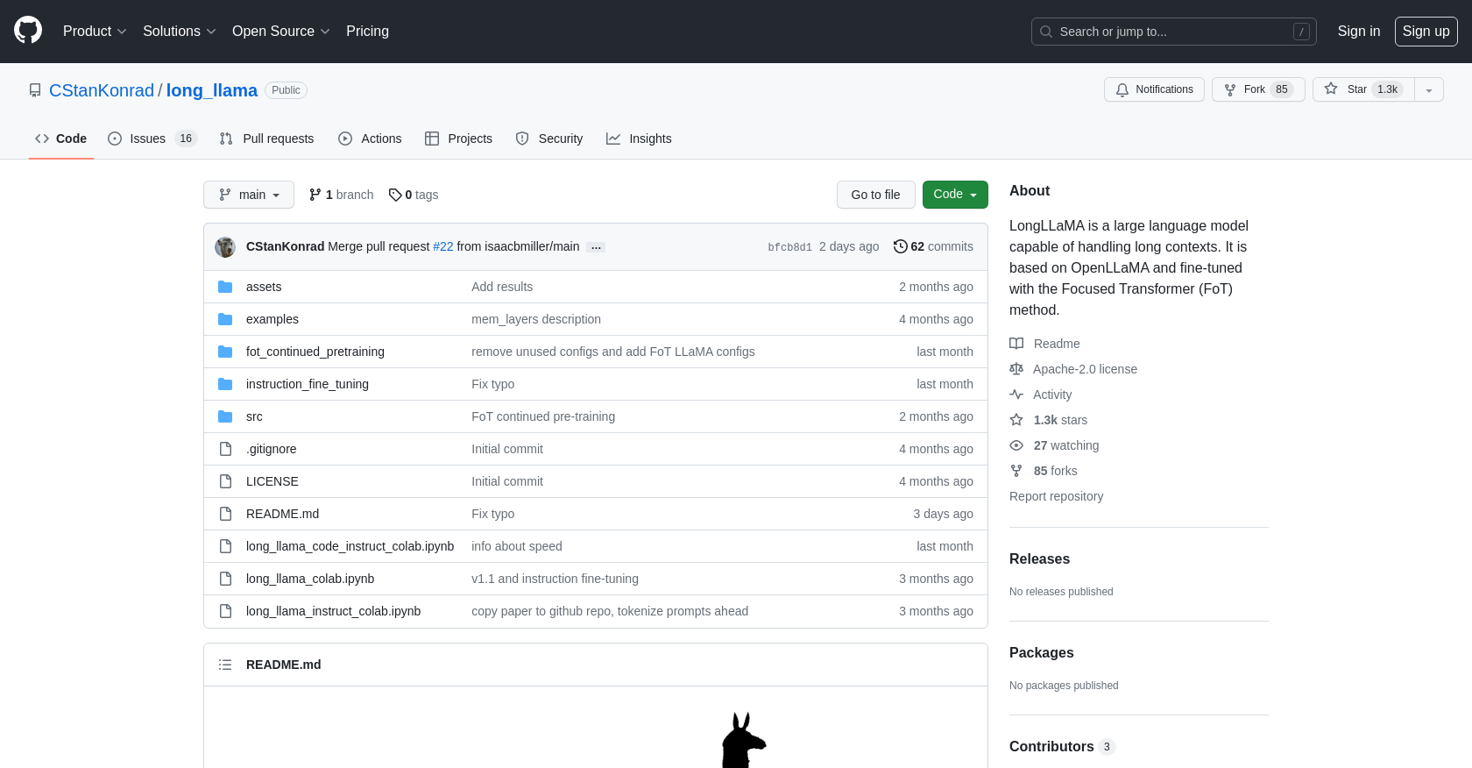
LongLLaMA is a large language model that has the capability to handle long contexts. It is a model that has been fine-tuned with the Focused Transformer (FoT) method and is based on OpenLLaMA.
This tool is hosted on GitHub and is available as a public repository created by CStanKonrad. It has gained significant popularity, with 1.3k stars and 85 forks on the platform.The primary purpose of LongLLaMA is to provide users with a powerful language model that can effectively process and understand long contexts.
It utilizes the FoT method, which involves fine-tuning the model to enhance its ability to focus on specific areas of the input text.Being a large language model, LongLLaMA has the potential to be beneficial in various applications, such as natural language processing, text generation, machine translation, and sentiment analysis, among others.
However, the specific use cases and functionalities of this tool are not explicitly mentioned in the provided text.As a public repository on GitHub, users have the opportunity to contribute to LongLLaMA by submitting issues, pull requests, and actions.
Additionally, the repository provides insights and security features to ensure the reliability and integrity of the tool.Overall, LongLLaMA offers a powerful language model capable of handling long contexts, which can be leveraged by developers and researchers in various natural language processing tasks.
Releases
Top alternatives
-
 Building reliable, interpretable AI systemsClaude — v5
Claude Opus 5
Coding and long, multi step tasks: big jump over Opus 4.8, close to Anthropic's top tier model (Fable 5) at half the cost.
Science and research: stronger at chemistry and biology related tasks.
Visuals: better looking charts, diagrams, slides, and interactive content.
Judgment: better at catching its own mistakes and fixing them without you having to point it out.
The strongest model available on Claude Pro.
Also usable via the API as claude-opus-5.
-
 Gemini: Google's most capable AI model yet
 Tealgreen🙏 409 karmaMar 29, 2025@GeminiThey nailed it. It’s better than 3.7 at coding.
 -
 Frontier AI in your handsI just used for a couple of scientific tasks and its output was as good as ChatGPT 4 and Gemini Pro. This is an interesting tool and I will be exploring it further
 -
 Run powerful AI models locally on your machine.
 -
 First sub-quadratic LLM for 12M-token reasoning tasks.
 -
 Open-source AI models for customization and deployment.A huge disappointment. It fails standard tasks that Sonnet 3.5 completes with no issue. I’ll be skipping this version.